


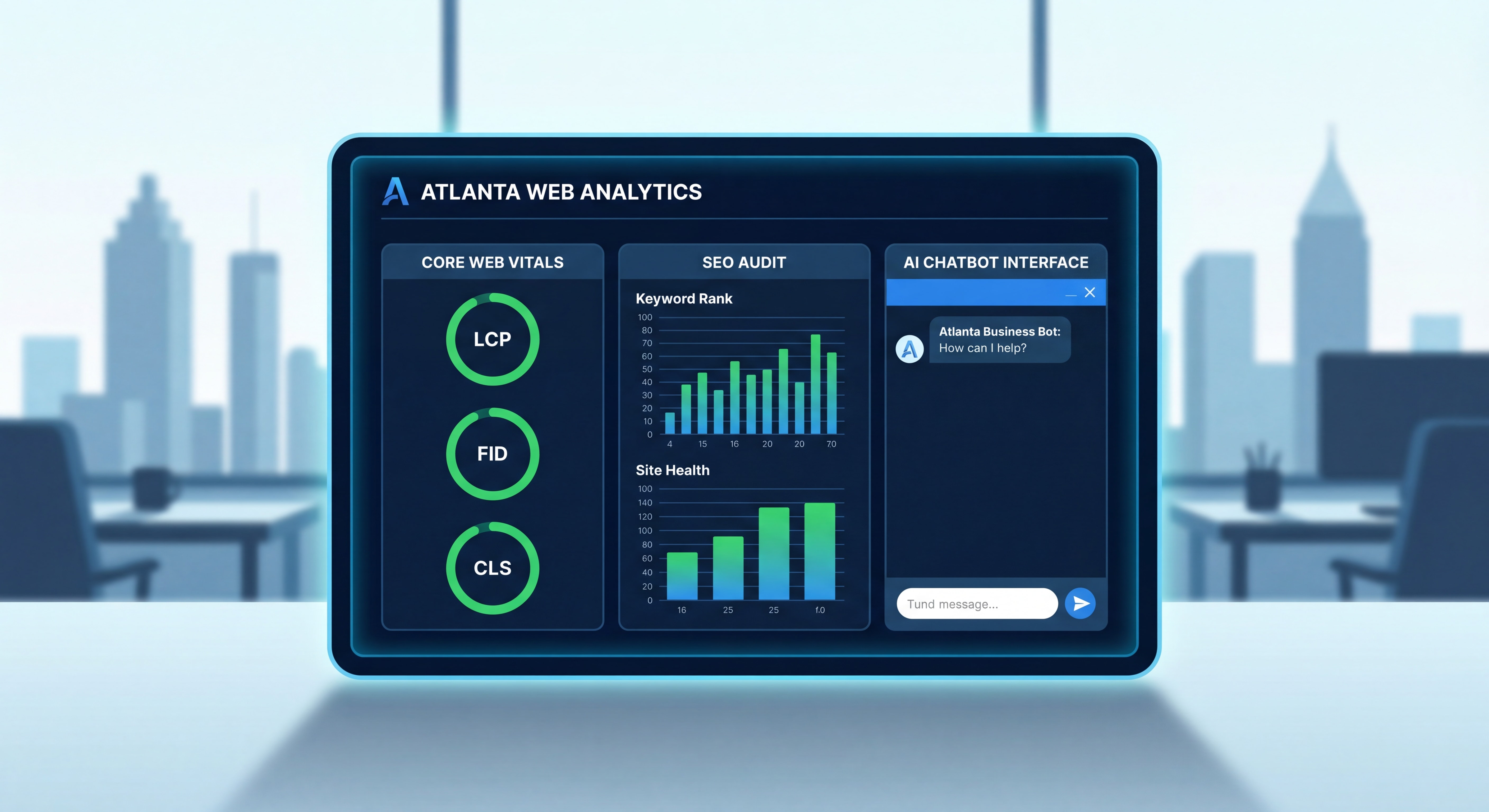
Most Atlanta businesses treat their website like a business card. Print it once, hand it out, and hope for the best. That mindset is costing them leads every single day — especially right now, when the gap between a high-performing site and a mediocre one is measured in rankings, revenue, and real customers walking out the door to a competitor who figured this out first.
This isn't a beginner's guide to web design Atlanta. This is the advanced playbook — the technical depth, the optimization layers, the content architecture, and the AI integrations that separate businesses ranking on page one from businesses wondering why their phone isn't ringing. If you've already got a site and you want to know why it's underperforming, or if you're ready to rebuild from the ground up with a strategy that actually works in 2026, this is where you start.
📊 $7.65 returned for every $1 invested – Content Marketing ROI
Table of Contents
- Why Your Atlanta Website Is Underperforming Right Now
- The Advanced SEO Audit Atlanta Businesses Actually Need
- Core Web Vitals: The Technical Floor You Can't Ignore
- Web Design as an SEO System, Not a Visual Exercise
- Content Marketing Atlanta: Strategy Over Volume
- AI Chatbot Integration: The Conversion Layer Most Sites Are Missing
- The Full-Stack Optimization Framework
- FAQ
- Key Statistics
Why Your Atlanta Website Is Underperforming Right Now
Atlanta is not a forgiving market. Between Buckhead law firms, Midtown tech startups, Old Fourth Ward restaurants, and the thousands of contractors, HVAC companies, and home service businesses fighting for visibility across the metro, the competition for organic search real estate is relentless. And it's getting more intense.
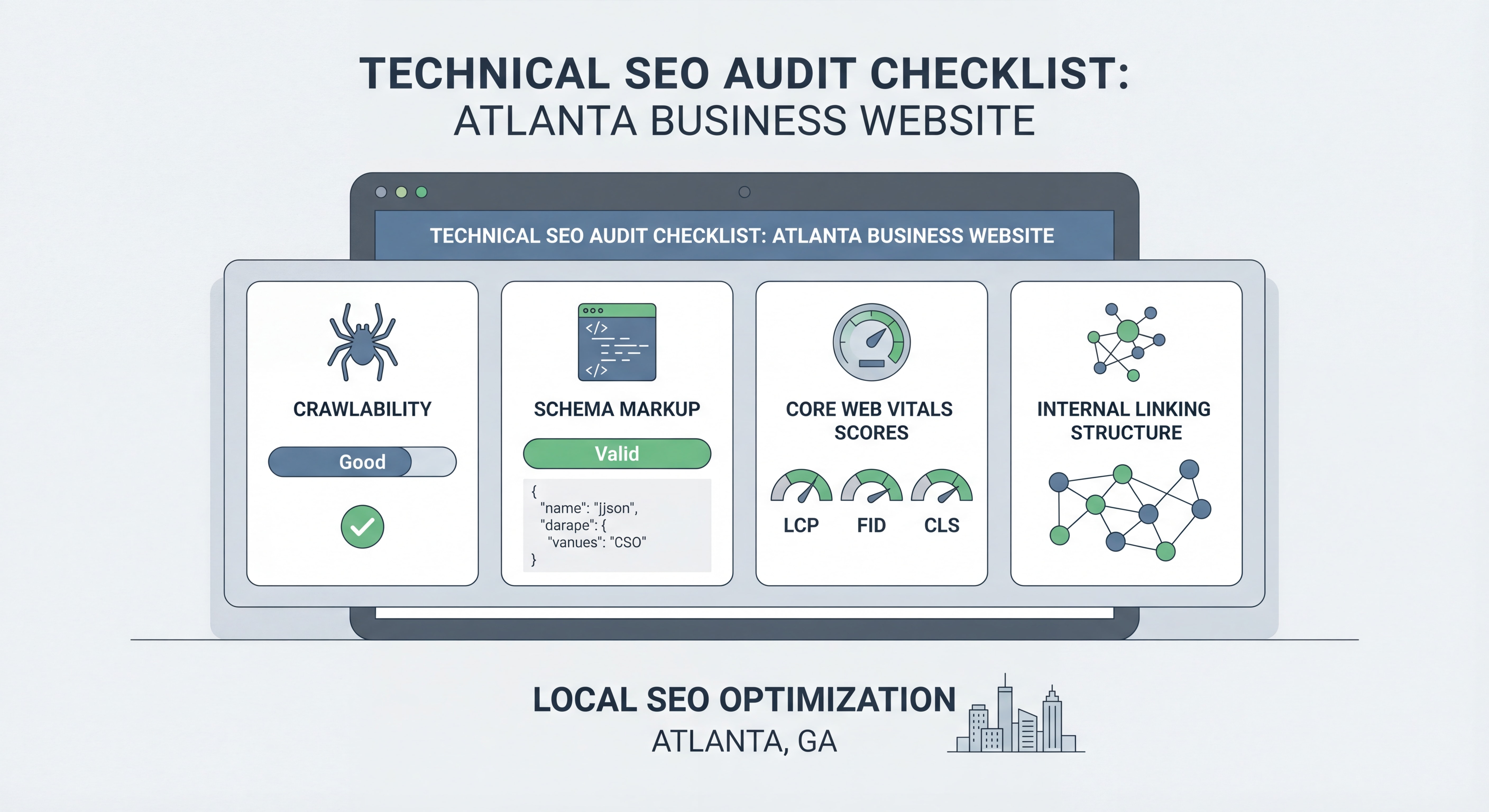
Here's what most business owners don't realize: their website isn't just a branding asset. It's a technical system. Every page has a crawlability status, a Core Web Vitals score, a schema configuration, an internal linking structure, and a content depth that Google evaluates in real time. When any one of those layers breaks down or goes unoptimized, the whole machine loses power.
The Scale Tech, an Atlanta-based firm, recently identified a shift in how corporate web strategy is being evaluated — moving away from the idea of a website as a static presence and toward what they're calling a "Digital Blueprint," a living, optimized asset that compounds in value over time. That framing is exactly right. A website that isn't actively maintained and optimized is a depreciating asset. A website built on a sound technical foundation, with strong SEO architecture and smart conversion tools, is one that works harder every month.
So before we talk about what to build, let's talk about what to fix.
The Advanced SEO Audit Atlanta Businesses Actually Need
A real SEO audit Atlanta isn't a 10-minute scan from a free tool that spits out a color-coded PDF. That's theater. A legitimate audit is a systematic teardown of every technical layer that affects how Google crawls, indexes, and ranks your site — followed by a prioritized action plan with measurable outcomes attached to each item.
Here's what an advanced audit actually covers.
Phase 1: Crawlability and Indexation
Start with the robots.txt file. It sounds basic, but the number of Atlanta business websites accidentally blocking their own service pages from being crawled is genuinely alarming. Pull your Google Search Console index coverage report. Look for pages that should be indexed but aren't, and pages that are indexed but shouldn't be — old thank-you pages, parameter-heavy URLs, duplicate content variants.
Your XML sitemap should only contain canonical, indexable URLs. If it includes redirected pages, noindexed URLs, or 404s, you're wasting crawl budget and sending Google mixed signals about what you actually want ranked.
Phase 2: Site Architecture and Internal Linking
Every important page on your site should be reachable within three clicks from the homepage. If a Google crawler has to dig six levels deep to find your core service page, that page is being deprioritized. Period.
Internal linking is one of the highest-leverage, lowest-cost SEO improvements available to any Atlanta business. When you link from a high-traffic blog post to your SEO services Atlanta page using keyword-rich anchor text, you're transferring authority from one page to another. Most businesses either don't do this at all or do it randomly. A structured internal linking map — where every page has a defined role in the authority hierarchy — is what separates a site that ranks for 5 keywords from one that ranks for 500.
Phase 3: Schema Markup Implementation
This is where most Atlanta businesses leave serious competitive ground on the table. Schema markup is structured data that tells Google exactly what your content is — a local business, a service, an FAQ, a review, an article. When implemented correctly, it unlocks rich results in the SERPs: star ratings, FAQ dropdowns, breadcrumbs, and business information panels that make your listing significantly more clickable than plain blue links.
For Atlanta businesses specifically, the priority schema types are:
| Schema Type | Purpose | SERP Impact |
|---|---|---|
| LocalBusiness | Identifies your business entity and location | Enables Knowledge Panel features |
| FAQPage | Marks up Q&A content | Triggers FAQ rich results in SERPs |
| Service | Defines individual services offered | Enhances service page visibility |
| BreadcrumbList | Defines site hierarchy | Shows breadcrumb paths in results |
| Review / AggregateRating | Displays customer ratings | Adds star ratings to search listings |
An Alpharetta roofing company that implements LocalBusiness schema with verified NAP data, service schema on each service page, and FAQ schema on targeted content pages is going to outperform a competitor with identical content but no structured data — because Google can understand and surface their information more confidently.
Phase 4: Redirect Chains, 404s, and Technical Debt
Every redirect chain costs you link equity. A URL that redirects to a URL that redirects to a final URL loses a meaningful percentage of its authority at each hop. Clean up your redirect chains to single 301s. Repair 404 errors with contextually relevant redirects. These aren't glamorous tasks, but they directly affect how much authority flows through your site.
"Technical SEO audits remain the highest-leverage investment for sites with existing content — fixing crawlability and schema issues can produce ranking improvements without publishing a single new page"
— Nadia Mohamed, SEO Consultant
Core Web Vitals: The Technical Floor You Can't Ignore
Google's Core Web Vitals aren't a nice-to-have in 2026. They're a hard floor. Sites that fail these metrics lose ground to competitors who pass them, especially in competitive Atlanta markets where content quality is often comparable across the top-ranking pages.
The three metrics that matter:
Largest Contentful Paint (LCP): How long it takes for the biggest visible element — usually a hero image or headline — to fully render. Target: under 2.5 seconds. A Sandy Springs medical practice with a 5-second LCP is losing patients to a competitor whose site loads in 1.8 seconds before the first appointment request is even made.
Interaction to Next Paint (INP): Replaced First Input Delay (FID) as the responsiveness metric. It measures how quickly your site responds to any user interaction — a click, a tap, a form field selection. Target: under 200ms.
Cumulative Layout Shift (CLS): How much your page layout jumps around while loading. Nothing destroys trust faster than a button that moves right as someone's about to click it. Target: under 0.1.
The business impact of these metrics is concrete. Google's own research shows that reducing page load time from 3 seconds to 1 second can improve conversion rates by up to 27%. A Decatur home services company that invests in performance optimization doesn't just rank better — they convert more of the traffic they already have.
📊 Mobile bounce rate drops from 65% to 38% after optimization – Core Web Vitals improvement impact
Here's a real-world optimization framework for Atlanta businesses:
| Performance Issue | Cause | Fix | Expected Impact |
|---|---|---|---|
| Slow LCP | Uncompressed hero images | Convert to WebP, add lazy loading | LCP improvement of 1–2 seconds |
| High INP | Render-blocking JavaScript | Defer non-critical scripts | Responsiveness to under 200ms |
| Poor CLS | Images without dimensions | Set explicit width/height in HTML | CLS score under 0.1 |
| Slow TTFB | Shared hosting overload | Upgrade to managed cloud hosting | TTFB under 600ms |
| Mobile performance gap | Desktop-only optimization | Implement mobile-first CSS | Mobile ranking improvement |
Web Design as an SEO System, Not a Visual Exercise
This is the mindset shift that most Atlanta businesses never make. They hire a designer to make the site look good. They hire an SEO agency to make it rank. And then they wonder why the two never seem to work together.
In 2026, web design Atlanta is an SEO function. Every design decision — layout, navigation structure, page hierarchy, CTA placement, image optimization, heading architecture — either helps or hurts your ability to rank and convert. There is no neutral.
Conversion-Focused Architecture
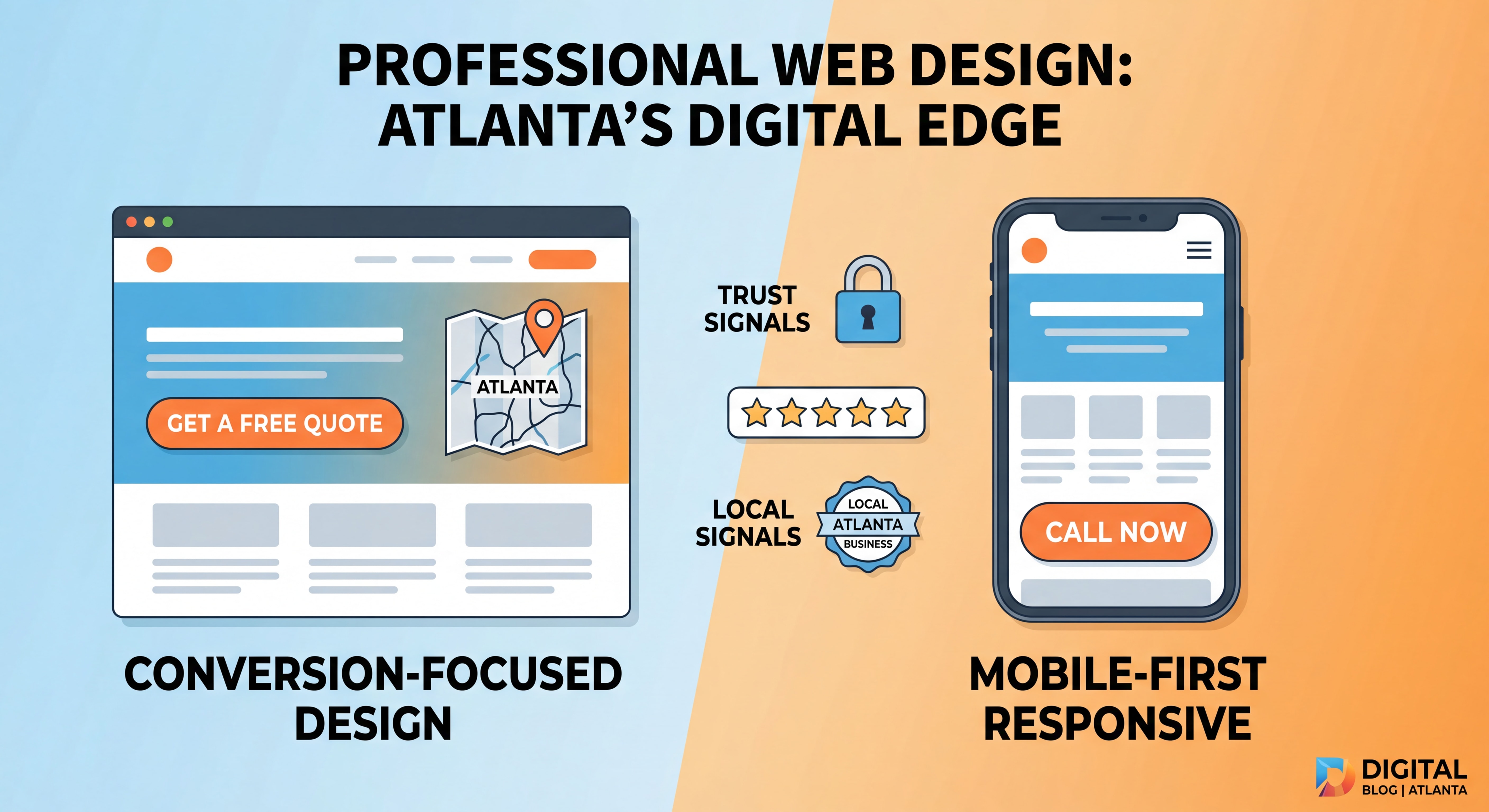
High-converting websites guide visitors toward a single, clear action. Not five actions. One. Every page should have one primary CTA placed above the fold, repeated at logical intervals throughout longer pages, and supported by trust signals — reviews, credentials, results — positioned directly adjacent to the ask.
For an Atlanta law firm, that means the "Schedule a Free Consultation" button appears before the scroll, mid-page after the services description, and again at the bottom before the footer. Not buried in a menu. Not hidden on a contact page that requires three clicks to find.
Mobile-First Is Not Optional
Atlanta's mobile traffic numbers mirror the national reality: the majority of local searches happen on a phone. Google's mobile-first indexing means the mobile version of your site is what gets crawled and ranked — not the desktop version. If your mobile experience is an afterthought, your rankings reflect that.
A responsive design isn't just about making text readable on a small screen. It means rethinking navigation for thumbs, compressing images for cellular connections, simplifying forms to three fields instead of twelve, and making click-to-call the most prominent element on every page for service businesses.
Heading Hierarchy and Content Architecture
Your H1, H2, and H3 structure is a semantic map that tells Google what your page is about and how the ideas relate to each other. A Marietta contractor whose service page has a clear H1 targeting "roofing contractor Marietta GA," H2s for each service type, and H3s for specific materials and processes has built a content architecture that Google can parse and rank with confidence. A page with one giant block of text and no heading structure is essentially asking Google to guess — and Google doesn't guess in your favor.
Content Marketing Atlanta: Strategy Over Volume
The content marketing Atlanta landscape shifted decisively in 2026. Volume is dead. Quality, depth, and topical authority are what move rankings now.
Global content marketing revenue is projected to surpass $100 billion in 2026. But the statistic that matters more for Atlanta business owners is this: content marketing generates 3x more leads than outbound marketing — and when executed with proper SEO strategies, B2B companies see returns reaching 748% ROI. The catch is patience. Meaningful results typically materialize over 3 to 6 months, which is exactly why businesses that start now have a compounding advantage over those who keep waiting.
For Atlanta businesses, the content strategy that works isn't about publishing more. It's about publishing strategically. That means:
Topical cluster architecture. One hub page targeting a broad keyword — say, "HVAC services Atlanta" — supported by cluster pages targeting specific long-tail variations: "how often should Atlanta homeowners service their HVAC," "best HVAC systems for Georgia humidity," "emergency HVAC repair Alpharetta." Each cluster page links back to the hub. The hub links to each cluster. Google reads this as topical authority, not just individual pages.
Intent-matched content. Every piece of content should match a specific search intent. Informational content (how-to guides, FAQs, explainers) targets top-of-funnel awareness. Comparative content (X vs. Y, best options for Atlanta businesses) targets mid-funnel consideration. Service and landing pages target bottom-of-funnel conversion intent. Mixing these up — trying to sell on a blog post, or trying to educate on a service page — confuses both users and search algorithms.
DigiMarCon Southeast 2026, which returned to Atlanta this April, brought a clear industry consensus: the future of content marketing is AI-assisted production combined with human editorial judgment. Businesses that use AI tools to scale content output while maintaining genuine local expertise and original insight will outperform those doing either purely AI-generated content or purely manual production.
📊 72% of companies credit content marketing with boosting lead generation – Content Marketing ROI
AI Chatbot Integration: The Conversion Layer Most Sites Are Missing
Here's a number worth sitting with: there is a 391% improvement in conversion when businesses respond to customers within one minute. One minute. Most Atlanta business websites respond to website visitors approximately never — at least not outside of business hours, and often not promptly even during them.
An AI chatbot changes that equation entirely.
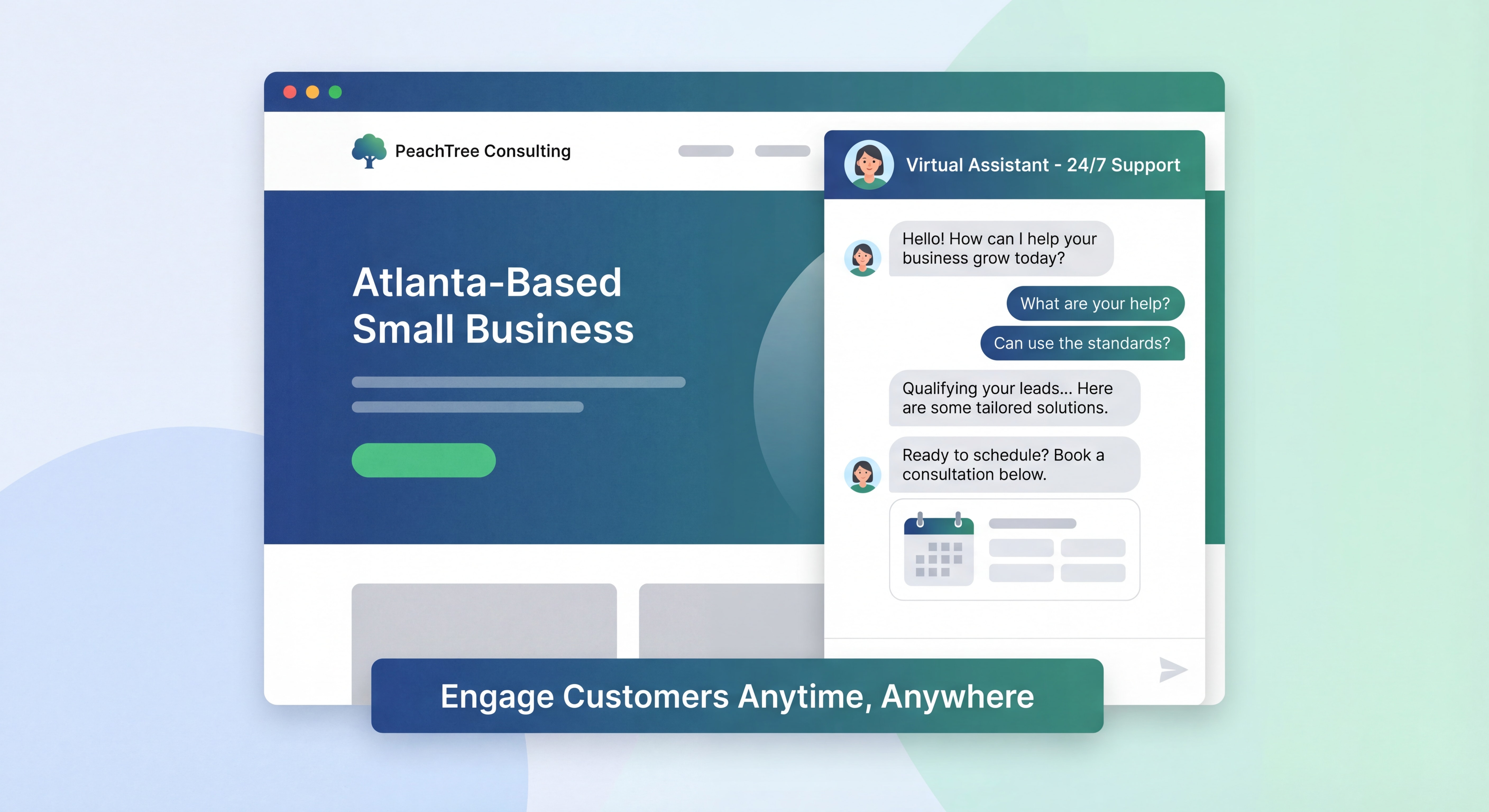
This isn't about replacing your team. It's about capturing the leads your team is currently missing — the Buckhead professional who visits your site at 11 PM, the Roswell homeowner who wants to schedule a quote on a Sunday morning, the Midtown restaurant owner who has a question about your services while they're between the lunch and dinner rush. Without a chatbot, these visitors either wait for a response that comes too late, or they bounce to a competitor.
The practical implementation for Atlanta small businesses in 2026 looks like this:
| Chatbot Function | Business Type | Result |
|---|---|---|
| Appointment scheduling | Dental, medical, law firms | Eliminates phone tag, captures bookings 24/7 |
| Lead qualification | Contractors, HVAC, roofing | Pre-qualifies leads before sales team contact |
| FAQ deflection | Any service business | Handles 40–60% of repetitive support queries |
| Service page guidance | Ecommerce, multi-service businesses | Guides visitors to the right service faster |
| After-hours capture | All business types | Captures leads that would otherwise be lost |
The AI-powered NLP chatbots available in 2026 are the sweet spot for most Atlanta businesses. Unlike rule-based decision-tree bots that feel robotic and frustrate users with limited responses, NLP chatbots understand natural language, handle unexpected questions, and improve over time. They can be trained on your specific service catalog, FAQ content, and pricing information — so when a homeowner in Sandy Springs asks "do you service my area?" at 9 PM, they get an accurate, helpful answer immediately.
The integration with your web design Atlanta strategy is critical. A chatbot that pops up aggressively on every page three seconds after arrival is an annoyance, not an asset. The right approach is contextual: trigger the chatbot on high-intent pages (service pages, pricing pages, contact pages) after a user has spent meaningful time engaging with content. That's a warm lead, not a cold interruption.
A local dental practice that deployed a website chatbot with appointment scheduling integration handled 40% of daily call volume through the bot within six months — freeing their front-desk staff for higher-value patient interactions while capturing bookings that previously slipped through the cracks.
The Full-Stack Optimization Framework
Everything covered in this article connects to a single framework. Technical SEO audit Atlanta → Core Web Vitals optimization → Conversion-focused web design → Content marketing Atlanta strategy → AI chatbot lead capture. Each layer amplifies the others.
Fix your technical foundation first. A site with broken crawlability and poor Core Web Vitals scores will underperform regardless of how good the content is. Once the technical floor is solid, build the content architecture. Once the content architecture is generating traffic, optimize the conversion layer — design, CTAs, chatbot — to capture as much of that traffic as possible.
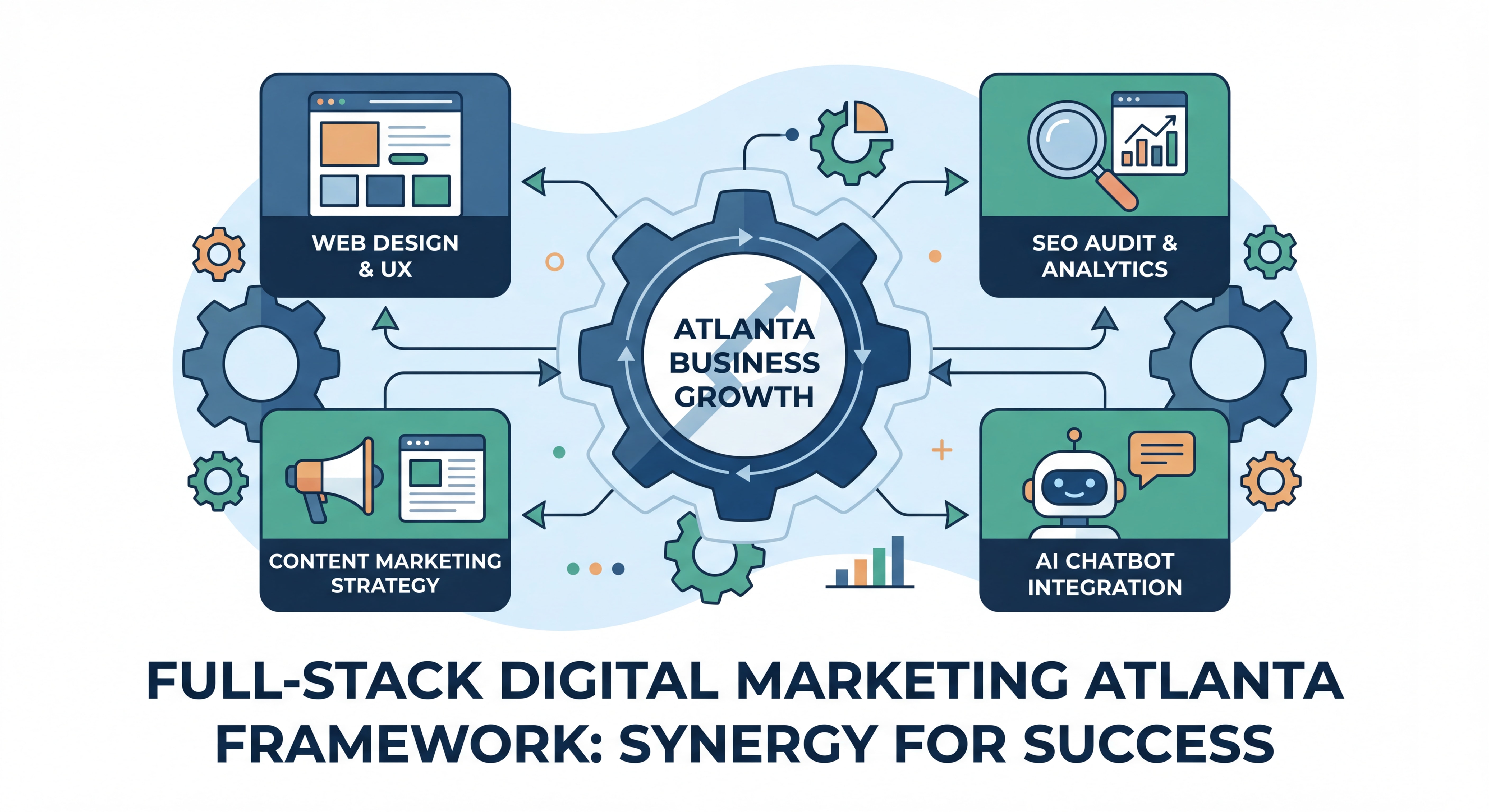
The Atlanta businesses that are winning in 2026 aren't the ones with the biggest budgets. They're the ones that treat their digital presence as a system — maintained, measured, and continuously improved. A Buckhead law firm that ranked #1 for three competitive keywords in 60 days didn't get there by luck. They got there because someone audited the technical foundation, fixed what was broken, built content that matched searcher intent, and made sure the site converted the traffic it earned.
That's the difference between a website that costs money and one that makes it.
Ready to put this strategy to work for your Atlanta business? Work with Atlanta SEO services and web design Atlanta experts who know this market — not a national agency that'll treat you like account number 4,872. Book a free SEO audit Atlanta — no fluff, just data.
Frequently Asked Questions (FAQ)
What should an SEO audit for an Atlanta business actually include?
A real SEO audit Atlanta goes well beyond surface-level keyword rankings. It covers crawlability and indexation (checking robots.txt, sitemap accuracy, and Google Search Console index coverage), Core Web Vitals performance across mobile and desktop, schema markup implementation, internal linking structure, redirect chains and 404 errors, on-page optimization across key service pages, and a competitive gap analysis for your specific Atlanta market. The audit should produce a prioritized action plan with estimated impact for each fix — not a generic 50-page report full of items that don't matter for your business.
How does web design in Atlanta affect my Google rankings?
Web design Atlanta directly affects rankings through multiple technical signals. Google evaluates Core Web Vitals (load speed, responsiveness, visual stability), mobile usability, site architecture (how easy it is to navigate and crawl), heading hierarchy, image optimization, and page experience signals. A site with strong design but poor technical performance will be outranked by a less visually polished site that loads faster and passes all Core Web Vitals thresholds. In 2026, design and SEO are the same conversation — not two separate ones.
What's the best way for an Atlanta small business to use content marketing?
Start with a topical cluster strategy. Identify your core service keyword — "plumber Atlanta," "family dentist Alpharetta," "roofing contractor Marietta" — and build a hub page targeting that term. Then create cluster content targeting specific long-tail questions your customers are actually searching: seasonal tips, comparison guides, neighborhood-specific service pages, FAQ content. Each cluster piece links back to the hub page. This architecture signals topical authority to Google and generates traffic at every stage of the buyer journey, not just the bottom of the funnel.
Is an AI chatbot worth it for a small Atlanta business?
For most Atlanta service businesses, yes — and the ROI math is straightforward. If your website gets 500 visitors per month and converts 2% into leads, you're generating 10 leads. A well-configured AI chatbot that captures an additional 15–20% of after-hours and high-intent visitors can meaningfully increase that number without adding headcount. The key is contextual deployment — triggering the chatbot on high-intent pages after meaningful engagement, not aggressively on every page. NLP-powered chatbots that can handle appointment scheduling and lead qualification deliver the strongest results for service businesses.
How long does it take to see results from an SEO audit and website optimization?
Technical fixes — resolving crawl errors, fixing redirect chains, implementing schema markup — can produce ranking improvements within 4 to 8 weeks as Google recrawls and reindexes the corrected pages. Core Web Vitals improvements often show measurable impact within 30 to 60 days. Content strategy results take longer: expect 3 to 6 months for new content to build authority and rank competitively for target keywords. The businesses that see the fastest results are those who fix technical issues first, then layer content and conversion optimization on top of a clean foundation.
Key Statistics
📊 391% improvement in conversion rate when businesses respond to website visitors within one minute — the core case for AI chatbot integration on every Atlanta business site. (Source: noem.ai, 2026)
💡 $7.65 returned for every $1 invested in content marketing — making it one of the highest-ROI channels available to Atlanta small businesses in 2026. (Source: SQ Magazine, 2026)
📈 42% increase in organic traffic reported by businesses that resolved Core Web Vitals failures and improved site performance scores. (Source: Digital Kulture Case Study, 2026)
🔍 72% of companies credit content marketing with directly boosting lead generation — the majority of which comes from SEO-integrated content strategies, not social media alone. (Source: Content Marketing Institute, 2026)

