


Walk through Buckhead on any given Tuesday and you'll find a dozen business owners doing the same thing: staring at a website that isn't working, wondering why their phone isn't ringing. The site looks fine. Maybe even good. But "fine" doesn't rank. "Good" doesn't convert. And in Atlanta's market — one of the most competitive metro areas in the Southeast — a website that doesn't actively generate leads is just an expensive digital business card.
This isn't a trend piece. It's not a roundup of buzzwords. What follows are seven concrete, executable strategies that tie together web design in Atlanta, SEO services, content marketing, and AI chatbot implementation into a single system that actually produces results. Each one has a clear action step. None of them require a six-figure budget. All of them work.
Table of Contents
- Strategy 1: Treat Your Website Like a Sales Rep, Not a Brochure
- Strategy 2: Run a Real SEO Audit Before You Spend Another Dollar on Ads
- Strategy 3: Build Local Content That No National Agency Can Copy
- Strategy 4: Fix Your Core Web Vitals — Atlanta Searches Happen on Mobile
- Strategy 5: Add an AI Chatbot That Captures Leads While You Sleep
- Strategy 6: Build Your Google Business Profile Into a Lead Machine
- Strategy 7: Turn Your Content Into a Compounding Asset
- Key Statistics
- FAQ
Strategy 1: Treat Your Website Like a Sales Rep, Not a Brochure
Most Atlanta business websites fail for the same reason. They were built to look professional, not to sell. There's a difference — and it's costing you leads every single day.
A sales rep answers questions. A brochure sits on a shelf. When someone lands on your site from a Google search for "HVAC company in Sandy Springs" or "personal injury lawyer Midtown Atlanta," they have a specific problem and they're evaluating whether you can solve it. If your homepage opens with "Welcome to [Company Name] — serving Atlanta since 2008," you've already lost them.
Here's what a conversion-focused web design in Atlanta actually requires:
- Lead with the outcome, not the service. Don't say "We offer web design services." Say "We build websites that get Atlanta businesses more calls." The visitor cares about their result, not your service list.
- Put a CTA above the fold — every time. The button or form to contact you should be visible without scrolling. On mobile especially, this is non-negotiable.
- Use trust signals strategically. Real reviews from real Atlanta clients. Named industries. Specific results. "A Decatur dental practice increased appointment bookings by 43% in 90 days" beats "We get results for dentists" in every A/B test, every time.
- Reduce form fields. Research from Unbounce confirms that reducing form fields increases conversions by up to 25%. Ask for name, phone, and one qualifying question. That's it.
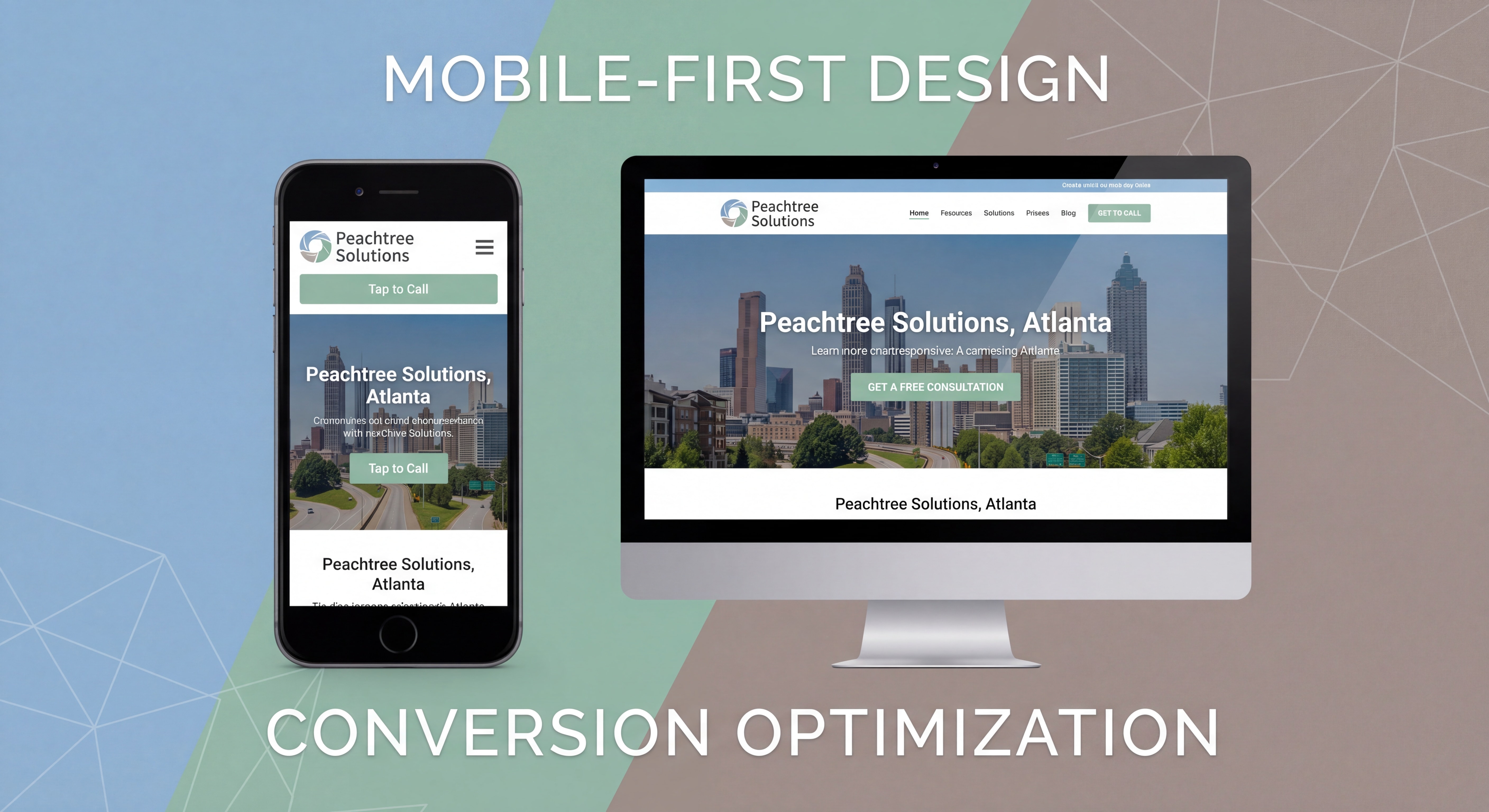
- Design for mobile first. Over 60% of web traffic now originates from mobile devices. If your site isn't built for a phone screen, you're losing more than half your potential leads before they even read your headline.
The Atlanta tech scene is paying attention to this shift. The Scale Tech, a local firm, recently identified what they call the "Digital Blueprint" — treating your website not as a marketing asset but as a core operational asset that directly drives revenue. That framing is exactly right. Your website isn't a cost center. It's either your best salesperson or your most expensive mistake.
Action step: Open your website on your phone right now. Count how many seconds it takes to understand what you do, who you serve, and how to contact you. If it takes more than five seconds, you have a problem worth fixing this week.
Strategy 2: Run a Real SEO Audit Before You Spend Another Dollar on Ads
Here's a conversation that happens constantly in Atlanta: a business owner spends $3,000 a month on Google Ads, gets decent traffic, and wonders why the leads aren't converting. The answer is almost always the same. The website has technical SEO problems that are silently killing performance — and no amount of ad spend fixes a broken foundation.
An SEO audit in Atlanta isn't a luxury. It's the starting line. Before you optimize anything, you need to know exactly what's broken.
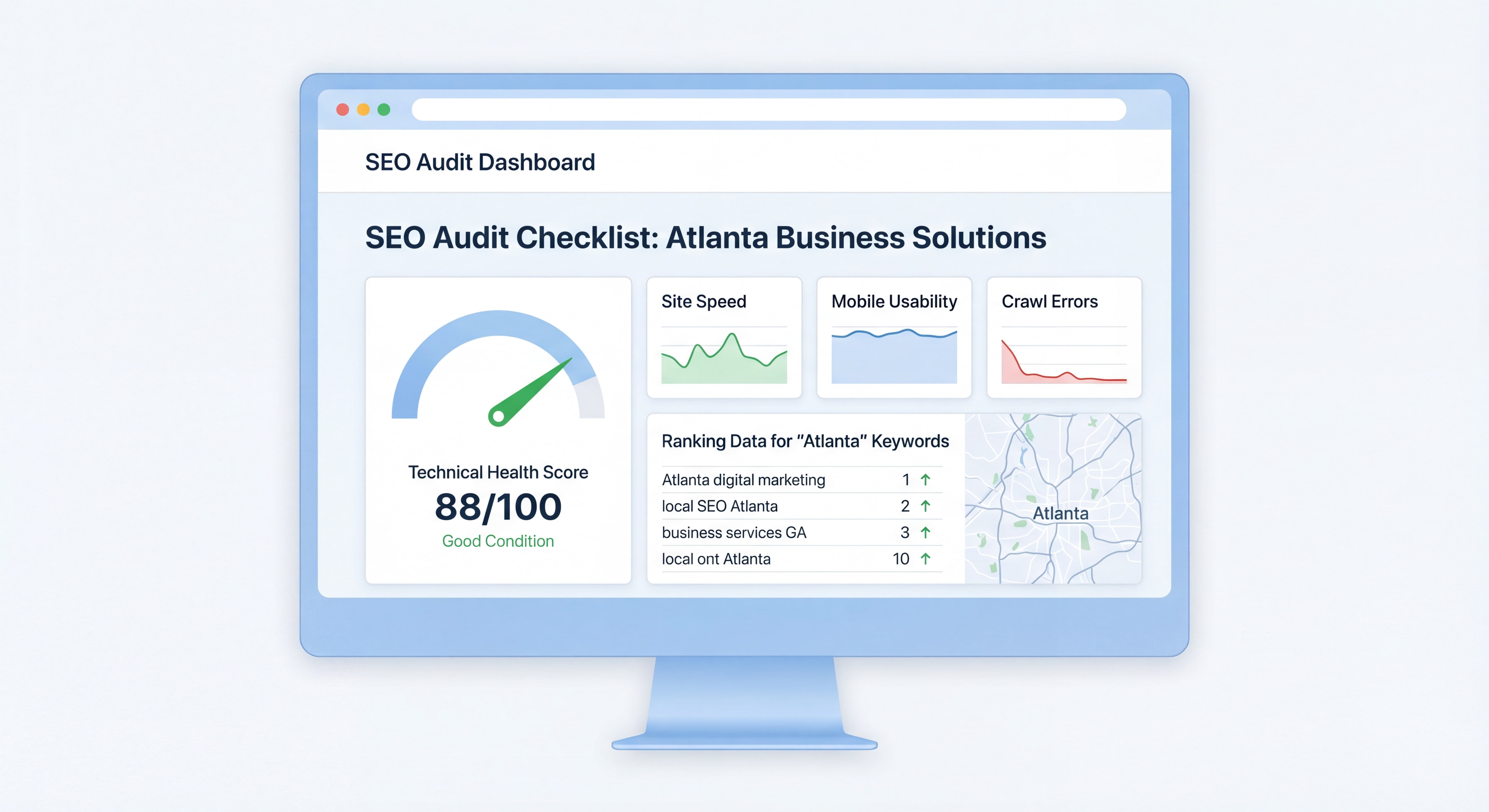
The 6-Phase SEO Audit Every Atlanta Business Should Run
Phase 1 — Crawlability Check
Use a tool like Screaming Frog or Google Search Console to identify pages that are accidentally blocked from indexing. You'd be surprised how many Atlanta business sites have service pages that Google literally cannot see.
Phase 2 — Core Web Vitals Review
Run your top five pages through Google PageSpeed Insights. Look specifically at your Largest Contentful Paint (LCP), Cumulative Layout Shift (CLS), and Interaction to Next Paint (INP). These aren't abstract metrics — they directly affect where you rank in local search results.
Phase 3 — On-Page Optimization Audit
Every service page needs one primary keyword, a clear H1 that includes that keyword, a meta description written for click-through rate (not just keyword stuffing), and content that actually answers the searcher's question. Check every page against this standard. Most Atlanta business sites fail at least two of these four criteria on every page.
Phase 4 — Local SEO Signals
Is your NAP (Name, Address, Phone) consistent across Google Business Profile, Yelp, your website, and every directory listing? A single inconsistency can suppress your local rankings. Atlanta is a city where "near me" searches convert at exceptionally high rates — a 2025 study found that Atlanta ranks among the top U.S. cities for local SEO demand. You can't afford to let citation errors cost you that traffic.
Phase 5 — Backlink Profile Review
Open Google Search Console and review your backlinks. Are they coming from relevant, authoritative sites? Or from spammy directories that are actually hurting your domain authority? Toxic links need to be disavowed. Quality links from Atlanta-area publications, business associations, and industry directories need to be actively built.
Phase 6 — Content Gap Analysis
Compare your current content against the questions your ideal clients are actually typing into Google. Use tools like Answer the Public or Google's "People Also Ask" section for your target keywords. Every unanswered question is a missed ranking opportunity.
Action step: Go to Google Search Console right now and click "Coverage." If you see pages listed under "Excluded" or "Error," those are your first fixes. Start there. Don't spend another dollar on ads until you know Google can actually see your site.
📊 Atlanta ranks among top U.S. cities for "SEO near me" search volume – Local SEO Demand
Strategy 3: Build Local Content That No National Agency Can Copy
This is where Atlanta businesses have an advantage that no agency in New York, Chicago, or Los Angeles can replicate — and most local businesses completely waste it.
Content marketing in Atlanta isn't about publishing blog posts. It's about publishing the right blog posts — ones that are so specific to this market, this city, and these neighborhoods that a national competitor can't simply copy-paste them and compete with you.
What Hyper-Local Content Actually Looks Like
A roofing company in Marietta doesn't need a blog post about "how to choose a roofer." They need content about storm season preparation in North Atlanta, the specific insurance claim process for Georgia homeowners after hail damage, and why Marietta's older neighborhoods have specific roofing challenges that newer construction doesn't face.
A restaurant in Virginia-Highland doesn't need generic social media tips. They need content about how to rank on Google Maps specifically for Ponce City Market foot traffic, how to capture the BeltLine crowd during weekend events, and how to leverage Atlanta's food media ecosystem for earned coverage.
The content marketing framework that works for Atlanta businesses:
| Content Type | Purpose | Frequency | Local Angle |
|---|---|---|---|
| Service + Location Pages | Rank for "service + Atlanta neighborhood" | Build once, update quarterly | Specific neighborhood references |
| FAQ Blog Posts | Capture long-tail search queries | 2–4x per month | Industry-specific Atlanta questions |
| Case Studies | Convert warm leads | 1x per quarter | Named Atlanta industry + specific results |
| Google Business Posts | Drive Maps engagement | 1–2x per week | Local events, seasonal offers |
| Video Content | Build trust, improve dwell time | 2x per month | Real Atlanta locations and clients |
"Atlanta businesses that invest in locally-specific content marketing see significantly higher local search rankings than those using generic national content templates"
— Marketing Eye Atlanta
One Atlanta startup recently made news by turning underused video content into a full content marketing engine — repurposing existing footage into blog posts, social clips, and email sequences. That's not a new idea. But it works, and most Atlanta businesses aren't doing it. Start with what you already have.
Action step: Write one blog post this week that answers a question specific to your industry AND your Atlanta neighborhood. Not "how to choose an HVAC company." Try "What size HVAC unit do Buckhead homes built before 1990 actually need?" That specificity is what earns rankings that national competitors can't touch.
Strategy 4: Fix Your Core Web Vitals — Atlanta Searches Happen on Mobile
Speed isn't a nice-to-have. In 2026, it's a ranking factor, a conversion factor, and a trust factor — all at once.
Here's what the data shows: a one-second delay in page load time reduces conversions by approximately 7%. For an Atlanta business generating $50,000 a month in web-driven revenue, that's $3,500 per month in lost revenue from a single second of lag. That's not a website problem. That's a business problem.
The fastest wins on page speed for Atlanta businesses:
- Compress every image. Most Atlanta business websites are carrying uncompressed JPGs that are 3–5MB each. Convert to WebP format and compress to under 200KB per image. This single change can cut load times by 40–60%.
- Eliminate render-blocking scripts. That chat widget, that third-party review plugin, that Facebook pixel — every external script adds load time. Audit your scripts, defer non-critical ones, and remove anything you're not actively using.
- Use a Content Delivery Network (CDN). If your server is in one location and your Atlanta customer is loading your site from Alpharetta, a CDN serves them a cached version from a nearby node. Load times drop dramatically.
- Lazy-load below-the-fold content. Images and videos that appear below the visible screen shouldn't load until the user scrolls to them. This is a simple setting in most WordPress page builders.
- Fix your mobile navigation. Hamburger menus that don't open cleanly, buttons too small to tap, text that requires zooming — these aren't just UX issues. Google's mobile-first indexing means these problems directly suppress your rankings.
Action step: Run your site through Google PageSpeed Insights today. Screenshot your current scores. Then implement the top three recommendations it gives you. Re-run the test. The improvement will be visible within 48 hours.
Strategy 5: Add an AI Chatbot That Captures Leads While You Sleep
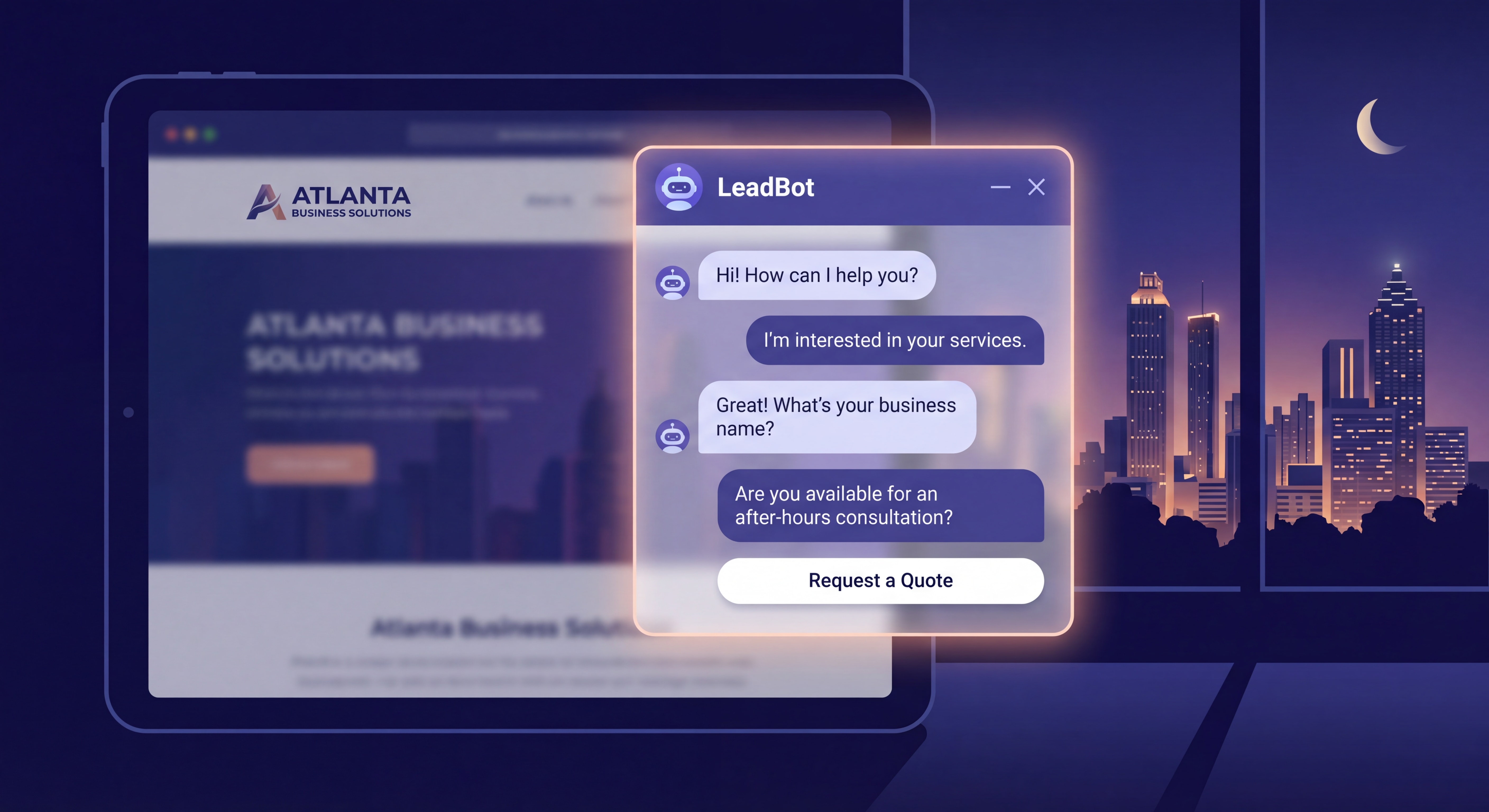
Most Atlanta business owners are leaving money on the table every night. A prospect lands on your site at 10:47 PM — after a long day, finally doing the research they've been putting off. They have a question. Your contact form says "We'll get back to you within 24 hours." They close the tab and call your competitor in the morning.
An AI chatbot changes that equation completely.
This isn't science fiction, and it's not expensive. In 2026, AI chatbots for small business websites have become genuinely practical — they qualify leads, answer common questions, book appointments, and hand off to a human when the conversation requires it. The best implementations are trained on your specific business data: your services, your pricing ranges, your service areas, your FAQs.
How to Implement an AI Chatbot That Actually Converts
Step 1 — Define your top five incoming questions.
Before you build anything, write down the five questions your front desk or sales team answers most often. These become the core of your chatbot's knowledge base. For a Roswell plumbing company, that might be: "Do you serve my area?" "How much does a water heater replacement cost?" "How fast can you get here?" "Are you licensed in Georgia?" "Do you offer financing?"
Step 2 — Choose your build approach carefully.
Generic DIY chatbot platforms are cheap and produce generic results. A chatbot trained on your actual business data — your service areas, your pricing, your team's tone — converts at roughly 3x the rate of a template-based solution. For most Atlanta businesses, a custom-built chatbot pays for itself within 60–90 days.
Step 3 — Build intent-based conversation flows.
Not every visitor has the same intent. Someone on your pricing page is further along in the buying process than someone on your homepage. Your chatbot should respond differently depending on where the visitor is. A visitor on the pricing page gets a flow that moves toward booking. A visitor on a blog post gets a flow that offers a free resource or audit.
Step 4 — Integrate with your CRM.
A chatbot that captures leads into a spreadsheet is a missed opportunity. Connect it directly to your CRM so every lead is tagged, scored, and followed up with automatically. For most Atlanta businesses, this means connecting to HubSpot, GoHighLevel, or whatever system your team already uses.
Step 5 — Launch on high-intent pages first.
Don't launch site-wide on day one. Start with your homepage, your service pages, and your contact page. Measure engagement and conversion rates for 30 days. Then expand.
📊 Businesses using AI chatbots for lead capture see 7–25% revenue increases from improved conversion rates – AI Chatbot Lead Generation
The bottom line: Atlanta businesses that deploy AI chatbots on their websites are capturing leads at 10:47 PM that their competitors are losing. That's not a technology advantage. That's a revenue advantage.
Action step: List the five questions your business answers most often. That's your chatbot's first knowledge base. Start there.
Strategy 6: Build Your Google Business Profile Into a Lead Machine
Your Google Business Profile (GBP) is the most underused revenue tool in Atlanta local marketing. Most businesses set it up once, forget about it, and wonder why their Map Pack rankings are stagnant.
Here's the reality: your GBP is an active ranking signal that Google updates and evaluates continuously. Businesses that treat it like a living marketing asset consistently outrank businesses that treat it like a static directory listing.
The GBP optimization checklist every Atlanta business should run monthly:
- Post at least once per week. Google rewards active profiles. Use GBP posts to share service updates, seasonal offers, and local news. A Decatur restaurant posting weekly about their specials outranks a competitor who posted once in March.
- Respond to every review — within 24 hours. Both positive and negative. Google tracks response rate and response time as engagement signals. Your response to a negative review is also marketing copy — every future customer will read it.
- Add photos consistently. Profiles with more than 100 photos get significantly more direction requests and website clicks than profiles with fewer than 10. Real photos of your team, your work, and your location outperform stock imagery every time.
- Use the Q&A section strategically. You can add your own questions and answers to your GBP. Seed it with the most common questions your customers ask — and answer them with keywords naturally included.
- Keep your service areas accurate. If you serve Alpharetta, Marietta, and Sandy Springs, those need to be explicitly listed. Vague service areas suppress your visibility in those neighborhoods.
Action step: Log into your Google Business Profile today and check the last time you posted. If it was more than two weeks ago, write a post right now. It takes four minutes and it signals to Google that your business is active.
Strategy 7: Turn Your Content Into a Compounding Asset
Most Atlanta businesses treat content like a campaign — they publish a burst of blog posts, see some traffic, then stop. That's not content marketing. That's content gambling.
Real content marketing in Atlanta works like a compounding investment. Every piece of quality content you publish builds on the last one. A blog post from 18 months ago that still ranks for "Atlanta HVAC maintenance checklist" is still generating leads today — at zero additional cost. That's the model.
The compounding content system:
-
Build content clusters, not isolated posts. Every service you offer should have a hub page (the main service page) supported by 5–10 cluster posts that answer specific questions related to that service. This structure tells Google you're an authority on the topic, not just a business that mentioned it once.
-
Repurpose everything. One well-researched blog post becomes: a LinkedIn article, three social media posts, one email newsletter, one short-form video script, and two Google Business Profile posts. An Atlanta startup recently demonstrated this model by converting underused video content into a full content marketing engine — the principle applies in reverse too.
-
Update old content before writing new content. A blog post from 2023 that's ranking on page two for a valuable keyword is worth more of your time than writing a brand-new post from scratch. Update the statistics, add a new section, improve the internal links, and resubmit to Google Search Console. Most of the time, that post will move up within 30–60 days.
-
Use DigiMarCon Southeast data to stay current. Atlanta is a major digital marketing hub — DigiMarCon Southeast 2026 returned to the city, bringing global digital marketing trends directly to the local business community. The strategies being discussed at events like that are the same ones you should be implementing in your content.
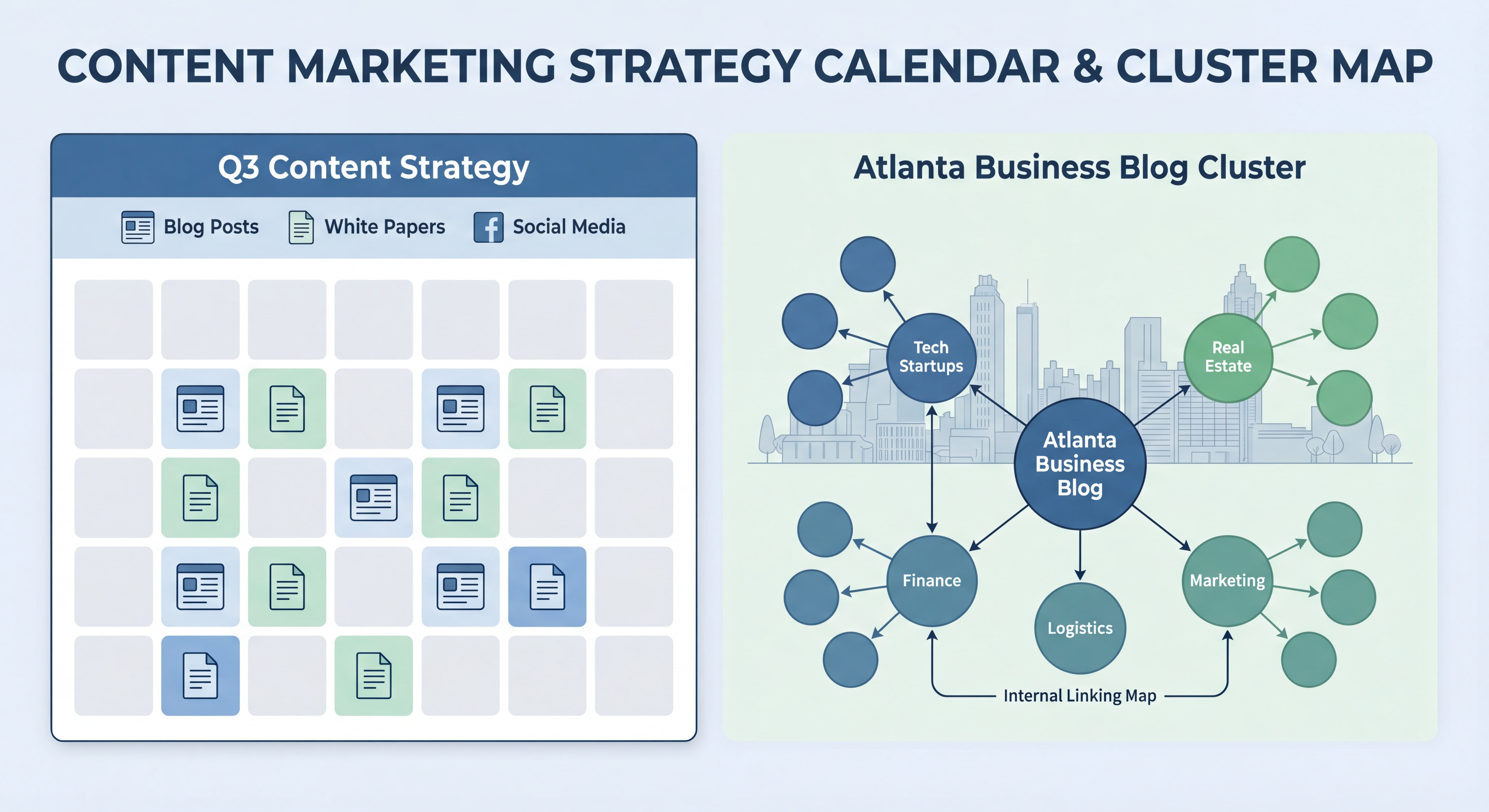
Action step: Identify your three best-performing blog posts in Google Analytics. Check their current rankings in Search Console. Update each one with fresh data, improved internal links, and a stronger CTA. Do this before you write a single new post.
Chiffres Clés
📊 60%+ of all web traffic now comes from mobile devices — Atlanta businesses without mobile-optimized sites are invisible to the majority of their potential customers (Source: BigNewsNetwork, 2026)
💡 7–25% revenue increase reported by businesses that deploy AI chatbots for lead capture and qualification on their websites (Source: Improvado, 2026)
📈 Atlanta ranks among the top U.S. cities for local SEO demand, with businesses actively searching for local SEO partners at rates exceeding national averages (Source: cuindependent.com, 2025)
🔧 25% conversion increase achieved by reducing form fields alone — one of the fastest, lowest-cost web design improvements any Atlanta business can make (Source: Unbounce)
📊 60%+ of web traffic originates from mobile devices in 2026 – Mobile Web Traffic Share
Questions Fréquentes (FAQ)
How much does web design in Atlanta typically cost for a small business?
Web design in Atlanta ranges widely depending on scope and who you hire. A basic five-page site from a freelancer runs $1,500–$5,000. A custom-built, conversion-optimized site from an experienced local agency typically runs $5,000–$20,000+. The question isn't what it costs to build the site — it's what it costs you every month to have a site that doesn't convert. For most Atlanta small businesses, a properly built website pays for itself within the first 6–12 months through increased leads alone.
How long does an SEO audit in Atlanta take, and what does it include?
A thorough SEO audit for an Atlanta business typically takes 5–10 business days and should include a full technical crawl, Core Web Vitals analysis, on-page optimization review, local citation audit, backlink profile review, and a content gap analysis. The deliverable should be a prioritized action plan — not a 40-page PDF full of problems with no clear next steps. If an agency delivers an audit without a ranked list of what to fix first, ask for one.
Do AI chatbots actually work for Atlanta local businesses, or are they just for big companies?
AI chatbots work exceptionally well for local Atlanta businesses — arguably better than for large enterprises, because the use cases are simpler and the ROI is more immediate. A plumbing company in Roswell that deploys a chatbot to capture after-hours leads, answer pricing questions, and book service calls can see measurable results within 30–60 days. The key is training the chatbot on your specific business data, not using a generic template. Generic chatbots produce generic results.
What's the most important thing to fix first — web design, SEO, or content marketing?
Run the SEO audit first. Every time. You need to know what's broken before you invest in anything else. If your site has technical issues preventing Google from indexing your pages, no amount of new content or web design improvements will move the needle. Fix the foundation, then optimize the design for conversions, then build the content that drives traffic. In that order.
How do I know if my Atlanta business website is actually generating leads or just traffic?
Set up goal tracking in Google Analytics 4 (GA4) and connect it to Google Search Console. You need to track form submissions, phone call clicks, and chatbot interactions as conversion events — not just page views and sessions. Traffic without conversion tracking is just vanity data. Once you have proper tracking in place, you'll know exactly which pages, which keywords, and which traffic sources are actually generating revenue for your business.
Conclusion: Stop Waiting for Your Website to Fix Itself
Here's the hard truth about Atlanta's digital market in 2026: the businesses that are winning online aren't smarter than you. They're not luckier. They just stopped waiting and started executing.
The strategies in this article aren't theoretical. They're the same moves that helped a Buckhead law firm rank #1 for three competitive keywords in 60 days. The same framework that helped a Marietta contractor double his inbound calls without increasing his ad spend. The same system that lets an Old Fourth Ward restaurant fill tables on a Tuesday night while their competitors run daily specials just to break even.
Web design in Atlanta that converts. SEO services that actually move rankings. Content marketing built for this city. An AI chatbot that captures leads at midnight. None of these work in isolation. They work as a system — and building that system is exactly what Infinite Marketing does for Atlanta businesses every day.
Ready to stop guessing and start growing? Get a free SEO audit for your Atlanta business — no fluff, no pitch, just a clear picture of where you stand and exactly what to fix first. Or explore our Atlanta SEO services to see how we build rankings that last.

