You opened a business in Atlanta. You’ve got a product or service people actually need. Maybe you’re in Buckhead, maybe you’re running a contracting company out of Marietta, maybe you just opened a dental practice in Sandy Springs. Doesn’t matter. The question is the same for all of you:
why isn’t your phone ringing?
Nine times out of ten, the answer starts online. More specifically, it starts with four fundamentals that most Atlanta business owners either skip entirely or execute halfway:
web design Atlanta,
SEO services Atlanta,
content marketing Atlanta, and AI chatbots. This guide breaks all four down from the ground up — no jargon, no fluff, no vague promises. Just what you need to know, in the order you need to know it, so you can stop guessing and start building something that actually works.
Table of Contents
Start Here: Why Your Website Is the Foundation
Before we talk about SEO, content, or chatbots, let’s be honest about something most agencies skip over.
All of it is built on your website. A weak site kills every other investment. You can rank on Google, you can run ads, you can post on Instagram every single day — and if your website is slow, confusing, or looks like it was built in 2014, the traffic you worked for will bounce right back out the door.
Atlanta is a competitive market. The metro area hosts regional and national headquarters across every industry imaginable. Buckhead law firms compete with national chains. Alpharetta tech companies fight for the same talent and clients as Silicon Valley. Midtown restaurants battle for visibility on a Google Maps screen the size of a human palm. In that environment, a mediocre website isn’t just a missed opportunity. It’s an active liability.
Here’s the good news: you don’t need to spend $50,000 to get this right. You need to understand the fundamentals, make smart decisions early, and build in the right order.
Web Design Atlanta: What Beginners Actually Need
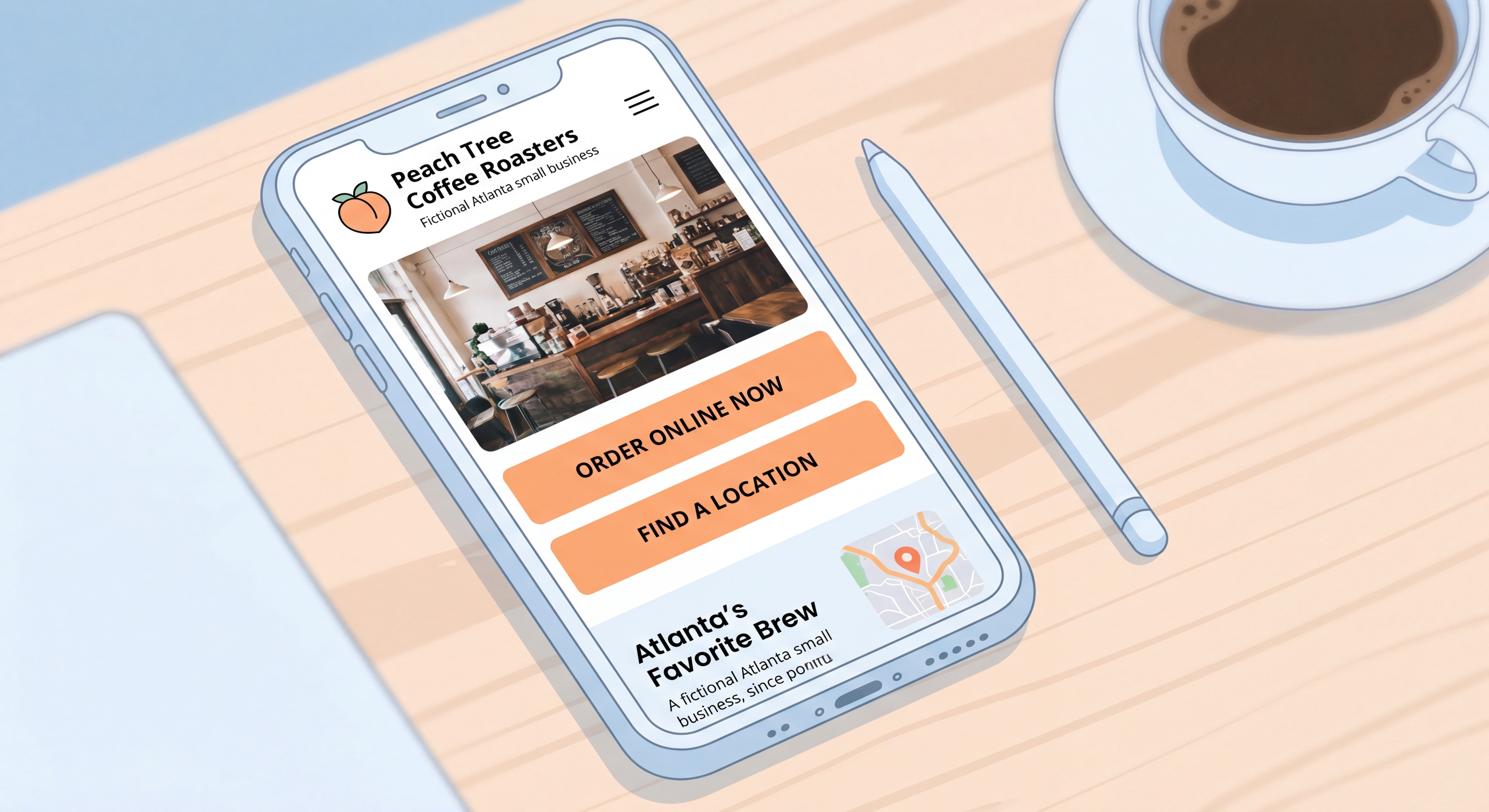
The Scale Tech, an Atlanta-based firm, recently identified a critical shift in how companies think about their online presence: the website is no longer a brochure — it’s a
core business asset, as foundational as a storefront or a lease. That framing matters. When you think of your website as a brochure, you build it once and forget it. When you treat it as a core asset, you invest in it, maintain it, and expect it to generate returns.
What Your Website Actually Needs to Do
A business website in Atlanta has one job above everything else:
convert visitors into leads. Not impress designers. Not win awards. Convert.
That means every page needs:
- A clear headline that explains what you do and who you serve
- A visible phone number or contact form above the fold
- Proof that you’re legitimate — reviews, certifications, photos of real work
- A mobile experience that works as well as the desktop version
That last point is non-negotiable. Atlanta users search on phones first. If your site takes more than three seconds to load on a mobile connection, a significant portion of your visitors will leave before they ever read a single word.
Platform Choices for Beginners
You don’t need a custom $60,000 build to get started. Here’s a realistic breakdown:
| Platform |
Best For |
Approximate Cost |
Learning Curve |
| WordPress |
Most Atlanta small businesses |
$3,000–$15,000 with agency |
Moderate |
| Squarespace |
Service businesses, creatives |
$23–$65/month DIY |
Low |
| Wix |
Very early-stage businesses |
$17–$35/month DIY |
Low |
| Shopify |
Ecommerce brands |
$39–$105/month |
Low-Moderate |
| Custom Build |
High-growth, complex needs |
$20,000–$60,000+ |
N/A (agency-built) |
Most Atlanta small business owners starting out should look at WordPress with professional setup or a platform like Squarespace. The key is choosing a platform that gives you the ability to add content over time — because content is what drives SEO, and SEO is what drives traffic.
The Five Pages Every Atlanta Business Website Needs
- Homepage — Clear headline, your primary service, your location, a CTA
- Services Page(s) — One page per service, written for the customer’s problem, not your process
- About Page — Real people, real story, local credibility signals
- Contact Page — Phone, address, a map embed if you have a physical location
- Reviews or Testimonials — Real outcomes from real Atlanta clients, not generic praise
Get these five right before you think about anything else. A Buckhead roofing company that nails these five pages will outperform a competitor with a 40-page site that’s poorly structured and slow to load.
📊
$3,000–$15,000 for professional builds – Atlanta small business website cost range
SEO Services Atlanta: How to Get Found Before Your Competitors
Your website exists. Good. Now the question is: can anyone find it?
Search engine optimization is how you answer that question with a yes.
SEO services Atlanta is one of the most searched terms among local business owners, and for good reason — Atlanta is one of the U.S. cities with the highest demand for local SEO help, according to a 2025 study tracking “SEO near me” searches nationally. The competition for Google’s first page in this market is real. The businesses showing up there aren’t lucky. They’re doing specific things consistently.
Here’s what those things are, broken down for beginners.
The Three Pillars of Local SEO
1. Your Google Business Profile (GBP)
This is the most important single asset for local search visibility in Atlanta. When someone searches “HVAC company near me” or “dentist in Sandy Springs,” what shows up in that map block at the top of the results is driven almost entirely by your Google Business Profile. Fill it out completely. Add photos. Collect reviews. Update your hours. This is free, and it’s the fastest path to better local visibility.
2. Your Website’s On-Page Signals
Google needs to understand what your business does and where you serve. That means your service pages should include your city, your neighborhood, and your specific services in the page titles, headings, and body copy — naturally, not stuffed. An Atlanta HVAC company targeting Marietta and Roswell should have pages that mention those areas in context, not just in a footer.
3. Reviews and Local Trust Signals
Atlanta businesses with consistent, recent Google reviews outperform those without them. Consistent means ongoing — not a burst of 20 reviews in one month followed by silence. Build a process for asking satisfied customers to leave reviews, and respond to every one you receive.
What to Expect from SEO (Timeline for Beginners)
This is where most new business owners get burned by bad expectations. SEO is not a switch you flip. It’s a foundation you build.
| Timeframe |
What You Should See |
| Days 1–30 |
Technical fixes, GBP cleanup, tracking setup |
| Days 31–60 |
Improved service pages, initial content, review velocity |
| Days 61–90 |
Early ranking movement on lower-competition terms |
| Months 4–6 |
Meaningful local visibility, lead attribution clarity |
| Months 6–12 |
Competitive keyword rankings, measurable lead growth |
A Decatur law firm that started from zero ranked in the top three local results for two competitive practice area keywords within five months — after a GBP rebuild, service page rewrites, and a structured review campaign. That’s a realistic outcome when the fundamentals are done right.
Your First SEO Audit Atlanta: What to Look at and Why
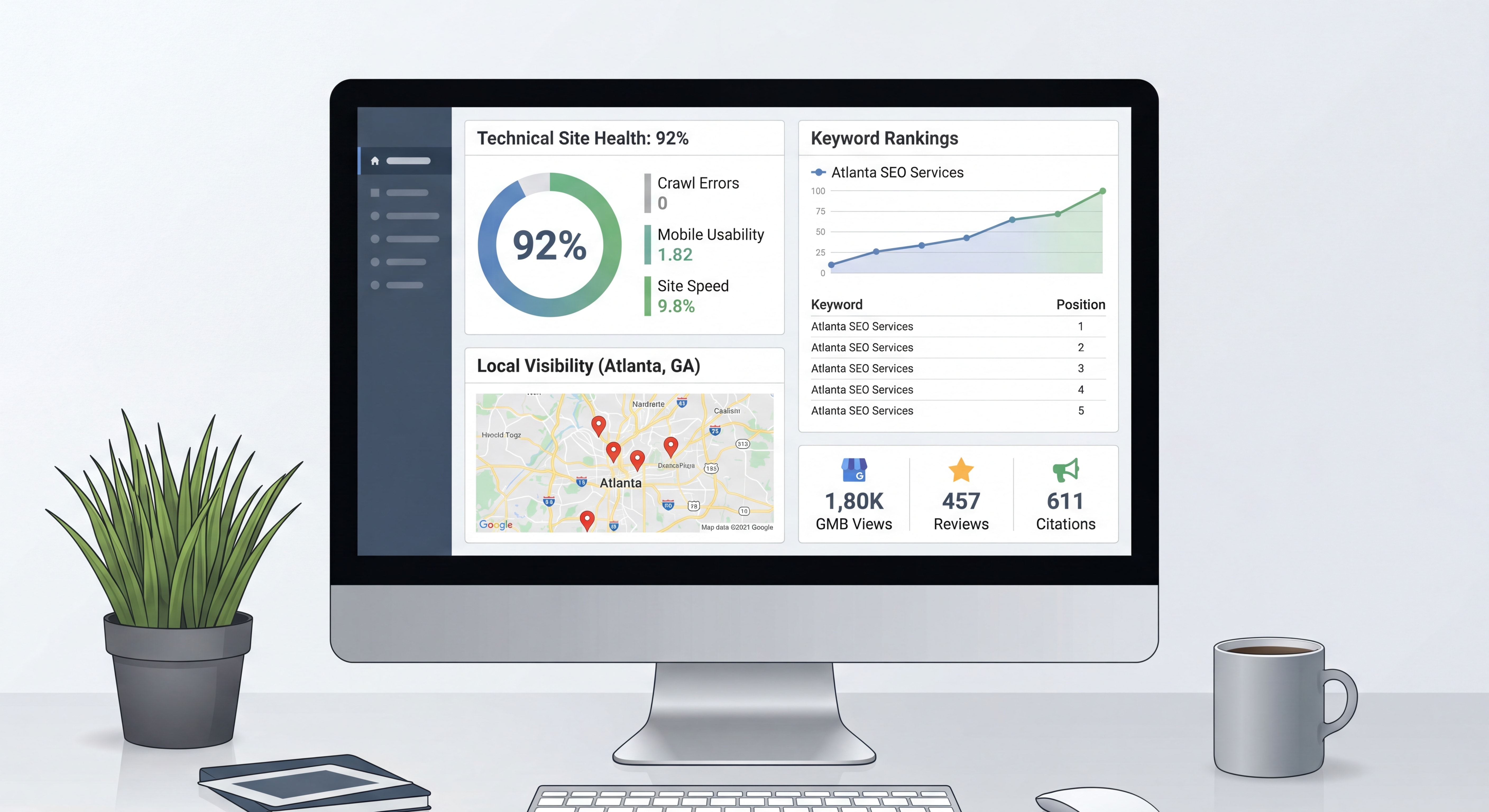
Before you can improve your SEO, you need to know where you stand. That’s what an
SEO audit Atlanta gives you — a clear picture of what’s working, what’s broken, and what’s costing you leads right now.
Most business owners hear “audit” and imagine something complicated and expensive. It doesn’t have to be. Here’s what a basic SEO audit covers, and why each piece matters.
What a Beginner’s SEO Audit Covers
Technical Health
Is your website fast? Is it mobile-friendly? Does Google have any trouble crawling and indexing your pages? Tools like Google Search Console (free) will flag crawl errors, mobile usability issues, and pages that aren’t being indexed. Fix these first. Everything else is built on top of a technically healthy site.
On-Page Optimization
Do your page titles include your primary keyword and your city? Are your headings structured logically (H1 → H2 → H3)? Is your content written for the actual questions your customers are asking? A Midtown restaurant owner who writes a page titled “Our Menu” instead of “Midtown Atlanta Farm-to-Table Restaurant | [Name]” is leaving search traffic on the table.
Google Business Profile Completeness
Is every field filled in? Are your categories accurate? Are your service areas defined? Are your photos recent and relevant? Missing or inconsistent NAP (Name, Address, Phone) information across the web — your website, your GBP, Yelp, directories — confuses Google and hurts your local rankings.
Competitor Gap Analysis
What keywords are your top three Atlanta competitors ranking for that you’re not? Where are they getting backlinks from? This isn’t about copying them — it’s about understanding the landscape you’re competing in.
Content Gaps
Are there questions your customers are actively searching that you have no page or post addressing? Every unanswered question is a missed opportunity for a competitor to capture that traffic instead.
“An SEO audit judges the current status of your online performance, identifies gaps, and offers actionable recommendations — going far beyond superficial checks into technical, on-page, and off-page factors”
— Marketing Eye Atlanta
Free Tools to Start Your Own Audit
You don’t need to pay for an audit to get started. These tools are free and genuinely useful:
- Google Search Console — Technical health, indexing status, search queries
- Google Analytics 4 — Traffic sources, user behavior, conversion tracking
- Google Business Profile Manager — GBP completeness and review management
- PageSpeed Insights — Mobile and desktop load time scores
- Screaming Frog (free up to 500 URLs) — Technical crawl, broken links, duplicate content
Run these before you spend a dollar on marketing. Know your baseline. Then build from there.
Content Marketing Atlanta: The Long Game That Pays Off
Here’s the question Atlanta business owners ask most often about content marketing:
“Do I really need to blog?”
The honest answer is: you don’t need to blog. You need to
answer questions your customers are already asking. A blog is just one format for doing that. The format matters less than the consistency, the relevance, and the quality of what you publish.
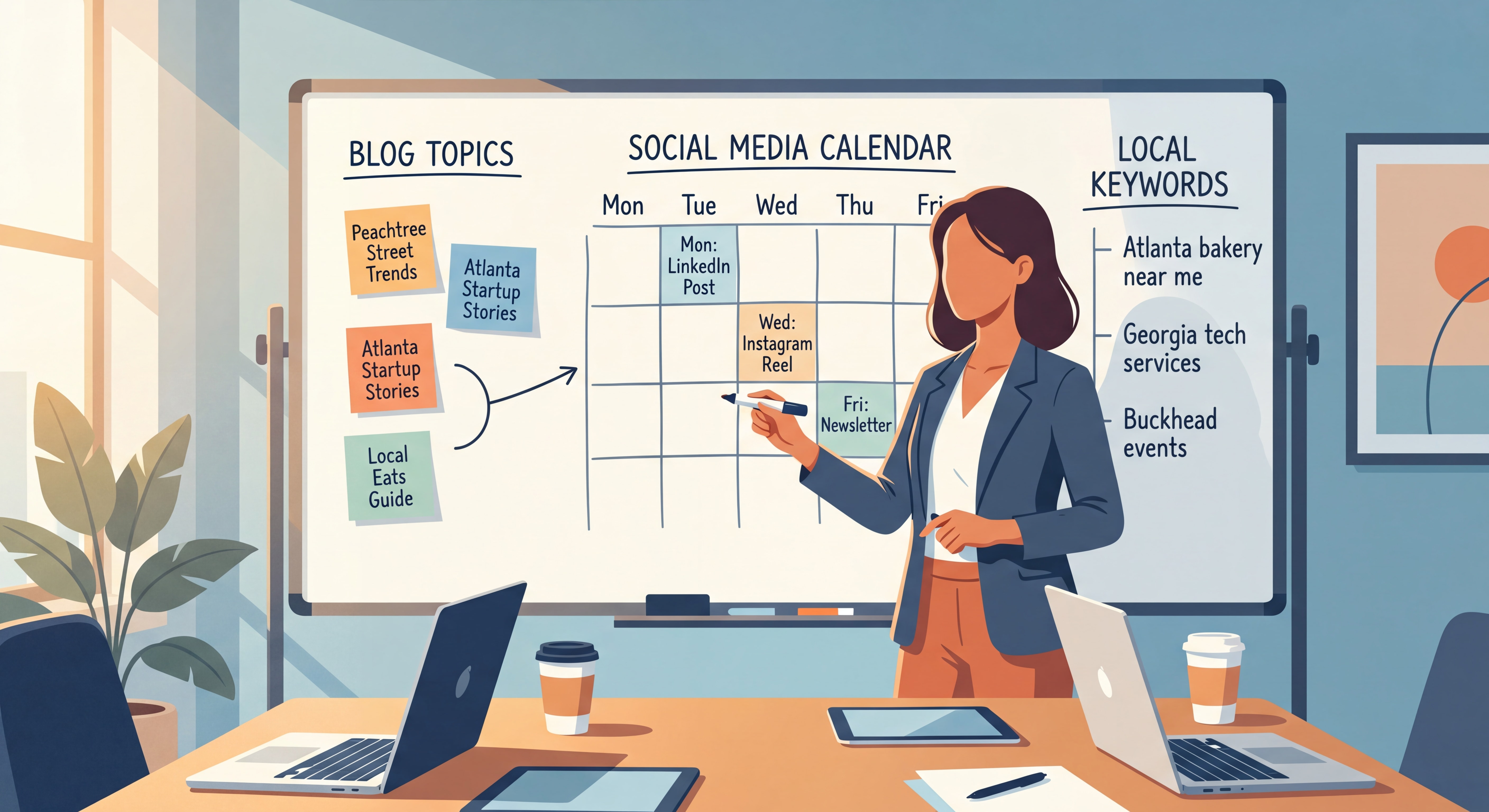
DigiMarCon Southeast 2026 returned to Atlanta this spring, drawing digital marketing professionals from across the country to discuss the state of content in a world increasingly shaped by AI-generated noise. The consensus?
Original, locally grounded content has never been more valuable. When everyone can generate generic articles in seconds, the businesses that win are the ones publishing content that couldn’t come from anywhere else — specific to their market, their industry, their customers.
That’s an advantage Atlanta small businesses actually have over national brands. You know your market. Use it.
Content Marketing Fundamentals for Beginners
Step 1: Know Who You’re Writing For
Before you write a single word, define your ideal customer. Not in vague terms like “homeowners in Atlanta.” Specifically: a homeowner in Alpharetta, 35–55, who just moved into a new house and needs HVAC service before summer. What questions does that person have? What are they scared of? What would make them trust you enough to call?
Step 2: Start With What You Know
The best content ideas come from your customers. What do they ask you every week? What misconceptions do they have when they call? What do they wish they’d known before hiring someone in your industry? Those questions are your content calendar.
Step 3: Pick One Channel and Do It Well
The biggest mistake beginners make is trying to be everywhere at once. Pick one: a blog on your website, a YouTube channel, an email newsletter. Do that one thing consistently for 90 days before adding anything else. Consistency beats complexity every time.
Step 4: Make Your Content Local
A Roswell HVAC company that writes “How to Prepare Your HVAC System for an Atlanta Summer” will outperform a national blog post on the same topic for local searches. Mention neighborhoods. Reference Georgia’s climate. Talk about the specific challenges of the Atlanta metro’s humidity and heat. Make it impossible to mistake your content for something written by someone who’s never been south of the Mason-Dixon line.
Step 5: Connect Content to Action
Every piece of content should have a next step. A blog post about “Signs Your Roof Needs Replacing in Atlanta” should end with a clear path to scheduling a free inspection. Education without a call to action is just charity. Good content marketing educates first — and then converts.
📊 **Content Marketing Institute, 2026]
AI Chatbots: The Beginner’s Advantage Most Atlanta Businesses Are Ignoring
Let’s talk about something most Atlanta small business owners either haven’t tried yet or tried once with a bad tool and gave up on:
AI chatbots.
The global chatbot market is growing at 23.3% annually. The businesses deploying them now are building a compounding advantage over the ones that wait. And here’s the part that matters for a small business in Virginia-Highland or a contractor in Marietta: you don’t need an enterprise budget to get started. The barrier to entry has dropped dramatically.
What an AI Chatbot Actually Does for a Small Business
An AI chatbot on your website does three things that directly impact your bottom line:
1. It captures leads when you’re not available.
Your website doesn’t sleep. A potential customer searching for an emergency plumber at 11 PM in Old Fourth Ward isn’t going to wait until 9 AM to get a response. A chatbot that collects their name, number, and the nature of their problem means you wake up to a qualified lead instead of a missed opportunity.
2. It answers common questions instantly.
What are your hours? Do you serve Decatur? What does a basic service call cost? These questions eat up your time when they come through phone or email. A well-configured chatbot handles them in seconds, freeing you to focus on the work that actually requires your expertise.
3. It qualifies leads before they reach you.
Not every inquiry is worth your time. A chatbot can ask the right questions upfront — service needed, location, timeline, budget range — and route only the qualified prospects to your calendar or your phone.
What to Look for When Getting Started
You don’t need a custom-built solution to start. Platforms like Tidio, Intercom, and Drift offer small business plans that can be configured without technical expertise. Here’s what to prioritize:** – Content marketing generates 3x more leads than outbound marketing at 62% lower cost
How These Four Work Together
Here’s where most beginner guides stop too early. They explain each piece in isolation and leave you to figure out how they connect. Let’s fix that.
Think of it as a funnel with four stages:
Stage 1 — Web Design Atlanta: Your foundation. Without a fast, mobile-friendly, conversion-focused website, everything else is wasted. Traffic that lands on a bad site bounces. Leads that find you through SEO won’t convert if the experience is confusing.
Stage 2 — SEO Services Atlanta: Your visibility engine. Once your site is solid, SEO gets it in front of people who are actively searching for what you offer. This is intent-based traffic — people who already want what you sell.
Stage 3 — Content Marketing Atlanta: Your trust builder. The people who find you through SEO need a reason to choose you over the five other options they’re considering. Content — blog posts, service page copy, FAQs, case studies — is how you demonstrate expertise and build the trust that converts browsers into buyers.
Stage 4 — AI Chatbot: Your conversion layer. Once traffic is landing and trust is building, the chatbot captures leads that would otherwise slip through the cracks — after hours, on weekends, or from visitors who aren’t ready to call but are ready to engage.
Each layer depends on the one before it. Skip web design and your SEO investment is wasted. Skip content and your traffic doesn’t convert. Skip the chatbot and you’re losing leads while you sleep.
“A strong small business marketing plan in 2026 is clear and focused — align brand, website, content, SEO, social, and reviews so each plays a specific role”
— B. McGuire Marketing, Atlanta Small Business Resources
Chiffres Clés
📊
Atlanta ranks among the top U.S. cities for “SEO near me” search demand — meaning your local competitors are actively investing in search visibility right now. (Source: cuindependent.com, December 2025)
💡
$3,000–$15,000 is the realistic range for a professional small business website in Atlanta — a one-time investment that works for you 24 hours a day. (Source: DriveLead Media, March 2026)
🤖
23.3% annual growth in the global chatbot market — the businesses deploying AI tools now are building a lead-capture advantage that compounds over time. (Source: ChatbotBuilder.net, 2026)
📈
Content marketing generates 3x more leads than outbound marketing at 62% lower cost — making it the highest-ROI channel for Atlanta small businesses on a budget. (Source: Content Marketing Institute, 2026)
Questions Fréquentes (FAQ)
How much does web design in Atlanta cost for a small business just getting started?
Most Atlanta small businesses spend between $3,000 and $15,000 for a professionally built website from a local agency or experienced freelancer. DIY platforms like Squarespace or Wix run $17–$65 per month and are a reasonable starting point if your budget is tight. The key is not to build the cheapest site — it’s to build a site that converts. A $5,000 site that generates 10 leads a month is a far better investment than a $500 template that generates none.
How long does it take to see results from SEO services in Atlanta?
Honest answer: three to six months for meaningful local visibility, six to twelve months for competitive keyword rankings. The Atlanta market is competitive, and SEO is a compounding investment — the longer you do it correctly, the stronger your results become. Businesses that expect overnight results from SEO end up disappointed. Businesses that commit to a 12-month strategy consistently outperform those that don’t.
What is an SEO audit and does my Atlanta business need one?
An SEO audit is a diagnostic review of your website’s technical health, on-page optimization, local visibility, and competitive position. Every Atlanta business with a website needs one before investing in SEO services. It tells you exactly what’s broken, what’s working, and where your biggest opportunities are. Many agencies offer free initial audits — take advantage of them, but make sure the audit includes actionable recommendations, not just a list of problems.
How do I start content marketing for my Atlanta business if I have no time and no marketing team?
Start smaller than you think you need to. One well-written blog post per month that answers a specific question your customers ask is more valuable than five rushed posts that say nothing useful. Prioritize your service pages first — make sure every service you offer has its own page with clear, specific, locally grounded copy. Then add content around the questions your customers ask most. Consistency over volume, every time.
Are AI chatbots worth it for small businesses in Atlanta?
Yes — if you set them up correctly. The key word is “correctly.” A chatbot that just says “Hi! How can I help?” and then fails to answer basic questions will frustrate visitors and hurt your brand. A chatbot configured to capture lead information, answer your five most common questions, and route complex inquiries to a human creates real value. Start with a simple, focused setup and expand from there. Most small business chatbot tools cost between $30 and $150 per month — a fraction of what a single missed lead costs you.
Conclusion: Build It in Order, Build It Right
The Atlanta market rewards businesses that show up consistently, look credible online, and make it easy for customers to take the next step. Web design, SEO, content marketing, and AI chatbots aren’t four separate initiatives. They’re four connected layers of the same system.
Start with your website. Make it fast, mobile-friendly, and built to convert. Then invest in SEO services to drive qualified Atlanta traffic to it. Build content that turns that traffic into trust. And deploy an AI chatbot to capture the leads your site earns — even when you’re not at your desk.
You don’t have to do all of this at once. But you do have to do it in order. And you do have to do it well.
Ready to get your Atlanta business’s digital foundation right from the start? Get a free
SEO audit Atlanta from Infinite Marketing — no fluff, just a clear picture of where you stand and what to do next. Or explore our
web design Atlanta and
SEO services Atlanta pages to see exactly how we build this for local businesses every day.