

Most Atlanta businesses think they have a marketing problem. They don't. They have a foundation problem. Their website loads too slowly for a visitor on Peachtree Street checking their phone between meetings. Their SEO audit hasn't been touched in 18 months. Their content strategy is a blog post published whenever someone has time. And their "chatbot" is a pop-up that says "Hi! How can we help?" and then goes completely silent.
In 2026, that's not a website. That's a very expensive digital brochure.
This guide is not for beginners. It's for Atlanta business owners who already understand the basics and are ready to go deeper — into the technical, the tactical, and the measurable. If you're running a law firm in Buckhead, a contractor operation out of Marietta, or a growing ecommerce brand in Midtown, what follows is the advanced playbook that separates the businesses ranking on page one from the ones wondering why their phone isn't ringing.
Table of Contents
- Why Your Atlanta Website's Technical Foundation Is Costing You Rankings
- The Advanced SEO Audit Framework Atlanta Businesses Actually Need
- Content Marketing Atlanta: Beyond Blog Posts Into Topical Authority
- AI Chatbots: The Real ROI for Atlanta Businesses in 2026
- Integrating It All: The Unified Digital Strategy
- Key Statistics
- FAQ
Why Your Atlanta Website's Technical Foundation Is Costing You Rankings {#technical-foundation}
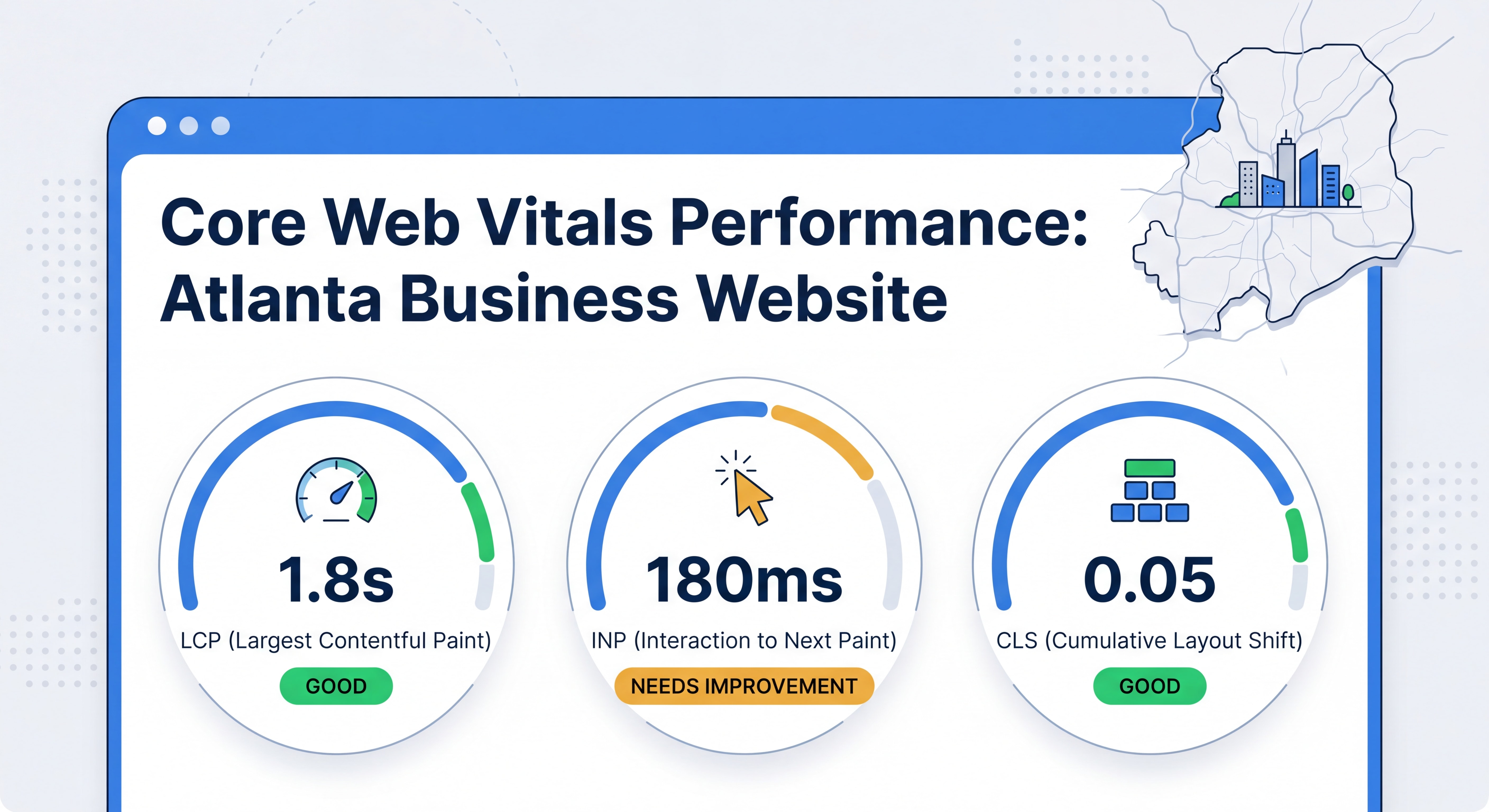
Here's something most Atlanta agencies won't say out loud: your content strategy is irrelevant if your website can't pass a basic technical audit. Google introduced Core Web Vitals 2.0 in early 2026, and the benchmarks got tighter. The three metrics — Largest Contentful Paint (LCP), Interaction to Next Paint (INP), and Cumulative Layout Shift (CLS) — now operate within a session-based evaluation model, not just a page-load snapshot.
What that means for your Old Fourth Ward restaurant or your Sandy Springs medical practice: Google is watching the entire user journey, not just whether your homepage loads fast.
Core Web Vitals: What "Good" Actually Looks Like in 2026
The thresholds have shifted. Here's where you need to land:
| Metric | Good | Needs Improvement | Poor |
|---|---|---|---|
| LCP (Largest Contentful Paint) | ≤ 2.5 seconds | 2.5–4.0 seconds | > 4.0 seconds |
| INP (Interaction to Next Paint) | ≤ 200ms | 200–500ms | > 500ms |
| CLS (Cumulative Layout Shift) | ≤ 0.1 | 0.1–0.25 | > 0.25 |
Pages ranking at position one in 2026 are 10% more likely to pass Core Web Vitals thresholds than pages ranking at position nine. In a market as competitive as Atlanta — where every Alpharetta HVAC company, every Decatur dentist, and every Buckhead law firm is fighting for the same top-three spots — that tiebreaker is everything.
The Web Design Atlanta Technical Stack That Actually Moves Rankings
Atlanta's Scale Tech published research in early 2026 identifying what they called the "Digital Blueprint" — the idea that your website architecture is no longer a marketing asset, it's a core business asset. They're right. Here's what advanced Web Design Atlanta looks like technically in 2026:
Image Optimization: Every image on your site should be in WebP or AVIF format. Compressed under 200KB. Served with responsive srcset attributes so mobile users aren't downloading desktop-sized files. A Midtown Atlanta dental practice that implemented this alone saw their LCP drop from 4.8 seconds to 2.1 seconds — a change that directly corresponded with a jump from page two to the top five for their primary keyword.
JavaScript Handling: Defer non-critical scripts. Implement code splitting so only the necessary code loads on each page. If your website is running five third-party scripts on every page load — analytics, heatmaps, chat widgets, ad pixels, review widgets — you're paying a performance tax on every visitor. Route-based splitting means your homepage only loads what the homepage needs.
Server Architecture: HTTP/3 with QUIC protocol, Brotli compression (which outperforms gzip by 11–15%), and edge caching that puts your content closer to where your Atlanta visitors actually are. If your server is sitting in a data center in Oregon, every Atlanta visitor is paying a latency penalty.
Mobile-First Design: This isn't optional. It's not even a best practice anymore. It's the floor. Atlanta is one of the most competitive business markets in the Southeast, and Google's mobile-first indexing means your mobile experience is your SEO experience. Large tap targets, vertical content flow, thumb-friendly navigation. If your site requires pinching and zooming, you've already lost the visitor.
📊 Pages at position 1 are 10% more likely to pass Core Web Vitals thresholds than pages at position 9 – Core Web Vitals & Rankings Correlation
The Advanced SEO Audit Framework Atlanta Businesses Actually Need {#advanced-seo-audit}
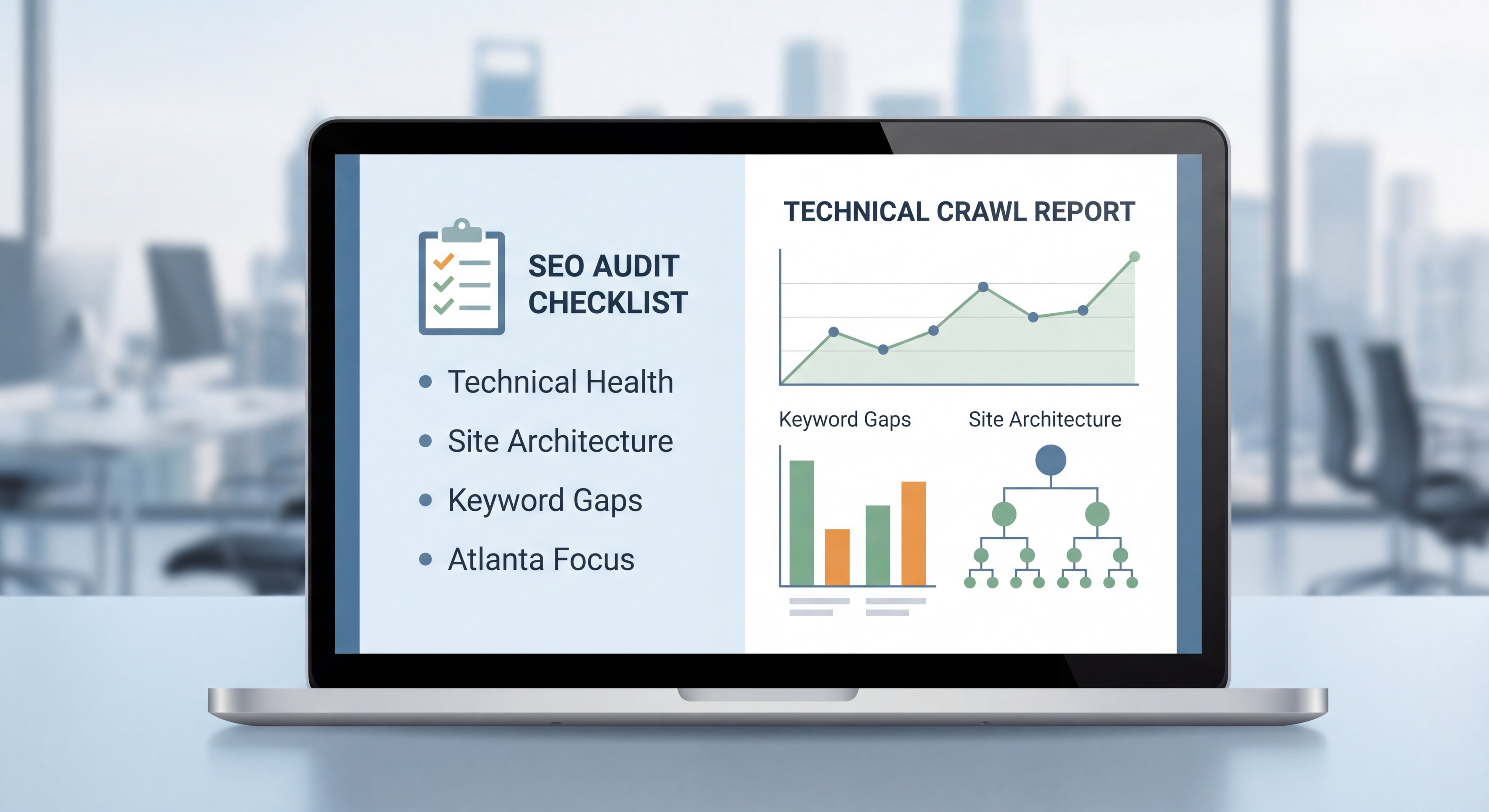
A standard SEO audit checks title tags, meta descriptions, and whether your sitemap is submitted to Google Search Console. That's fine for 2019. In 2026, a real SEO Audit Atlanta goes six layers deeper — and the businesses that run these audits quarterly are the ones consistently outranking competitors who audit annually, if at all.
The DigiMarCon Southeast 2026 conference, held in Atlanta in April 2026, highlighted a critical shift: AI-driven search engines — including Google's AI Mode, ChatGPT, and Gemini — are now pulling from entity-rich, schema-structured, authoritative content. Traditional keyword-stuffed pages are not just underperforming. They're actively being deprioritized.
The 6-Layer Advanced SEO Audit Framework
Layer 1: Technical Crawl & Crawl Budget Analysis Run a full technical crawl using tools like Screaming Frog or Ahrefs Site Audit. You're looking for redirect chains (every redirect adds latency and dilutes link equity), orphaned pages (pages with no internal links pointing to them), duplicate content across URL parameters, and crawl errors that are wasting your crawl budget. For a site with 50+ pages — which includes most Atlanta service businesses with location pages — crawl budget management is not theoretical. It's a real issue.
Layer 2: Local Entity & Schema Audit This is where most Atlanta businesses are leaving the most money on the table. Google's AI search now evaluates entities, not just keywords. Your business needs structured data — LocalBusiness schema, FAQPage schema, Service schema — implemented correctly and validated. A Marietta contractor without proper LocalBusiness schema is invisible to AI search in a way that keyword density never caused.
Layer 3: Keyword Cluster & Semantic Gap Analysis Stop auditing individual keywords. Audit keyword clusters. A Buckhead law firm shouldn't just be targeting "personal injury lawyer Atlanta." They should own the entire semantic cluster: car accident attorney Atlanta, negligence lawyer Buckhead, Georgia personal injury settlement, how long does a personal injury case take in Georgia. Map your existing content against the full cluster. Identify the gaps. Fill them with targeted content.
Layer 4: Competitor SERP Reverse Engineering Pull the top five ranking pages for your primary keyword. Analyze their word count, heading structure, schema implementation, internal linking pattern, and backlink profile. Then do something most Atlanta businesses never do: look at what they're not doing that you could do better. A study from Influencer Marketing Hub's 2025 SEO Benchmark Report found that content depth and topical authority now outweigh raw backlink count in most local search categories.
Layer 5: Google Business Profile Audit This one is critical in 2026 specifically. SEO Guru Atlanta reported in late March 2026 that Google has begun removing call buttons from organic Map Pack listings. If your Buckhead restaurant or Sandy Springs medical practice relies on Map Pack calls as a primary lead source, that change is happening right now. Your GBP audit needs to cover: completeness of all attributes, photo freshness (minimum 10 active photos), review velocity, Q&A section population, and service area accuracy.
Layer 6: AI Crawlability Assessment New in 2026. AI search engines crawl differently than traditional Googlebot. They prioritize clearly structured content, explicit entity declarations, and content that directly answers specific questions. Run your top landing pages through an AI readability check. If the answer to "what does this business do and who do they serve" isn't clear within the first 100 words, your AI search visibility is suffering.
The Atlanta SEO Audit Timeline That Actually Works
| Phase | Timeline | Key Activities |
|---|---|---|
| Baseline Audit | Month 1 | Full technical crawl, GBP audit, competitor analysis |
| Quick Wins | Month 1–2 | Fix crawl errors, implement schema, optimize GBP |
| Content Gap Filling | Month 2–4 | Create cluster content, update underperforming pages |
| Authority Building | Month 3–6 | Local citation cleanup, review velocity program |
| Ongoing Monitoring | Monthly | Track rankings, Core Web Vitals, GBP insights |
"Atlanta businesses with optimized Google Business Profiles receive 42% more direction requests and 35% more website clicks" — Local SEO Impact Data
Content Marketing Atlanta: Beyond Blog Posts Into Topical Authority {#content-marketing-atlanta}
The Atlanta startup ecosystem is producing genuinely creative content marketing approaches. Hypepotamus covered an Atlanta startup turning underused video footage into repurposed marketing content — a strategy that extracts maximum value from existing assets rather than constantly creating from scratch. That's the right instinct. But for most Atlanta businesses, the content problem isn't creativity. It's architecture.
Publishing a blog post every two weeks without a strategic content architecture is the digital equivalent of handing out flyers in a city where nobody walks. The work happens. The results don't.
Topical Authority: The Advanced Content Framework
Google's 2026 ranking signals heavily weight topical authority — the degree to which your website comprehensively covers a subject area. A Virginia-Highland restaurant that has one page about their menu, one "About Us" page, and a contact form has zero topical authority. An HVAC company in Alpharetta with 40 pages covering every aspect of heating, cooling, installation, repair, seasonal maintenance, brand comparisons, and local service areas has enormous topical authority — and the rankings to prove it.
Here's how to build it for Content Marketing Atlanta in 2026:
Step 1: Map the Hub-and-Spoke Architecture Every topic cluster needs a hub page (the comprehensive overview) and spoke pages (the deep dives). For an Atlanta law firm, the hub might be "Personal Injury Law in Atlanta." The spokes cover car accidents, slip and fall, medical malpractice, wrongful death — each targeting a specific long-tail cluster. Every spoke links back to the hub. The hub links to every spoke. Google sees a comprehensive, interconnected knowledge base rather than isolated pages.
Step 2: Repurpose Strategically A 2,000-word blog post contains the raw material for: one LinkedIn article, three short-form social posts, one email newsletter section, one FAQ schema addition, and one short video script. Atlanta businesses that repurpose systematically get 6–8x the distribution from the same content investment. The Atlanta startup featured in Hypepotamus understood this instinctively — the same principle applies to any business with existing content assets.
Step 3: Update Before You Create Before publishing new content, audit what you already have. Updating an existing page that ranks on page two for a competitive keyword is almost always faster and more impactful than creating a new page from scratch. Add current 2026 statistics. Expand thin sections. Add an FAQ schema block. Strengthen internal linking. A Decatur contractor who updated their "roofing services" page with current pricing ranges, before-and-after project photos, and a structured FAQ section moved from position 14 to position 4 in under 60 days — without a single new backlink.
Step 4: Answer Questions Before They're Asked The businesses winning in Atlanta's 2026 search landscape are the ones whose content anticipates buyer questions at every stage of the decision journey. Not just "what is HVAC maintenance" (awareness), but "how much does HVAC maintenance cost in Atlanta" (consideration) and "best HVAC maintenance company in Alpharetta" (decision). Map your content to all three stages. Most Atlanta businesses only have content at the awareness stage — which is the stage furthest from a conversion.
📊 Businesses that publish consistent, architecturally structured content generate 3x more leads than those without a documented strategy – Content Marketing ROI
AI Chatbots: The Real ROI for Atlanta Businesses in 2026 {#ai-chatbots}
Let's be direct about what AI chatbots are and aren't in 2026, because the noise around this topic is genuinely unhelpful.
They are not magic. Bloomberg reported in April 2026 that AI chatbots give misleading medical advice 50% of the time — a finding that underscores why context and implementation matter more than the technology itself. A healthcare practice in Sandy Springs deploying an AI chatbot without proper guardrails isn't just ineffective. It's a liability.
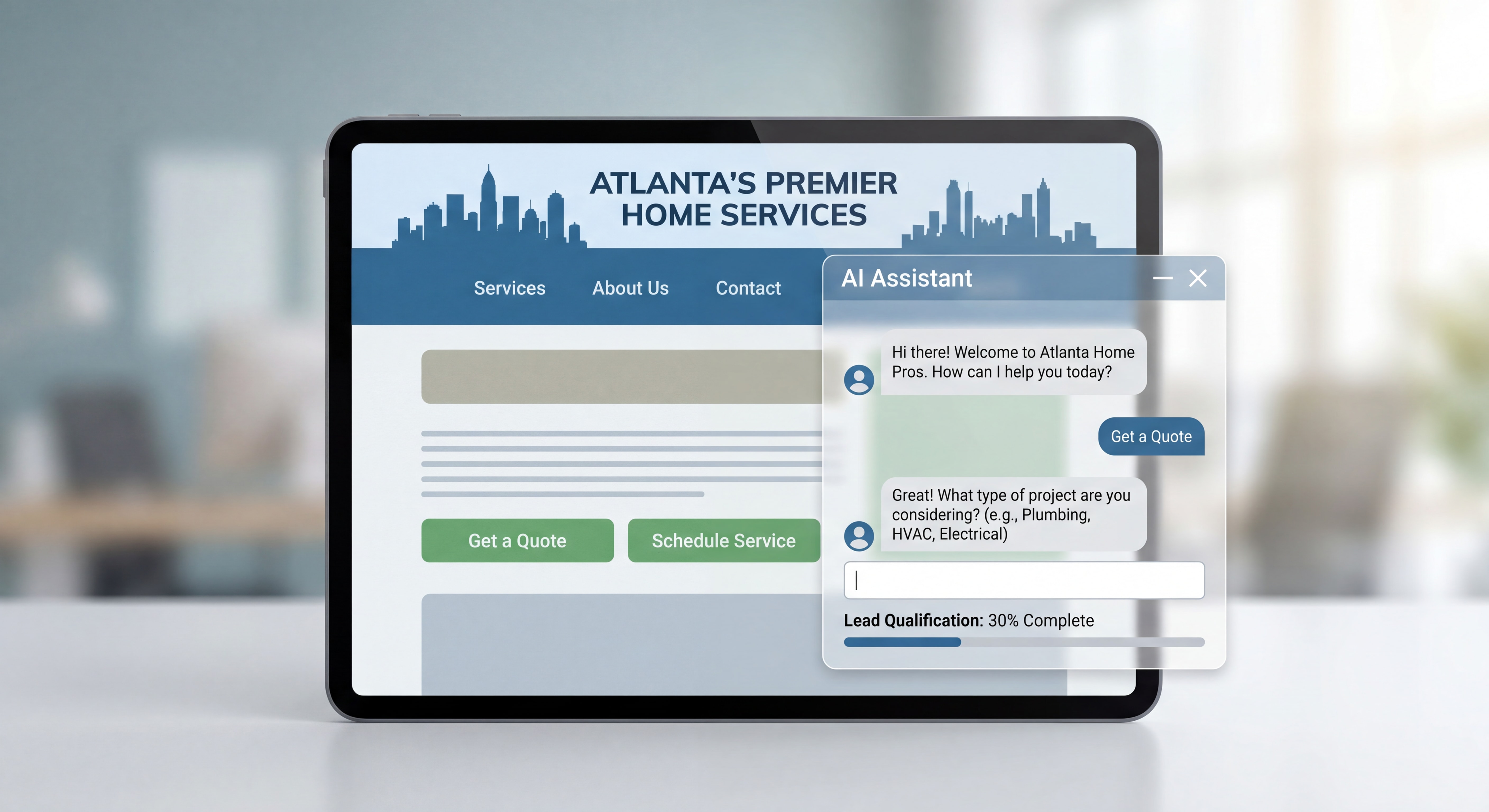
But for the right use cases — lead qualification, after-hours inquiry capture, FAQ deflection, appointment scheduling — the ROI data is compelling and well-documented.
What the Numbers Actually Say
A Buckhead real estate firm that deployed a properly configured AI chatbot saw their website conversion rate jump from 7.5% to 26% — from 15 leads per month to 52 — in a single quarter. Revenue impact: $180,000 in Q1 2026 alone. That's not a marketing claim. That's a documented case study from Atlanta's own market.
Industry-wide data backs it up:
- 57% of companies report significant ROI from AI chatbots within the first year
- ROI ranges from 148% to 200% for properly implemented business chatbots
- 72% faster resolution of customer inquiries compared to traditional contact forms
- 20% increase in customer retention for businesses using AI chatbots versus those relying solely on email forms
The distinction between a chatbot that generates ROI and one that frustrates visitors comes down to three things: specificity, integration, and escalation.
The Atlanta Business Chatbot Implementation Framework
Specificity: A generic chatbot that says "How can I help you today?" and offers five vague menu options is useless. An Atlanta HVAC company's chatbot should open with: "Are you dealing with a heating or cooling issue right now, or looking to schedule routine maintenance?" That one question routes the visitor correctly, captures intent data, and feels like a service — not a barrier.
Integration: Your chatbot needs to connect to your CRM, your calendar, and your phone system. A lead captured at 11 PM on a Tuesday by your chatbot that doesn't hit your CRM until you manually check a separate dashboard on Wednesday morning is a lead that's already called your competitor. Platforms like Tidio, Podium, and custom-built solutions can integrate directly with HubSpot, Salesforce, and Google Calendar. Podium specifically has documented 11x more inbound leads for local businesses using their WebChat-to-SMS transition model — a visitor chats on your site, the conversation continues via text, and your team picks it up in a unified inbox.
Escalation: Define clearly when the bot hands off to a human. The worst chatbot experiences happen when AI tries to handle something it shouldn't — complex complaints, sensitive medical questions, legal inquiries. Build hard escalation triggers. If a visitor uses words like "lawsuit," "emergency," "urgent," or "complaint," the bot should immediately route to a human or schedule a direct callback. This isn't a limitation. It's good design.
Chatbot Cost vs. ROI: The Atlanta Business Reality Check
| Business Type | Monthly Chatbot Cost | Avg. Monthly Lead Increase | Estimated Monthly Revenue Impact |
|---|---|---|---|
| Local Service (HVAC, Plumbing) | $50–$200 | 15–30 additional leads | $3,000–$12,000 |
| Law Firm | $200–$800 | 8–20 additional consultations | $8,000–$40,000 |
| Medical Practice | $200–$500 | 20–50 appointment bookings | $4,000–$15,000 |
| Restaurant/Hospitality | $50–$150 | 25–60 reservation inquiries | $2,500–$8,000 |
| Ecommerce | $100–$400 | 30–80 cart recovery conversations | $3,000–$20,000 |
The math is rarely complicated. The implementation usually is. That's why most Atlanta businesses that "tried a chatbot and it didn't work" didn't actually implement one — they installed one.
📊 57% of companies report significant ROI from AI chatbots within the first year, with documented ROI ranging from 148% to 200% – AI Chatbot ROI
Integrating It All: The Unified Digital Strategy {#unified-strategy}
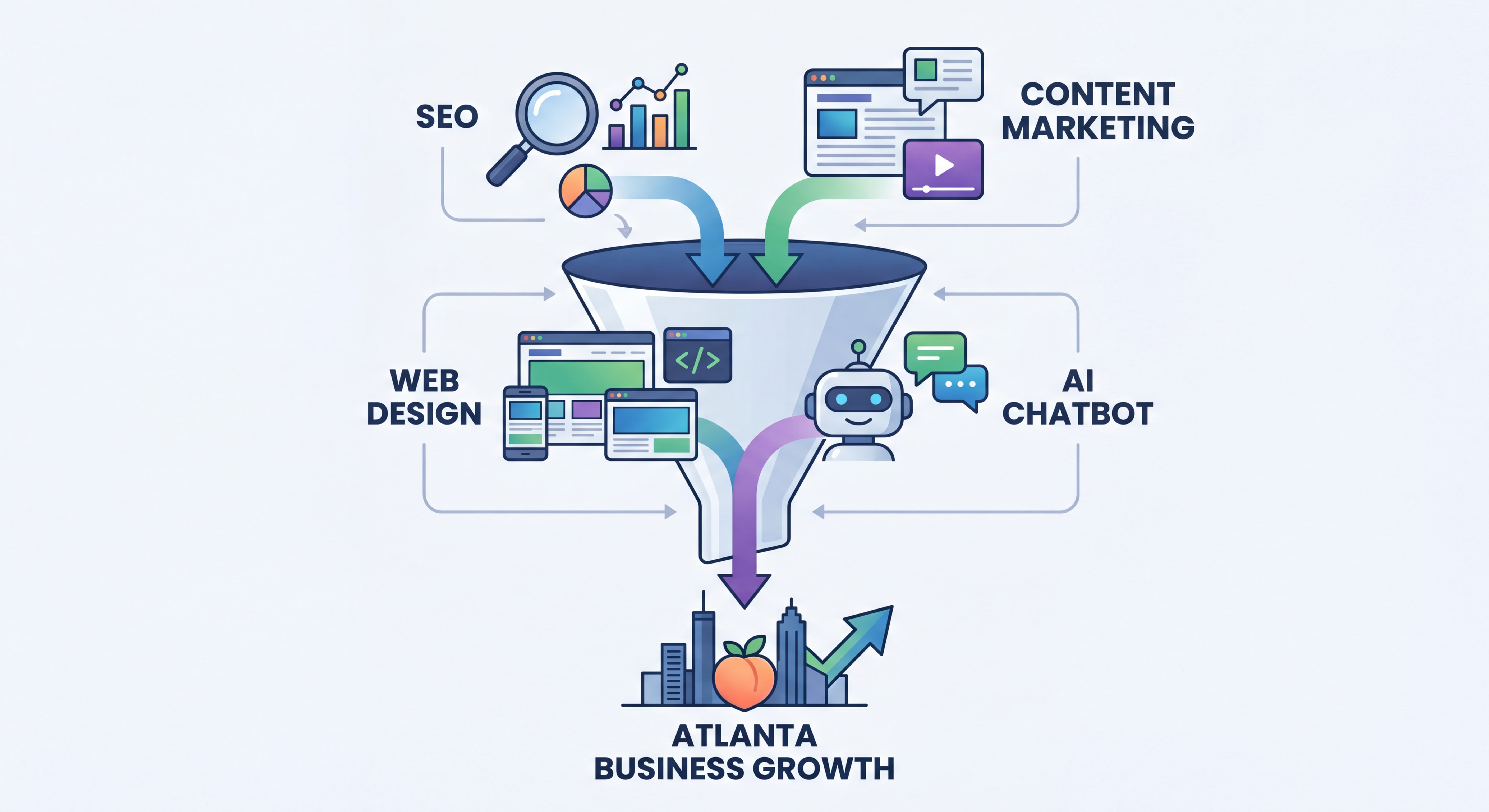
The businesses that dominate Atlanta search in 2026 are not the ones with the best website, or the best SEO, or the best chatbot. They're the ones where all of it works together.
Your Web Design Atlanta foundation determines how fast and how well your SEO efforts take hold. A technically sound website with excellent Core Web Vitals gives your content a platform worth ranking. Your SEO Audit Atlanta process identifies exactly which gaps to fill and which pages to fix first, preventing wasted effort. Your Content Marketing Atlanta strategy builds the topical authority that turns rankings into sustained traffic. And your AI chatbot converts that traffic into leads — including the ones who arrive at 2 AM on a Sunday, when your team is unavailable and your competitor's contact form is just sitting there, doing nothing.
Here's the integration sequence that works:
Fix the technical foundation first. No content strategy survives a website with 4-second load times and failing Core Web Vitals. Fix the foundation before building on top of it.
Run the full 6-layer SEO audit. Know exactly where you stand before you spend another dollar on content or ads.
Build the content architecture. Hub-and-spoke. Every page connected. Every question answered. Every stage of the buyer journey covered.
Deploy the chatbot with intent. Specific triggers. CRM integration. Clear escalation paths. Not a widget — a system.
Measure what matters. Not vanity metrics. Not impressions. Qualified leads, cost per acquisition, conversion rate by traffic source, and revenue attributed to organic search. Those are the numbers that tell you whether your strategy is working.
Atlanta's digital marketing landscape shifted significantly in 2026. Strive Enterprise opened their Atlanta office citing accelerated growth in the metro's digital marketing sector. YEAH! Local was recognized as a top Atlanta AI digital marketing agency. The market is more competitive than ever — and the gap between businesses with a real integrated strategy and those without one is widening every quarter.
The question isn't whether you need advanced web design, SEO services, content marketing, and AI chatbot capabilities. You do. The question is whether you're executing them as isolated tactics or as a connected system.
One generates activity. The other generates revenue.
Chiffres Clés
📊 10% — Pages ranking at position #1 are 10% more likely to pass Core Web Vitals thresholds than pages at position #9, making technical performance a direct competitive advantage in Atlanta's crowded search landscape. (Source: almcorp.com Technical SEO Guide 2026)
💡 26% conversion rate — An Atlanta Buckhead real estate firm jumped from 7.5% to 26% website conversion rate after deploying a properly configured AI chatbot, generating $180K in additional Q1 2026 revenue. (Source: BizAI Atlanta Case Study 2026)
📈 42% more direction requests — Businesses with fully optimized Google Business Profiles receive 42% more direction requests and 35% more website clicks than those with incomplete profiles. (Source: Local SEO Impact Data 2026)
🤖 91% of small businesses that adopted AI marketing tools in 2026 reported a measurable increase in revenue — with the average AI marketing stack costing between $50 and $200 per month. (Source: bearmybrand.com 2026 Data)
Questions Fréquentes (FAQ)
How much does a proper SEO audit cost for an Atlanta business in 2026?
A legitimate, comprehensive SEO audit for an Atlanta small-to-mid-size business typically runs between $500 and $3,000, depending on the size of your site and the depth of analysis. Be skeptical of any agency offering a "free audit" that consists of an automated report with no human interpretation — those are lead generation tools, not audits. A real SEO audit covers technical crawl analysis, local entity and schema review, keyword cluster gap analysis, competitor SERP reverse engineering, Google Business Profile evaluation, and an AI crawlability assessment. The deliverable should be a prioritized action plan, not a list of problems without solutions. Agencies in Atlanta that do this well will typically walk you through the findings in a live call and explain the revenue impact of each recommendation.
What's the difference between Web Design Atlanta and conversion-focused web design?
Standard web design builds a website that looks good and functions correctly. Conversion-focused web design builds a website that is engineered to turn visitors into leads. The difference shows up in specifics: where CTAs are placed and how they're written, how trust signals are positioned relative to decision points, how forms are structured to minimize friction, how the mobile experience is optimized for thumb-based navigation, and how page speed is treated as a revenue metric rather than a technical checkbox. In 2026, Google's Core Web Vitals 2.0 evaluates the full user session — not just page load — which means conversion-focused design and SEO-optimized design are now the same thing. A Marietta contractor whose website loads in under 2 seconds, displays clear service areas, shows real project photos, and has a one-click call button on mobile will outperform a competitor with a beautiful but slow, unclear website every single time.
How do Atlanta businesses know if their AI chatbot is actually working?
Track four metrics: lead capture rate (what percentage of chatbot conversations result in a contact form completion, phone number capture, or appointment booking), deflection rate (what percentage of FAQ-type questions the bot resolves without human intervention), response time (how quickly the bot engages a new visitor — anything over 10 seconds is too slow), and escalation accuracy (what percentage of escalations to human agents are genuinely complex versus something the bot should have handled). If your chatbot has a 2% lead capture rate, it's not working. A well-configured chatbot for an Atlanta service business should be capturing between 15% and 30% of engaged visitors as qualified leads. If you're not tracking these metrics, you don't actually know whether your chatbot is an asset or a liability.
How often should Atlanta businesses update their content marketing strategy?
The content architecture — your hub-and-spoke structure, your keyword cluster map, your topic authority plan — should be reviewed quarterly. Individual pieces of content should be audited on a rolling 6-month cycle. Any page that ranks between positions 8 and 20 for a target keyword should be prioritized for an update before new content is created. In Atlanta's competitive market, where industries like legal, home services, healthcare, and real estate are all fighting for the same top-three positions, the businesses that consistently update and strengthen existing content outperform those that chase volume. One well-executed content update that moves a page from position 12 to position 3 generates more traffic than five new blog posts that rank nowhere.
Is an AI chatbot appropriate for every Atlanta business type?
No. And that's an important distinction. AI chatbots deliver the strongest ROI for businesses with high inquiry volume, predictable FAQ patterns, and clear lead qualification criteria — HVAC companies, law firms, dental practices, real estate agencies, restaurants taking reservations, and ecommerce brands. They're less effective for highly specialized B2B businesses where every inquiry is genuinely unique, or for industries with strict regulatory requirements around automated communication (certain financial services, for example). The worst chatbot deployments happen when a business installs a generic widget without configuring it for their specific industry, service area, and customer intent signals. The best deployments feel less like a bot and more like a knowledgeable front-desk team member who's available around the clock — and who routes complex questions to the right human immediately.
Ready to put this strategy to work for your Atlanta business? Get a free SEO audit from Infinite Marketing — no fluff, just a data-driven look at exactly where your website stands and what it would take to move the needle. Explore our Atlanta SEO services and web design solutions built specifically for the Atlanta market.
