
You opened a business in Atlanta. You’ve got a product or service that works. Customers who find you love you. But your phone isn’t ringing the way it should, your website looks like it was built in 2014, and you have no idea where to start with any of this “digital marketing” stuff.
You’re not alone. Most small business owners in Buckhead, Decatur, Marietta, and across the Atlanta metro are in exactly the same position — overwhelmed by options, burned by vague promises, and unsure which fundamentals to tackle first.
This guide cuts through all of it. No jargon. No fluff. Just a clear, honest breakdown of the four building blocks every Atlanta business needs to compete online in 2026:
Web Design Atlanta,
SEO Services Atlanta,
Content Marketing Atlanta, and AI chatbots. We’ll cover what each one actually is, why it matters for your specific market, and how to get started without wasting money.
Let’s go.
Table of Contents
Why Atlanta’s Digital Landscape Is Different
Atlanta is not Phoenix. It’s not Chicago. It’s not some generic mid-size metro where a cookie-cutter digital strategy will do the job.
The Atlanta market is hyper-competitive, hyper-local, and hyper-diverse. You’ve got Fortune 500 companies headquartered in Midtown competing for the same Google real estate as a family-owned HVAC company in Alpharetta. A Buckhead law firm is fighting for local search visibility against 200 other attorneys. A restaurant in Virginia-Highland has to stand out on Google Maps against thousands of dining options within five miles.
The Atlanta metro added over 70,000 new businesses between 2023 and 2025. That’s not a stat to celebrate — that’s competition. Every one of those businesses is a potential rival for the same search clicks, the same social feeds, and the same customer attention you’re trying to capture.
That’s why getting the fundamentals right matters more here than almost anywhere else in the Southeast. And it starts with your website.
Building Block 1: Web Design Atlanta
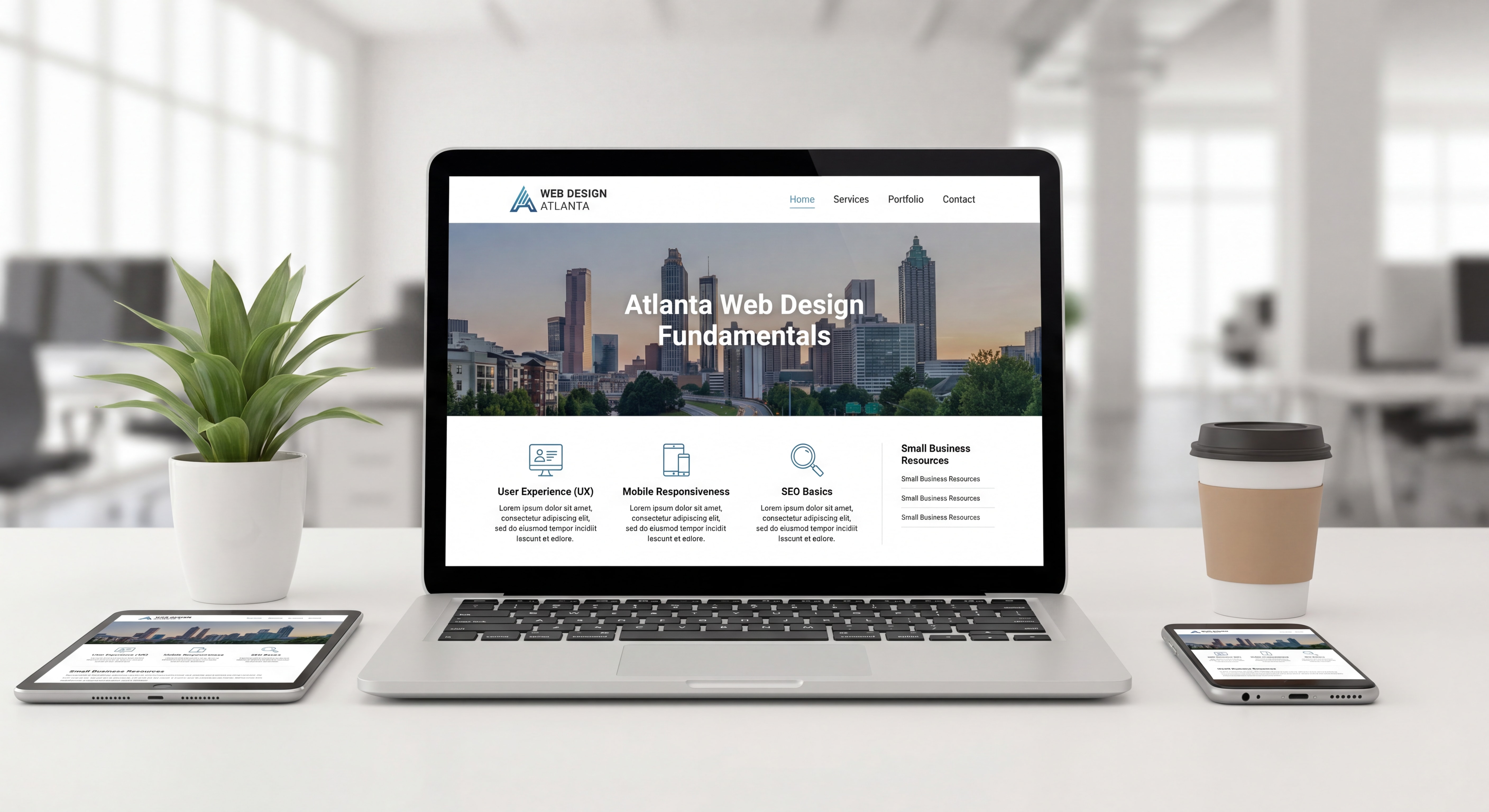
What “Good Web Design” Actually Means for a Small Business
Most people think web design is about making a site look pretty. That’s about 20% of the job. The other 80% is about making your website
work — meaning it loads fast, shows up correctly on a phone, tells visitors exactly what you do and where you do it, and moves them toward calling you, booking an appointment, or buying something.
A website that looks beautiful but doesn’t convert is an expensive brochure nobody reads.
Here’s what good web design actually requires at the foundational level:
Speed. Google’s data is unambiguous: 53% of mobile users leave a page that takes more than 3 seconds to load. In Atlanta, where over 70% of local searches happen on mobile devices, a slow website is a lead-killing machine. Your site should load in under 2.5 seconds. Period.
Mobile-first layout. Your site needs to be built for the phone screen first, desktop second. Not the other way around. If your current site pinches and zooms on a smartphone, you’re losing customers every single day.
Clear messaging above the fold. The first thing a visitor sees — before they scroll — should answer three questions instantly: Who are you? What do you do? Why should I care? If your homepage opens with a generic stock photo and a tagline like “Excellence in Service,” you’ve already lost them.
Local signals baked in. A Decatur plumber’s website should say “Decatur” and “Atlanta” prominently — in the headline, in the body copy, in the footer, in the page titles. Not because Google needs to be tricked, but because your customers need to know they’ve found someone local who actually serves their area.
The “Digital Blueprint” Shift Happening Right Now in Atlanta
Atlanta-based tech firms are already flagging a major shift in how corporate and small business websites are being built. The concept of a website as a “digital blueprint” — a core business asset that drives strategy, not just a digital business card — is gaining serious traction in the Atlanta market. The Scale Tech, an Atlanta firm, identified this shift in early 2026, noting that companies treating their web presence as a strategic asset are outperforming competitors who treat it as a one-time expense.
For a small business owner, this means one thing: your website is infrastructure, not decoration. Treat it accordingly.
What to Do First: A 5-Point Web Design Checklist for Beginners
- Run a mobile test. Go to Google’s free Mobile-Friendly Test tool and enter your URL. If it fails, that’s your first priority.
- Check your load speed. Use Google PageSpeed Insights. Anything under 70 on mobile needs work.
- Read your homepage out loud. If you can’t explain what your business does in two sentences from your own homepage, a stranger definitely can’t.
- Count your calls to action. Every page should have at least one clear next step — call, book, buy, contact. If there’s no CTA, there’s no conversion path.
- Verify your NAP. Name, Address, Phone number — consistent across every page of your site, matching exactly what’s on your Google Business Profile.
Building Block 2: SEO Services Atlanta — Starting With an Audit
What Is SEO and Why Does It Matter Right Now
Search Engine Optimization is how you get found on Google when someone in Atlanta types in what you offer. That’s it. No mystery. No black box.
When a homeowner in Sandy Springs searches “emergency plumber near me” at 11pm, Google serves them a list of results. The businesses at the top of that list get the calls. The businesses on page two get nothing. SEO is the process of making sure your business shows up at the top — or at least on the first page — for the searches your customers are actually doing.
Here’s why this matters more in 2026 than it ever has before: a recent study on local SEO demand found that Atlanta ranks among the top U.S. cities for “SEO near me” search volume. Atlanta business owners are actively searching for help — which means your competitors are actively investing in SEO right now. If you’re not, you’re falling behind in real time.
What Is an SEO Audit and Why It’s Your Starting Point
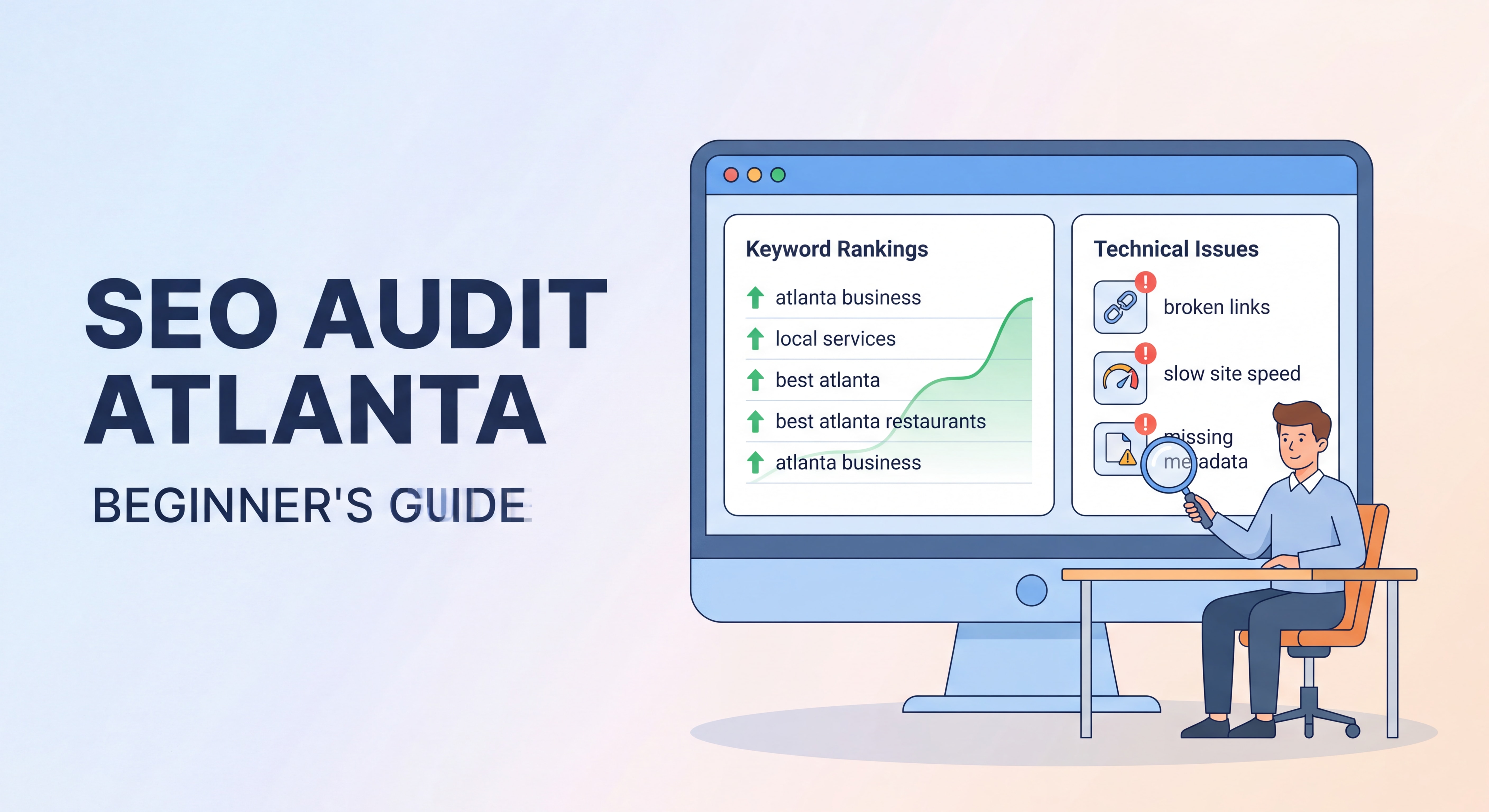
Before you can fix anything, you need to know what’s broken. That’s what an
SEO Audit Atlanta delivers.
An SEO audit is a systematic review of your website that identifies every factor holding you back in search rankings. Think of it like a health checkup for your digital presence. A doctor doesn’t prescribe medication before running tests. You shouldn’t invest in SEO before running an audit.
Here’s what a real SEO audit covers:
| Audit Category |
What Gets Checked |
Why It Matters |
| Technical SEO |
Site speed, crawlability, broken links, mobile issues |
Google can’t rank pages it can’t properly read |
| On-Page SEO |
Title tags, meta descriptions, header structure, keyword usage |
Tells Google what each page is about |
| Local SEO |
Google Business Profile, NAP consistency, local citations |
Critical for “near me” and Atlanta-specific searches |
| Content Quality |
Thin pages, duplicate content, keyword gaps |
Google rewards depth and penalizes thin content |
| Backlink Profile |
Who links to you, spam links, authority signals |
Links = trust signals in Google’s eyes |
| Competitor Gap |
Keywords competitors rank for that you don’t |
Reveals your fastest growth opportunities |
The 5 SEO Fundamentals Every Atlanta Beginner Needs to Nail
1. Claim and optimize your Google Business Profile. This is free. It takes 30 minutes. And it’s the single highest-impact thing you can do for local visibility in Atlanta. Your GBP is what shows up in the map pack — the three listings that appear at the top of local searches. If yours is incomplete, unclaimed, or has the wrong hours, you’re invisible.
2. Fix your title tags. Every page on your site has a title tag — the blue text that shows up in Google search results. Most small business websites have either generic titles (“Home | My Business”) or no titles at all. Every title tag should include your primary keyword and your city. “HVAC Repair in Marietta, GA | [Your Business Name]” is infinitely better than “Home.”
3. Create one page per service. Don’t cram everything onto one page. A roofing company should have separate pages for roof repair, roof replacement, gutter installation, and commercial roofing — each targeting a specific keyword. One topic per page. Every time.
4. Get your NAP consistent everywhere. Your business name, address, and phone number need to be identical across your website, Google Business Profile, Yelp, Facebook, and every other directory you’re listed in. Inconsistencies confuse Google and hurt your local rankings.
5. Start earning local backlinks. Get listed in the Atlanta Business Chronicle directory. Join your local Chamber of Commerce and get their link. Sponsor a local event and get mentioned on their website. These Atlanta-specific links tell Google you’re a real, local business — and they move the needle.
📊
Atlanta ranks among top U.S. cities for “SEO near me” search volume – Atlanta Local SEO Demand
Building Block 3: Content Marketing Atlanta

What Content Marketing Actually Is (And What It Isn’t)
Content marketing is not blogging for the sake of blogging. It’s not posting on Instagram three times a week and hoping something sticks. It’s not churning out articles that nobody reads.
Content marketing is the practice of creating useful, specific, search-optimized content that answers the questions your customers are already asking — and positioning your business as the most credible answer in the room.
Done right, content marketing is the most cost-efficient lead generation tool available to a small Atlanta business. Done wrong, it’s a time sink that produces zero results.
Why Content Marketing Works Differently in Atlanta
Atlanta’s market has a characteristic that most national content strategies miss entirely: it’s a city of neighborhoods, each with its own commercial culture and buyer behavior.
A Buckhead resident searching for a financial advisor has different expectations than someone in East Atlanta Village. A restaurant owner in Old Fourth Ward cares about different things than a contractor in Kennesaw. Content that speaks to the specific context of your target customer’s neighborhood, industry, and situation will always outperform generic content that could have been written for any city in America.
One Atlanta startup that understood this principle early is worth noting: a content company profiled by Hypepotamus in 2025 built an entire business model around repurposing underused video content into targeted marketing assets — recognizing that Atlanta’s business community was sitting on a goldmine of unused content that could be activated with the right strategy.
The lesson for beginners: you probably have more content raw material than you think. Customer questions, service explanations, before-and-after stories, neighborhood-specific guides — all of it is content waiting to be created.
A Beginner’s Content Marketing Framework for Atlanta Businesses
Step 1: Build your “Atlanta answer pages.”
These are pages that answer the specific questions your Atlanta customers type into Google. Not “how does HVAC work” — but “how much does AC repair cost in Marietta” or “best time to replace a roof in Atlanta.” Hyper-local. Hyper-specific. These pages rank faster and convert better than generic service pages.
Step 2: Create a Google Business Profile posting schedule.
Post to your GBP at least twice a week. Share offers, updates, photos of completed work, and short tips relevant to your industry. This is free, takes 10 minutes per post, and directly impacts your visibility in Atlanta’s local map pack.
Step 3: Repurpose everything.
One piece of content should live in multiple places. A blog post becomes a social media caption, a GBP post, an email newsletter section, and a short video script. You don’t need more content — you need to use what you create more efficiently.
Step 4: Track what’s working.
Use Google Search Console (free) to see which search queries are bringing people to your site. Double down on the topics that are already driving traffic. Cut the ones that aren’t.
“DigiMarCon Southeast 2026 returned to Atlanta, signaling the city’s growing importance as a digital marketing hub in the Southeast”
— FinancialContent(https://infinitemarketing.co) and let’s map it out together.