

 Your website is either working for you right now — or it’s costing you money every single day. For Atlanta business owners in Buckhead, Midtown, Old Fourth Ward, and across the metro, the gap between a site that converts and one that just exists is wider than most people realize. And in 2026, that gap is getting harder to ignore.
This isn’t a general overview. This is a practical, step-by-step guide to the four pillars that determine whether your digital presence generates real leads or quietly bleeds your budget: web design in Atlanta, a proper SEO audit, a focused content marketing strategy, and deploying an AI chatbot that actually does something useful. Each section gives you something you can act on today — not someday.
Let’s get into it.
Your website is either working for you right now — or it’s costing you money every single day. For Atlanta business owners in Buckhead, Midtown, Old Fourth Ward, and across the metro, the gap between a site that converts and one that just exists is wider than most people realize. And in 2026, that gap is getting harder to ignore.
This isn’t a general overview. This is a practical, step-by-step guide to the four pillars that determine whether your digital presence generates real leads or quietly bleeds your budget: web design in Atlanta, a proper SEO audit, a focused content marketing strategy, and deploying an AI chatbot that actually does something useful. Each section gives you something you can act on today — not someday.
Let’s get into it.
Table of Contents
- Step 1: Fix Your Web Design Before You Spend Another Dollar on Marketing
- Step 2: Run a Real SEO Audit — Not a Vanity Report
- Step 3: Build a Content Marketing Strategy That Earns Trust in Atlanta
- Step 4: Deploy an AI Chatbot That Converts, Not Just Chats
- How These Four Pillars Work Together
- Chiffres Clés
- FAQ
Step 1: Fix Your Web Design Before You Spend Another Dollar on Marketing
Here’s a truth most agencies won’t say out loud: running ads to a broken website is like pouring water into a bucket full of holes. The water isn’t the problem. The bucket is. Atlanta’s The Scale Tech recently identified what they’re calling the “Digital Blueprint” shift — the idea that a company’s website is no longer just a brochure, but a core strategic asset that drives every other marketing channel. They’re right. And if your site was built three years ago and hasn’t been touched since, it’s already behind.The 5-Point Web Design Audit Every Atlanta Business Needs to Do First
1. Mobile speed — check it right now. Pull up your site on your phone. Does it load in under 3 seconds? If it doesn’t, you’re losing visitors before they ever read a word. Google’s Core Web Vitals score directly affects your search rankings, and Atlanta consumers — whether they’re in Alpharetta searching for a contractor or in Virginia-Highland looking for a restaurant — are on their phones. A slow site is a closed door. 2. Is your primary call-to-action visible without scrolling? This is the one that kills conversions silently. Your phone number, your “Book Now” button, your contact form — if a visitor has to hunt for it, most of them won’t. Place your CTA in the top navigation, in the hero section, and at the bottom of every service page. Three times minimum. Not aggressive. Just present. 3. Does your homepage answer three questions in 5 seconds? What do you do. Who do you serve. Why should I trust you. If your homepage can’t answer all three in the first screen a visitor sees, you’ve already lost the conversation. An Atlanta HVAC company that says “Serving Atlanta Homeowners Since 2009 — Licensed, Insured, 4.9 Stars on Google” answers all three immediately. “Welcome to our website” answers none of them. 4. Is your site architecture built for SEO or just aesthetics? A beautiful site that Google can’t crawl is a liability. Every service you offer should have its own dedicated page with a unique URL, a focused keyword, and internal links connecting it to the rest of your site. If your plumbing company has one page that lists every service in a bullet list, you’re invisible for every specific search that matters. 5. Are you using schema markup? Most small Atlanta businesses have never heard of it. Schema markup is code you add to your site that tells Google exactly what your business does, where you’re located, what your hours are, and what your reviews say. It’s one of the highest-leverage technical improvements you can make — and it takes less than an hour to implement on most sites.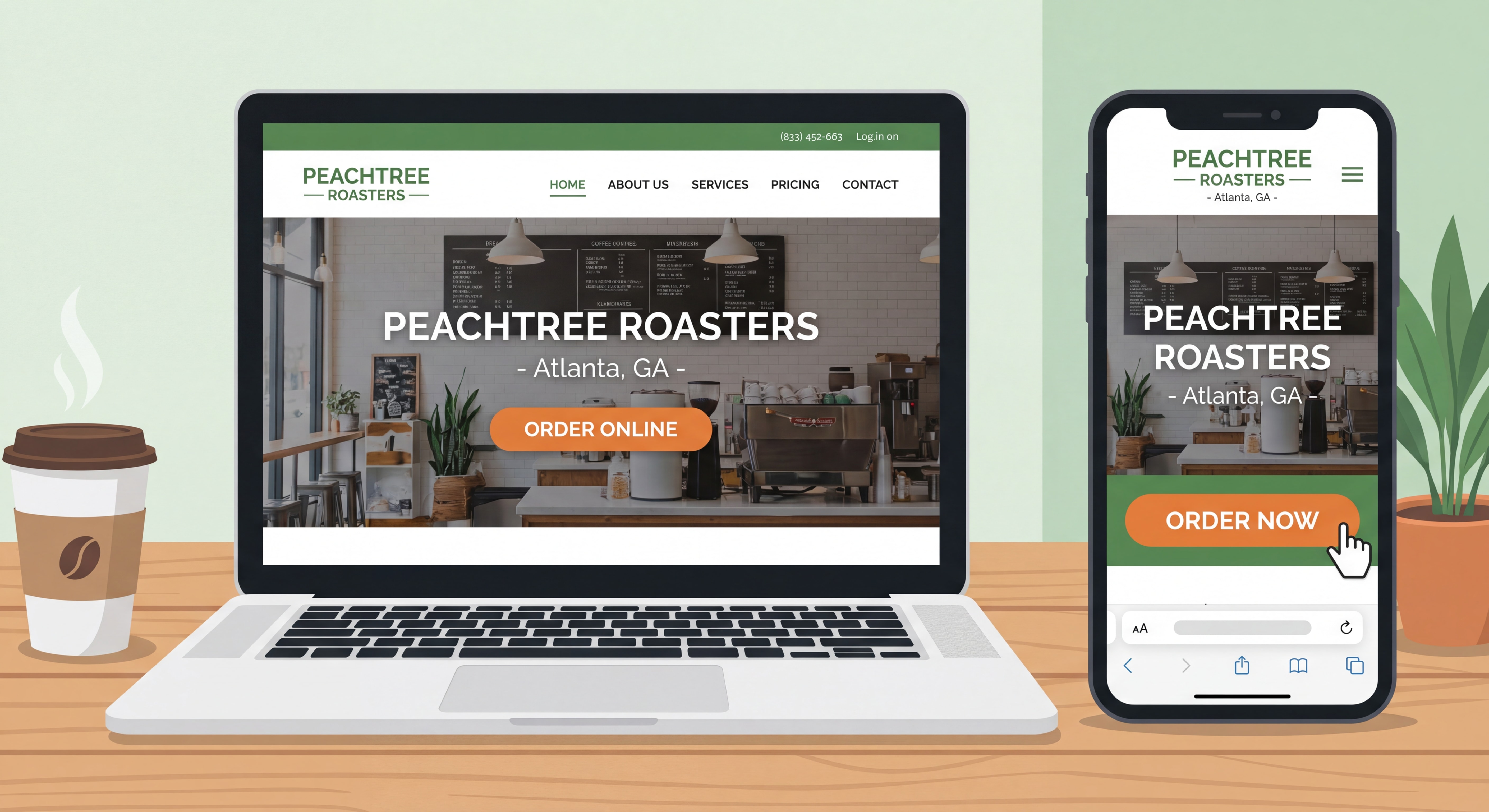
What Good Web Design in Atlanta Actually Looks Like in 2026
The best-performing local business websites in Atlanta share four characteristics. They load fast. They have a clear, singular focus on each page. They show proof — reviews, certifications, results — above the fold. And they make the next step obvious. That’s it. It’s not about animations. It’s not about the latest design trend. It’s about removing every possible reason for a visitor to leave without contacting you.Step 2: Run a Real SEO Audit — Not a Vanity Report
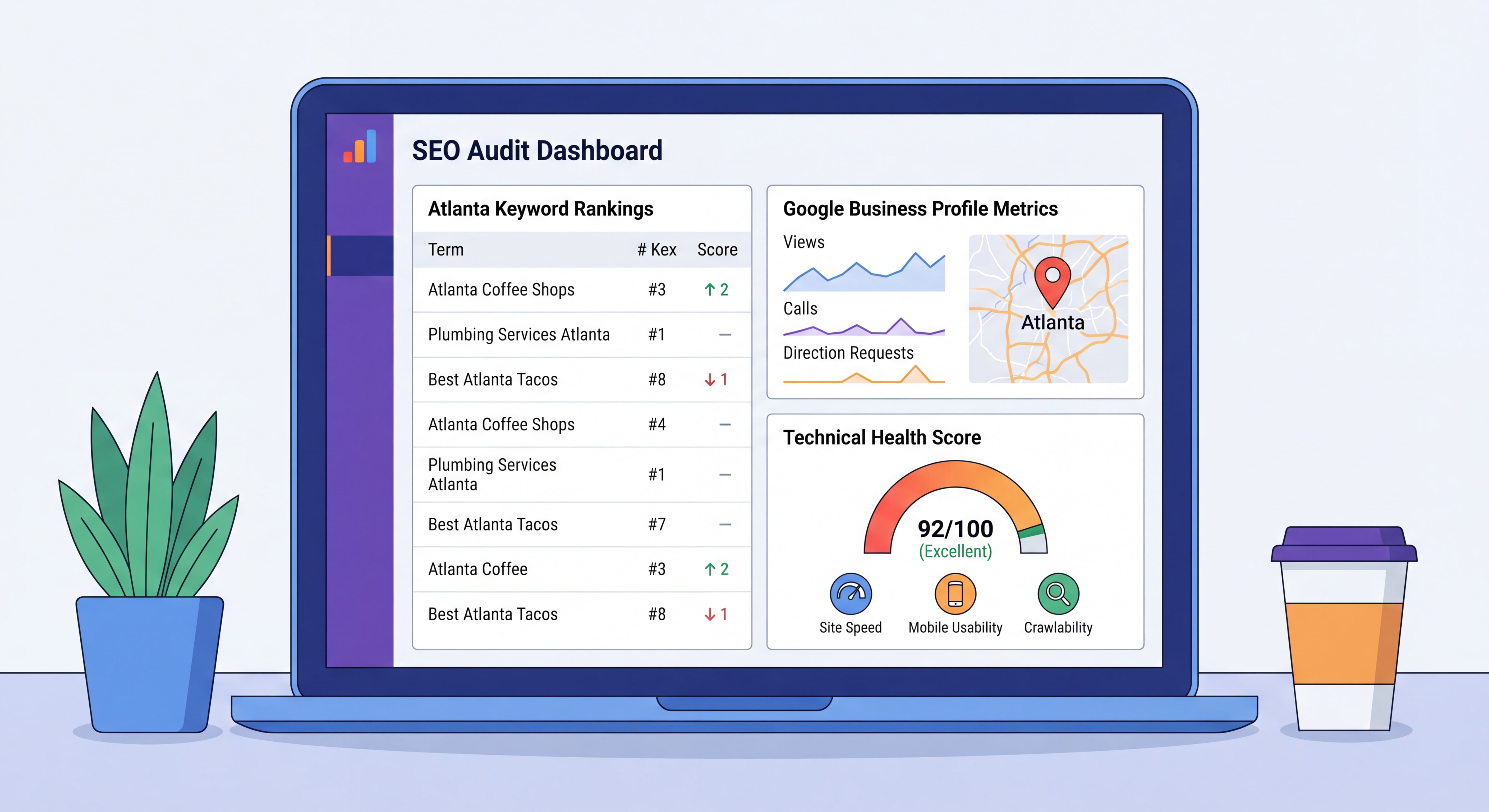
An SEO audit that tells you your site has “good domain authority” and “strong backlink diversity” without telling you why your phone isn’t ringing is not an audit. It’s theater. A real SEO audit in Atlanta answers one question: what is specifically preventing this business from ranking for the searches its customers are actually making? Here’s how to run one yourself — or know what to demand from an agency.The 7-Part SEO Audit Checklist for Atlanta Businesses
Part 1: Keyword Gap Analysis Open Google and search for the top 5 services you offer with “Atlanta” appended. Write down who ranks on page one. Those are your direct competitors. Now look at their pages — what are they covering that you’re not? That gap is your opportunity. Part 2: Google Business Profile Audit Your GBP listing is often the first thing a local customer sees. Check every field: business category (be as specific as possible), services listed (add every single one), photos (add real photos of your team, your work, your location — not stock images), and Q&A section (answer common questions before customers ask them). A Sandy Springs law firm that has 47 photos and 200 reviews will outrank a competitor with 3 photos and 12 reviews almost every time. Part 3: On-Page SEO Check For each of your key service pages, verify:- The primary keyword appears in the H1 heading
- The meta title and meta description are written (not auto-generated)
- The first paragraph contains the primary keyword naturally
- Images have descriptive alt text — not “IMG_4892”
- The page has internal links to at least 2 other pages on your site
 Part 6: Content Gap Review
Are you publishing content that answers the questions your customers are asking? A Decatur dentist whose site has no blog, no FAQ page, and no educational content is invisible for every informational search that precedes a booking decision. A competitor who has published “How Much Does Invisalign Cost in Atlanta?” will capture that traffic — and that patient — every time.
Part 7: Competitor Backlink Analysis
Where are your top competitors getting links from? Local Atlanta business journals, neighborhood association websites, Chamber of Commerce listings, industry directories. Every link they have that you don’t is a gap. Start closing it.
📊 Atlanta ranks among the top U.S. cities for “SEO near me” search demand – Local SEO demand
Part 6: Content Gap Review
Are you publishing content that answers the questions your customers are asking? A Decatur dentist whose site has no blog, no FAQ page, and no educational content is invisible for every informational search that precedes a booking decision. A competitor who has published “How Much Does Invisalign Cost in Atlanta?” will capture that traffic — and that patient — every time.
Part 7: Competitor Backlink Analysis
Where are your top competitors getting links from? Local Atlanta business journals, neighborhood association websites, Chamber of Commerce listings, industry directories. Every link they have that you don’t is a gap. Start closing it.
📊 Atlanta ranks among the top U.S. cities for “SEO near me” search demand – Local SEO demand
Step 3: Build a Content Marketing Strategy That Earns Trust in Atlanta
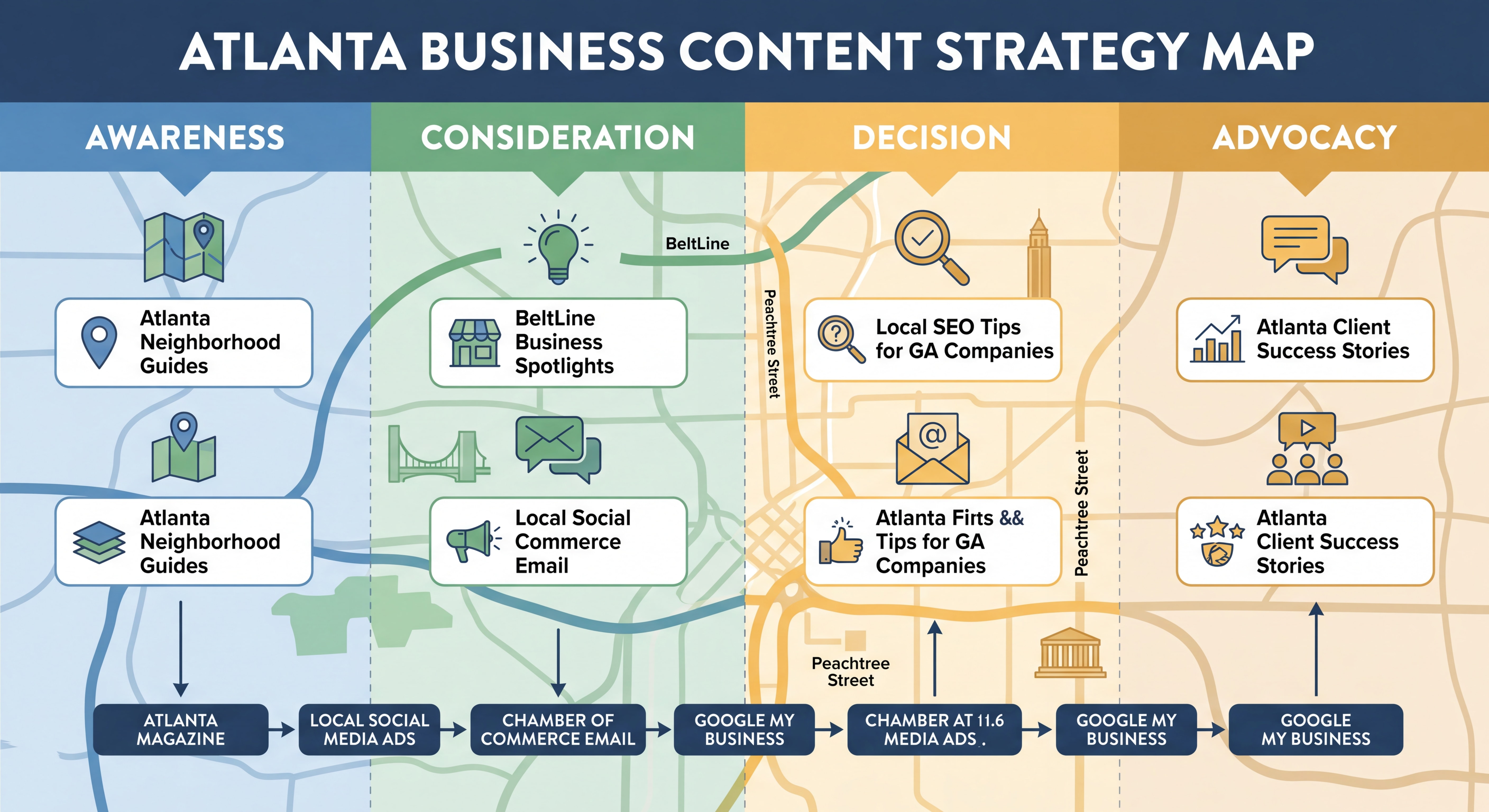
Content marketing done right doesn’t feel like marketing. It feels like getting useful information from someone who actually knows what they’re talking about. That’s the goal. DigiMarCon Southeast 2026 is returning to Atlanta this year, and the central theme running through the entire conference is the same thing smart local businesses are figuring out on their own: content is no longer optional infrastructure — it’s the primary trust-building mechanism between a business and its next customer. Here’s how to build a content strategy that actually works for an Atlanta business in 2026.The 4-Step Content Marketing Framework for Atlanta Businesses
Step 1: Map your content to the buyer journey — not the calendar. Most small businesses make the same mistake. They post when they feel like it, about whatever feels relevant that week. That’s not a strategy. That’s noise. Map your content to three stages:- Awareness: What questions are people asking before they know they need you? (Example: “Why is my HVAC bill so high in summer?” for an Atlanta HVAC company)
- Consideration: What are they comparing when they’re evaluating options? (“HVAC repair vs. replacement cost in Atlanta”)
- Decision: What do they need to see to choose you? (“Best HVAC company in Marietta — reviews and results”)
- A LinkedIn article
- Three social media posts
- A short-form video script
- An email newsletter section
- A FAQ entry on your website
 📊 Businesses that publish consistent educational content generate 3x more leads than those that don’t – Content marketing ROI
Step 4: Deploy an AI Chatbot That Converts, Not Just Chats
The AI conversation is loud right now. And a lot of it is noise. But for Atlanta small businesses, there’s a practical, low-cost, high-impact application hiding underneath all the hype: an AI chatbot on your website that captures leads at 11pm on a Tuesday when you’re not there to answer the phone. That’s it. That’s the use case that matters most for local businesses in 2026.How to Set Up an AI Chatbot That Actually Generates Leads
Step 1: Define the one job your chatbot needs to do. Don’t try to build a bot that answers every possible question. Build a bot that does one thing exceptionally well. For most Atlanta service businesses, that one thing is: capture contact information from visitors who are ready to book or inquire, and deliver that information to you immediately. A Buckhead law firm that deployed a simple intake chatbot — one that asks three qualifying questions and collects name, email, and case type — reported capturing leads from website visitors who would have otherwise bounced at 10pm without filling out a contact form. Step 2: Write the chatbot script like a human, not a robot. The single biggest reason chatbots fail is that they sound like chatbots. Write conversational, direct copy. “Hey — looking for a quote? I can get you connected in about 2 minutes. What kind of project are you working on?” performs dramatically better than “Hello. How may I assist you today?” Step 3: Connect it to your CRM or email immediately. A lead that sits in a chatbot dashboard you check once a week is a dead lead. Connect your chatbot to whatever system you use — even if that’s just a Gmail inbox — so you get notified the moment someone submits their information. Speed of response is one of the most significant factors in lead conversion. Responding within 5 minutes vs. 5 hours isn’t a marginal difference. It’s the difference between winning and losing the job. Step 4: Use it for FAQ deflection, not just lead capture. Train your chatbot to answer the 10 most common questions your team gets every week. What are your hours? Do you serve my area? How much does X cost? What’s your process? Every question your chatbot answers is a question your team doesn’t have to field — and a visitor who got their answer without having to call is more likely to book. Step 5: Review the transcripts weekly. Your chatbot conversations are a goldmine of market research. What questions are people asking that you haven’t answered on your website? What objections are coming up repeatedly? What services are people asking about that you don’t currently offer? Read the transcripts. Update your site accordingly.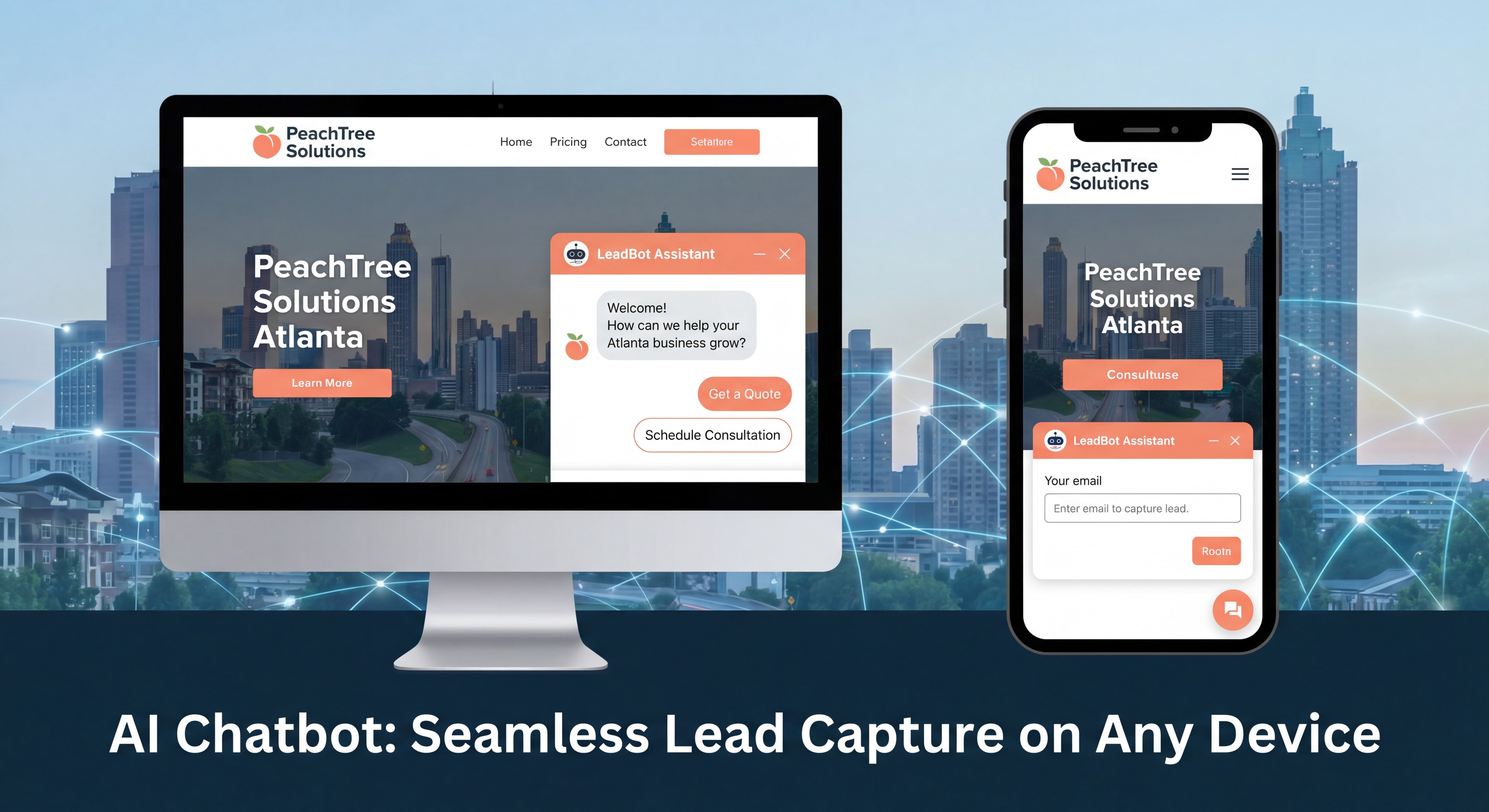 📊 Businesses using AI chatbots capture up to 67% more leads outside business hours compared to contact forms alone – AI chatbot lead capture
How These Four Pillars Work Together
Here’s what most Atlanta business owners miss: these aren’t four separate strategies. They’re one system. Your web design is the foundation — it determines whether any of the other three investments pay off. Your SEO audit tells you exactly what’s broken and what to fix first. Your content marketing builds the trust that turns strangers into warm prospects. And your AI chatbot captures those prospects at every hour of the day, not just when you’re available to answer the phone.| Pillar | Primary Goal | Timeline to Results | Difficulty |
|---|---|---|---|
| Web Design | Convert traffic into leads | Immediate after launch | Medium |
| SEO Audit | Identify ranking opportunities | 30–90 days | Low |
| Content Marketing | Build trust and organic traffic | 3–6 months | Medium |
| AI Chatbot | Capture leads 24/7 | Immediate after setup | Low |
“Atlanta ranks among the top U.S. cities for local SEO demand, with businesses increasingly searching for specialized digital marketing partners who understand the metro market” — cuindependent.com
Key Statistics
📊 53% of mobile users abandon a website that takes longer than 3 seconds to load — and most Atlanta small business sites still fail this test (Source: Google, 2026) 💡 3x more leads are generated by businesses that publish consistent, educational content compared to those that don’t (Source: Content Marketing Institute, 2026) 📈 67% more leads are captured outside business hours by companies using AI chatbots versus contact-form-only websites (Source: Drift/Salesforce Research, 2026) 🔍 Atlanta ranks among the top U.S. cities for “SEO near me” search demand — meaning your competitors are already investing in local SEO, and the window to outpace them is narrowing (Source: cuindependent.com, December 2025)Frequently Asked Questions
How much does web design in Atlanta typically cost for a small business?
For a professional, conversion-focused website built for a small to mid-size Atlanta business, expect to invest between $3,000 and $12,000 depending on the number of pages, functionality required, and whether e-commerce or booking integrations are needed. Cheaper options exist — but a $500 template site that loads slowly, isn’t optimized for local SEO, and has no clear conversion path will cost you far more in lost leads than it saves upfront. The right question isn’t “how cheap can I build a website?” It’s “how much revenue do I lose every month with a website that doesn’t convert?”What does an SEO audit in Atlanta actually include — and how long does it take?
A real SEO audit covers technical health (crawl errors, site speed, indexing), on-page optimization (keywords, meta data, content structure), local SEO (Google Business Profile, citations, reviews), and competitive analysis (what your top Atlanta competitors are doing that you’re not). A thorough audit for a small business typically takes 3–5 business days and should deliver a prioritized action list — not just a report full of scores. If an agency delivers an audit that doesn’t tell you exactly what to fix first and why, it’s not a real audit.How long does content marketing take to produce results for an Atlanta business?
Organic content marketing is a 3–6 month investment before you see meaningful traffic growth — and that’s assuming you’re publishing consistently and targeting the right local keywords. The businesses that get frustrated and quit at month two are the ones who never see the results that month four would have delivered. That said, some content — particularly FAQ pages, location-specific service pages, and Google Business Profile posts — can produce results in weeks. Start with those. Build the long-term content engine in parallel.Can an AI chatbot actually replace a real receptionist for my Atlanta business?
No — and any tool that claims otherwise is overselling. An AI chatbot handles the top of the funnel: capturing information from visitors, answering common questions, and routing serious inquiries to your team. It doesn’t replace the human judgment required to close a sale, handle a complex customer situation, or build the kind of relationship that generates referrals. Think of it as a 24/7 intake coordinator, not a replacement for your people. Used correctly, it makes your human team more productive by filtering out low-quality inquiries and delivering warm, pre-qualified leads directly to whoever handles your bookings.What’s the single highest-ROI digital marketing move for a small Atlanta business in 2026?
Fixing your Google Business Profile and building out location-specific service pages on your website. It’s not glamorous. It doesn’t require a big budget. But a fully optimized GBP listing with real photos, complete service listings, active Q&A, and a consistent stream of reviews will outperform most paid advertising campaigns for local search visibility — especially for businesses in competitive Atlanta submarkets like Marietta, Sandy Springs, and Alpharetta where “near me” searches are high-volume and high-intent.Get more Atlanta leads with a free SEO audit — no fluff, just data. The team at Infinite Marketing works exclusively with Atlanta-area businesses and knows exactly what it takes to rank, convert, and grow in this market. Book your free strategy call today and walk away with a clear plan — whether you hire us or not.
