

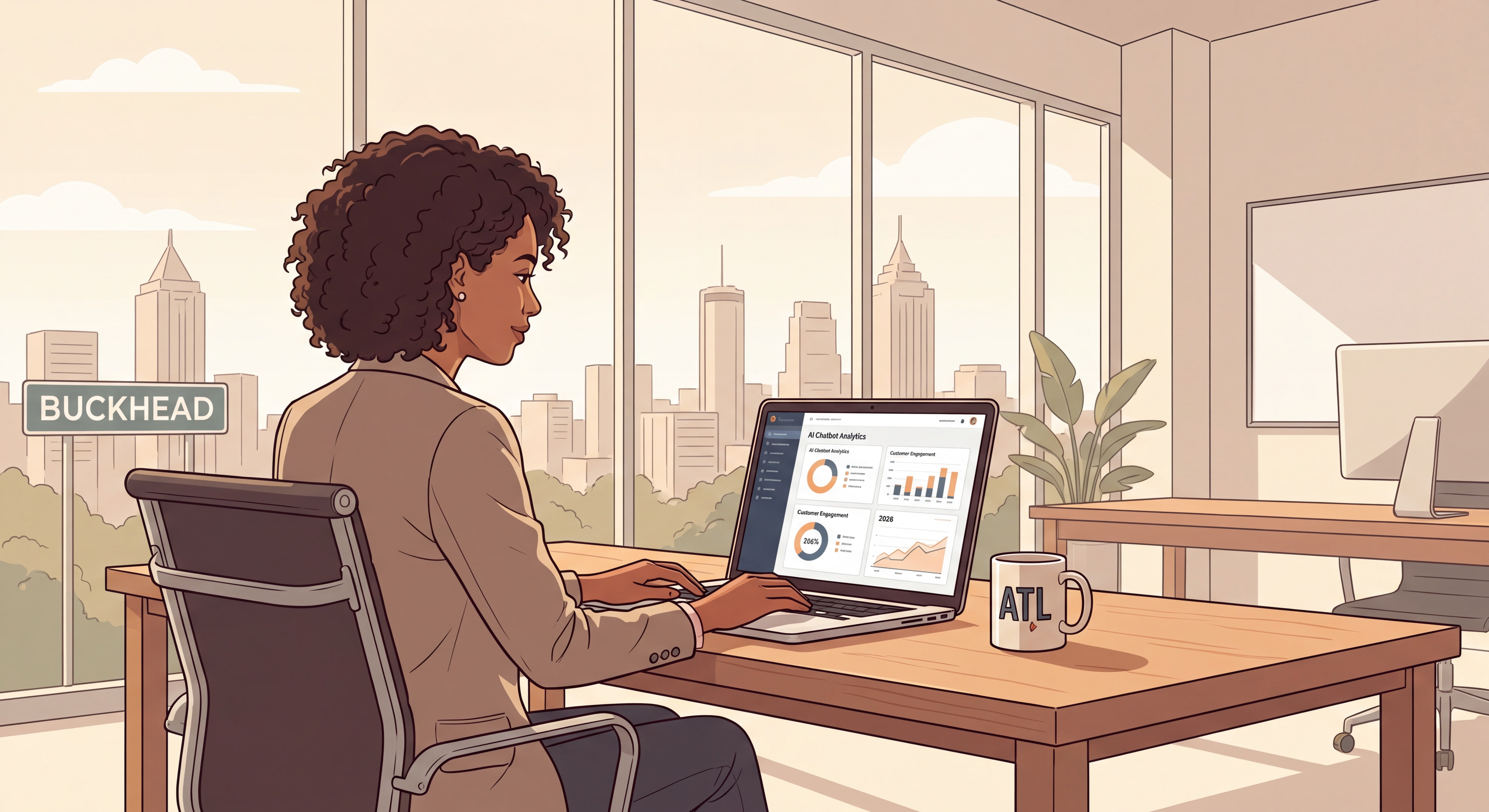
It's a Tuesday afternoon in Midtown Atlanta. A prospect lands on your HVAC website at 9:47 PM — after hours, after your team has gone home. They have one question: "Can someone come out tomorrow?" No one answers. They hit the back button and call your competitor. You never even knew they were there.
That scenario plays out hundreds of times a week across Atlanta's small business landscape — in law offices on Peachtree Street, dental practices in Buckhead, and e-commerce shops running on Shopify and WordPress. And right now, in 2026, the AI chatbot landscape is shifting so fast that what worked six months ago is already outdated. New platforms, new warnings, new integrations, and some genuinely game-changing announcements are reshaping what a small business chatbot can actually do for you.
This article breaks down the latest developments — the ones that matter for Atlanta business owners who want real results, not tech hype.
Table of Contents
- The Big News: What Just Changed in AI Chatbots
- The Forbes Warning Atlanta Businesses Can't Ignore
- Shopify Goes Agentic: A Seismic Shift for E-Commerce
- WordPress Chatbots in 2026: New Plugins, New Power
- Voice Chatbots Are No Longer a Gimmick
- What Does This Cost? Real Numbers for Real Businesses
- Before vs. After: A Realistic Atlanta Scenario
- Related Services
- FAQ
- Key Statistics
- Final CTA
The Big News: What Just Changed in AI Chatbots
The AI chatbot space in 2026 is not the same industry it was even at the start of the year. Three major developments are reshaping how Atlanta small businesses should think about deploying conversational AI on their websites.
First, Apple's CarPlay now supports multiple AI chatbot apps directly from iPhone — announced in April 2026. That means your customers are literally talking to AI assistants while driving to work through Decatur or Alpharetta, asking questions and making purchasing decisions before they ever reach a computer. If your business isn't reachable through conversational AI, you're invisible during some of the most intent-heavy moments of the day.
Second, Shopify launched its Agentic Storefronts in March 2026, making products from Shopify stores buyable directly inside ChatGPT, Microsoft Copilot, Google AI Mode, and Perplexity. AI-driven orders on the platform increased 15-fold in 2025 alone. This isn't a future trend — it's happening right now, and Atlanta retailers running Shopify stores who haven't explored this are already behind.
Third, the backlash against bad chatbot implementations is louder than ever — and it's a direct opportunity for smart small businesses to differentiate. We'll get to that in a moment.
"AI-driven orders on Shopify increased 15-fold in 2025" — Shopify Blog
The Forbes Warning Atlanta Businesses Can't Ignore
A Forbes piece published on April 20, 2026 dropped a headline that should make every Atlanta business owner pay attention: "Customers Hate Your AI Chatbot. Small Businesses Should Listen."
The article, written by small business AI strategist TerDawn DeBoe, makes a counterintuitive argument — and it's one worth understanding carefully.
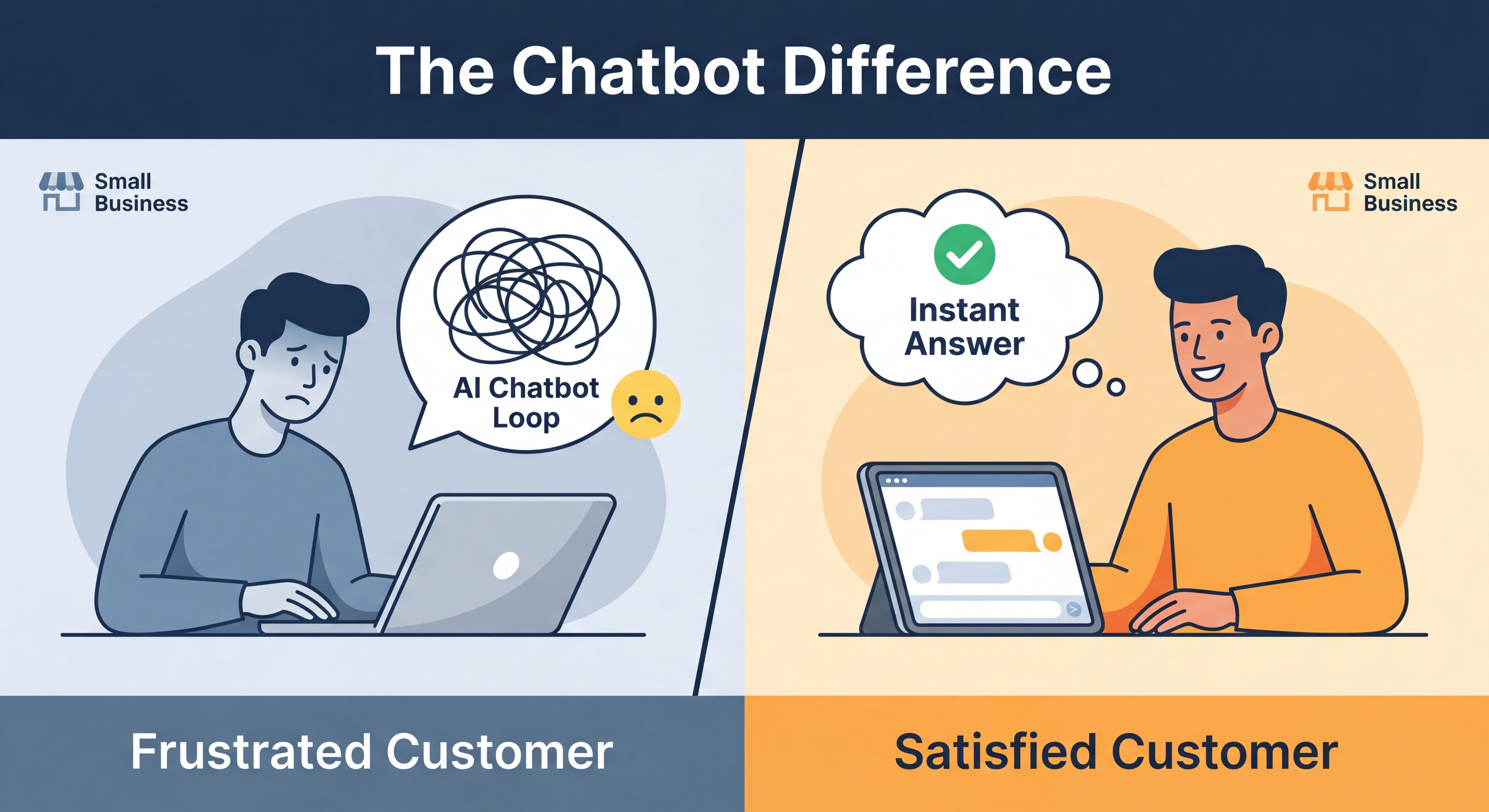
The core insight: nearly one in five consumers who've used AI for customer service saw zero benefit from the experience. That's a failure rate four times higher than AI use in general, according to Qualtrics research. Customers get trapped in loops. Their questions go unanswered. Frustration builds. And by the time a human finally picks up, the damage is already done.
But here's the part most people miss. DeBoe argues this is actually a massive opportunity for small businesses.
Large corporations are training consumers to accept low-quality automated customer service. Once these customers contact a small business and connect with a live person who listens and resolves their issue, that contrast creates the foundation for a trusted, loyal relationship.
So what does this mean for your Atlanta business? It means the goal isn't to replace human interaction with a chatbot — it's to use ai chatbots strategically. Deploy them to handle the 70% of repetitive, routine questions (hours, pricing, availability, directions) so your team can focus on the 30% that actually requires human judgment and relationship-building.
A well-configured small business chatbot doesn't compete with your team. It protects your team's time for the conversations that actually close deals.
"Customers Hate Your AI Chatbot. Small Businesses Should Listen" — Forbes
Shopify Goes Agentic: A Seismic Shift for E-Commerce
If you're running a Shopify store in Atlanta — whether you're selling handmade goods in Little Five Points or running a product-based service business — the March 2026 Shopify announcements are the biggest platform news in years.
Shopify's Agentic Storefronts now allow your products to appear and be purchased directly inside AI conversations. A customer chatting with ChatGPT (880 million monthly users) can browse your inventory, compare products, and check out — all without leaving the AI interface. No per-listing fees. No commission on these sales. Default-on for eligible stores.
Shopify also co-developed the Universal Commerce Protocol (UCP) with Google, an open standard for AI-driven transactions. Brands like Keen Footwear and Pura Vida are already generating revenue through Microsoft's Copilot Checkout.
Fast Company reported in March 2026 that "Shopify has gone all in on the agentic commerce gold rush" — and for good reason. The platform's Sidekick AI assistant can now build custom apps from natural language prompts, generate Flow automations, and proactively alert merchants to inventory issues before they become problems.
For Atlanta shopify chatbots users, the practical takeaway is this: your chatbot strategy in 2026 needs to account for off-site AI conversations, not just the widget on your homepage. The customer journey increasingly starts inside an AI assistant — not a Google search.
| Shopify AI Feature | What It Does | Available Since |
|---|---|---|
| Agentic Storefronts | Products buyable inside ChatGPT, Copilot, Google AI | March 2026 |
| Universal Commerce Protocol | Open standard for AI-driven checkout | March 2026 |
| Sidekick App Builder | Build apps via natural language prompts | Winter 2026 |
| Sidekick Pulse | Proactive inventory and sales alerts | Winter 2026 |
| ChatGPT Checkout | Sell through ChatGPT (4% merchant fee) | January 2026 |
📊 15x increase in 2025 – Shopify AI-driven orders
WordPress Chatbots in 2026: New Plugins, New Power
Most Atlanta small businesses run their websites on WordPress — and the wordpress chatbots ecosystem has expanded dramatically this year. Hostinger published a comparison of the top 10 WordPress AI plugins in March 2026, and the options available today look nothing like what existed two years ago.
Here's a practical breakdown of what's currently available for WordPress sites:
| Plugin / Tool | Best For | Pricing | Key Feature |
|---|---|---|---|
| Tidio (Lyro AI) | SMBs wanting live chat + AI hybrid | From $24.17/mo | Handles 70% of FAQs automatically |
| Chatbase | Multi-channel AI chatbot | $40–$500/mo | Trains on your own URLs and PDFs |
| WPBot | Budget-conscious WordPress owners | Free / $59–$99/yr | Native WordPress, no external dependencies |
| MxChat | WordPress-native with RAG technology | Varies | Retrieves answers directly from your knowledge base |
| Voiceflow | No-code custom conversation design | Free tier available | 10–15 min setup, works with any hosting |
The most important development in wordpress chatbots right now is the shift toward RAG (Retrieval-Augmented Generation) technology. Instead of a bot making up answers or pulling from generic training data, RAG-powered chatbots retrieve information directly from your specific knowledge base — your service pages, FAQs, pricing documents. For an Atlanta law firm or dental practice, this means the chatbot gives accurate, specific answers rather than generic AI responses that erode trust.
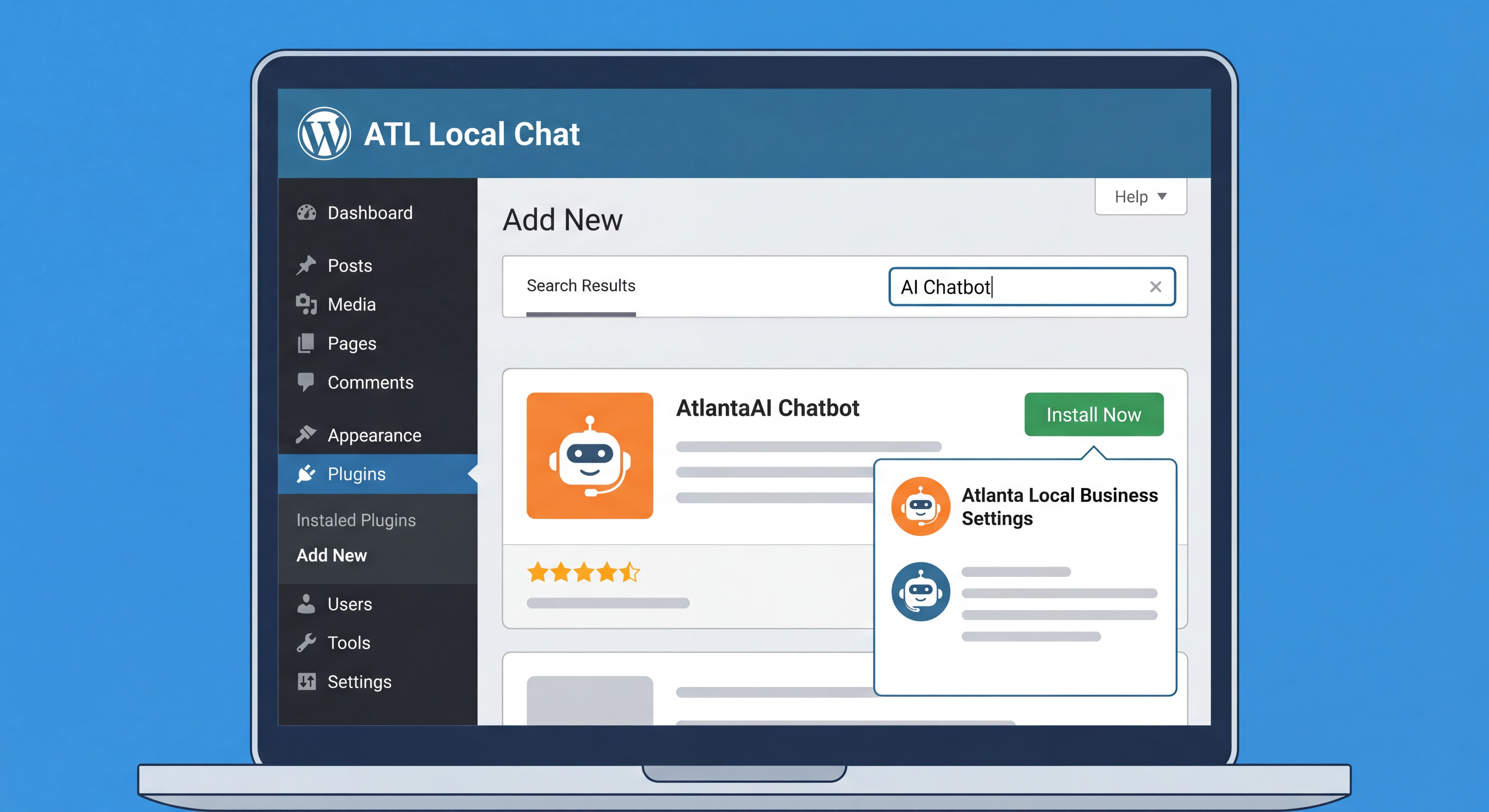
Setup is simpler than most business owners expect. A basic WordPress chatbot can be live in under 20 minutes using plugins like Voiceflow's embed widget or WPBot's native installer — no developer required.
Voice Chatbots Are No Longer a Gimmick
Reuters declared at the end of 2025 that "chatbots have found their voice as audio assistants rise" — and 2026 is proving that prediction correct.
Voice AI has matured rapidly. Voice chatbots now handle inbound phone calls with sub-500ms response times, natural interrupt detection, and emotion recognition. Platforms like Vapi, ElevenLabs, and RingCentral AIR let businesses deploy AI phone agents that answer calls, qualify leads, and book appointments — sounding nearly indistinguishable from a human receptionist.
The numbers are striking: the cost of an AI voice call runs as low as $0.20 per call, compared to $7–$12 for a human agent. RingCentral's AI Receptionist now serves over 8,300 businesses, growing 44% quarter-over-quarter.
For an Atlanta HVAC company fielding calls from Roswell to East Atlanta Village, or a personal injury law firm getting inquiries at midnight, a voice chatbot that qualifies leads and books appointments 24/7 is a genuine competitive edge.
That said, a word of caution: StatNews published a piece in April 2026 warning that voice-first chatbots carry unique risks, particularly around emotional dependency and mental health implications. For most business applications — scheduling, FAQs, lead qualification — these concerns don't apply. But it's a reminder that deployment context matters. Use voice AI where it adds practical value, not just because it's new.
📊 As low as $0.20 per call vs. $7–$12 for human agents – Voice AI phone call cost
What Does This Cost? Real Numbers for Real Businesses
Let's cut through the vague pricing you'll find on most agency websites. Here's what Atlanta small businesses are actually paying in 2026:
| Tier | Monthly Cost | Best For | What You Get |
|---|---|---|---|
| Starter / Free | $0–$30/mo | Solo operators, testing | Basic FAQ automation, limited conversations |
| Small Business | $30–$100/mo | Service businesses, retailers | Lead capture, CRM integration, 1,000–5,000 conversations |
| Growth | $100–$300/mo | Multi-location, e-commerce | Advanced AI, analytics, voice integration, WooCommerce/Shopify |
| Custom / Agency-Built | $500–$2,000+/mo | High-volume, complex workflows | Fully custom flows, dedicated support, deep integrations |
According to DocMind, which analyzed pricing data across 25,000+ businesses, customer service chatbots deliver an average ROI of 1,275% when properly configured. A realistic scenario: a small Atlanta law firm spending $75/month on a chatbot that handles initial client intake, FAQ responses, and appointment scheduling is saving 10–15 hours of staff time per week. At $25/hour in admin labor, that's $1,000–$1,500 in monthly savings from a $75 investment.
The key phrase is properly configured. That Forbes article we referenced earlier? The failures it describes almost always come from businesses that deployed a generic out-of-the-box chatbot and walked away. The ROI comes from chatbots trained on your specific business, your services, your pricing, and your FAQs.
Before vs. After: A Realistic Atlanta Scenario
The Business: A mid-sized dental practice in Buckhead with a WordPress website, running 200–300 website visitors per month.
Before a chatbot:
- 40% of after-hours inquiries go unanswered
- Front desk spends 2–3 hours/day answering repetitive questions (hours, insurance, pricing)
- New patient conversion rate: approximately 12%
- Average response time to web inquiries: 4–6 hours
After deploying a properly configured small business chatbot:
- 24/7 instant responses to FAQs (insurance accepted, appointment availability, location)
- Appointment booking integrated directly into the chat widget
- Front desk time on repetitive calls drops by 60%
- New patient conversion rate climbs to 18–22%
- Average response time: under 30 seconds
The math is straightforward. At an average new patient value of $800–$1,200, converting just two additional patients per month from web traffic pays for six months of chatbot subscription at the growth tier.
Related Services
Looking to get more from your Atlanta business's digital presence? These services work hand-in-hand with a smart AI chatbot strategy:
- AI Chatbot Setup & Configuration for Atlanta Businesses — Custom-built chatbots trained on your services, pricing, and FAQs
- WordPress Website Design & Optimization — Conversion-focused sites built for Atlanta service businesses
- Shopify Store Development & AI Integration — E-commerce builds with agentic commerce capabilities
- Local SEO for Atlanta Small Businesses — Get found by customers in Buckhead, Midtown, Decatur, and beyond
- Read Also: How Atlanta Businesses Are Using AI to Double Their Lead Response Rate
Frequently Asked Questions
Do AI chatbots actually work for small businesses, or is this just hype?
They work — but only when configured correctly. Generic, out-of-the-box chatbots that aren't trained on your specific business often frustrate customers and damage trust. A properly set-up small business chatbot trained on your services, FAQs, and pricing can handle 60–70% of routine inquiries automatically, freeing your team for high-value interactions. The key is specificity: the more your chatbot knows about your business, the better it performs.
What's the difference between a regular chatbot and the new "agentic" AI systems?
A traditional chatbot responds to questions — it's reactive. An agentic AI system acts on behalf of the customer, autonomously comparing options, checking availability, and completing transactions. Shopify's new Agentic Storefronts are a real-world example: AI agents can browse your product catalog, compare items, and complete a purchase inside ChatGPT without the customer ever visiting your website. For most Atlanta small businesses right now, a well-configured conversational chatbot on your website is the right starting point before exploring agentic commerce.
How do I add a chatbot to my WordPress website?
It's simpler than most people expect. Plugins like WPBot, Tidio, or Voiceflow's embed widget can be installed and configured in 15–30 minutes with no coding required. For best results, train your chatbot on your service pages, FAQ content, and pricing information. If you want a chatbot that integrates with your CRM, booking system, or WooCommerce store, plan for a slightly longer setup or work with a local Atlanta developer who specializes in AI integrations.
Are voice chatbots ready for small businesses in 2026?
Yes, for the right use cases. Voice AI has matured significantly — platforms like Vapi and ElevenLabs now offer natural-sounding phone agents at costs as low as $0.20 per call. For Atlanta businesses that receive high volumes of inbound calls (HVAC companies, dental offices, law firms), a voice chatbot handling after-hours calls and basic lead qualification is a cost-effective solution. For businesses where the phone relationship is central to the brand experience, use voice AI to assist your team rather than replace the first point of human contact.
How do I avoid the chatbot mistakes Forbes warned about?
Three rules: First, don't deploy a chatbot designed to deflect customers — deploy one designed to help them. Second, always provide a clear, easy path to a real human when needed. Third, train your chatbot specifically on your business rather than relying on generic AI responses. The Forbes backlash is almost entirely about chatbots that prioritize cost-cutting over customer experience. A chatbot that genuinely solves problems builds trust; one that traps customers in loops destroys it.
Key Statistics
📊 Average 1,275% return on investment – AI chatbot ROI for small businesses
📊 1 in 5 consumers who've used AI for customer service saw zero benefit — a failure rate 4x higher than AI use in general (Qualtrics, 2026)
💡 15x increase in AI-driven orders on Shopify in 2025, with agentic commerce expanding rapidly into ChatGPT and Microsoft Copilot (Shopify Blog, 2026)
📞 $0.20 per call — the cost of an AI voice agent vs. $7–$12 for a human agent, with voice AI growing 44% quarter-over-quarter (Orbilon Technologies, 2026)
🏢 64% of small businesses plan to adopt a chatbot by 2026, yet most deployments fail due to poor configuration rather than technology limitations (Marketing LTB, 2026)
Ready to Stop Losing Atlanta Leads After Hours?
The landscape has shifted. AI chatbots for small businesses are no longer a nice-to-have — they're the difference between capturing a lead at 10 PM or watching it walk to your competitor. But the new research is clear: how you deploy matters as much as whether you deploy.
Atlanta businesses in Buckhead, Midtown, Decatur, and beyond are already using smart, well-configured chatbots to handle after-hours inquiries, qualify leads, book appointments, and integrate with WordPress and Shopify stores. The ones winning aren't using generic bots — they're using chatbots trained specifically on their business, their customers, and their goals.
Don't let another after-hours lead disappear. Contact us today to get a custom AI chatbot strategy built for your Atlanta business — one that captures leads, respects your customers, and actually drives revenue.
