 Shopify developer Atlanta
 partnerships are producing jaw-dropping results for local businesses — and the numbers don’t lie. From a Black-owned cosmetics brand that landed Sephora after rebuilding on Shopify, to a Midtown retailer that watched its conversion rate climb nearly 200% post-redesign, Atlanta’s ecommerce scene is quietly becoming one of the most dynamic in the Southeast.
If you’ve been wondering whether investing in professional ecommerce web design and website development in Atlanta is worth it, these real-world success stories will give you your answer. Each case below reveals the before, the after, and the strategy that made the difference.
Table of Contents
Why Atlanta Is Becoming an Ecommerce Powerhouse
Atlanta is no longer just a hub for Fortune 500 headquarters and film production. It has quietly evolved into one of the most fertile grounds for ecommerce growth in the United States. In 2021, Shopify made a landmark move by announcing its
first U.S. distribution center in Georgia — a signal that the state’s logistics infrastructure and business climate were ready for serious ecommerce scale.
“Shopify chose Georgia for its first U.S. distribution center, underscoring the state’s growing role in national ecommerce infrastructure”
— Bisnow
That infrastructure investment trickled down to local entrepreneurs. Today, Atlanta businesses across apparel, beauty, pet products, and professional services are partnering with expert
Shopify developers in Atlanta to build stores that don’t just look good — they convert. And the results are stunning.
📊 **Brenton Way Shopify Statistics 2026]
Case Study 1: Atlanta Apparel Brand — 198% Conversion Surge
The Challenge: A well-established Atlanta-based apparel brand had a Shopify store that was generating traffic but hemorrhaging potential customers at the product and collection page level. Their messaging hierarchy was unclear, navigation was confusing, and the checkout process had too many friction points. Visitors were browsing but not buying.
The Strategy: The brand partnered with a
Shopify developer in Atlanta specializing in conversion rate optimization (CRO). The agency conducted a full audit of user behavior — heatmaps, session recordings, and funnel analysis — before touching a single line of code. The redesign focused on three pillars:
- Messaging clarity: Rewriting product page copy to lead with customer benefits, not features
- Navigation restructuring: Simplifying collection architecture so shoppers could find products in fewer clicks
- Checkout optimization: Reducing the checkout from four steps to two, adding trust badges and a guest checkout option
The Results:** – Shopify powers over 5.6 million active online stores worldwide and processed more than $300 billion in GMV in 2025(
https://limova-public-v2.s3.eu-central-1.amazonaws.com/blog-images/blog-image-1776228777264-u2ob61zu.jpeg)
Case Study 2: Range Beauty — From Atlanta Startup to Sephora Shelves
The Brand: Range Beauty is one of Atlanta’s most inspiring ecommerce origin stories. Founded by Alicia Scott in Smyrna, Georgia, Range Beauty was built to serve a market that had been ignored: plant-powered makeup for ultra-reactive, melanin-rich skin.
The Shopify Foundation: Scott launched Range Beauty on Shopify, leveraging the platform’s
Build Black initiative — a program designed to create one million Black-owned businesses. Shopify’s accessible infrastructure gave her the ecommerce web design flexibility to build a brand identity that spoke directly to her community without needing a massive development budget.
The Growth Trajectory: What started as a $150 experiment with ingredients and packaging became a nationally recognized brand. The milestones tell the story:
- ✅ Participated in Sephora Accelerate, the retail giant’s incubator for emerging brands
- ✅ Became the first Black woman-owned beauty brand to receive investment on Shark Tank
- ✅ Launched in Sephora retail locations nationally
- ✅ Collaborated with Glossier, one of the most influential DTC beauty brands in the world
- ✅ Founded the Range Impact Fund to address healthcare disparities for Black communities
Why Atlanta Mattered: Scott specifically relocated to Atlanta from Brooklyn because research showed it ranked as a
top city for Black women-owned businesses. The city’s entrepreneurial ecosystem — combined with Shopify’s ecommerce infrastructure — gave Range Beauty the runway it needed to scale from a local pop-up brand to a Sephora-stocked national player.
“Range Beauty became the first Black woman-owned beauty brand to receive an investment on Shark Tank, built on Shopify’s platform”
— Shopify Blog
The Lesson for Atlanta Entrepreneurs: You don’t need millions in seed funding to build a nationally recognized ecommerce brand. The right
website development in Atlanta strategy, built on the right platform, can take you from $150 in ingredients to Sephora shelves.
Case Study 3: Rigby Pets — Building a Branded Experience That Sells
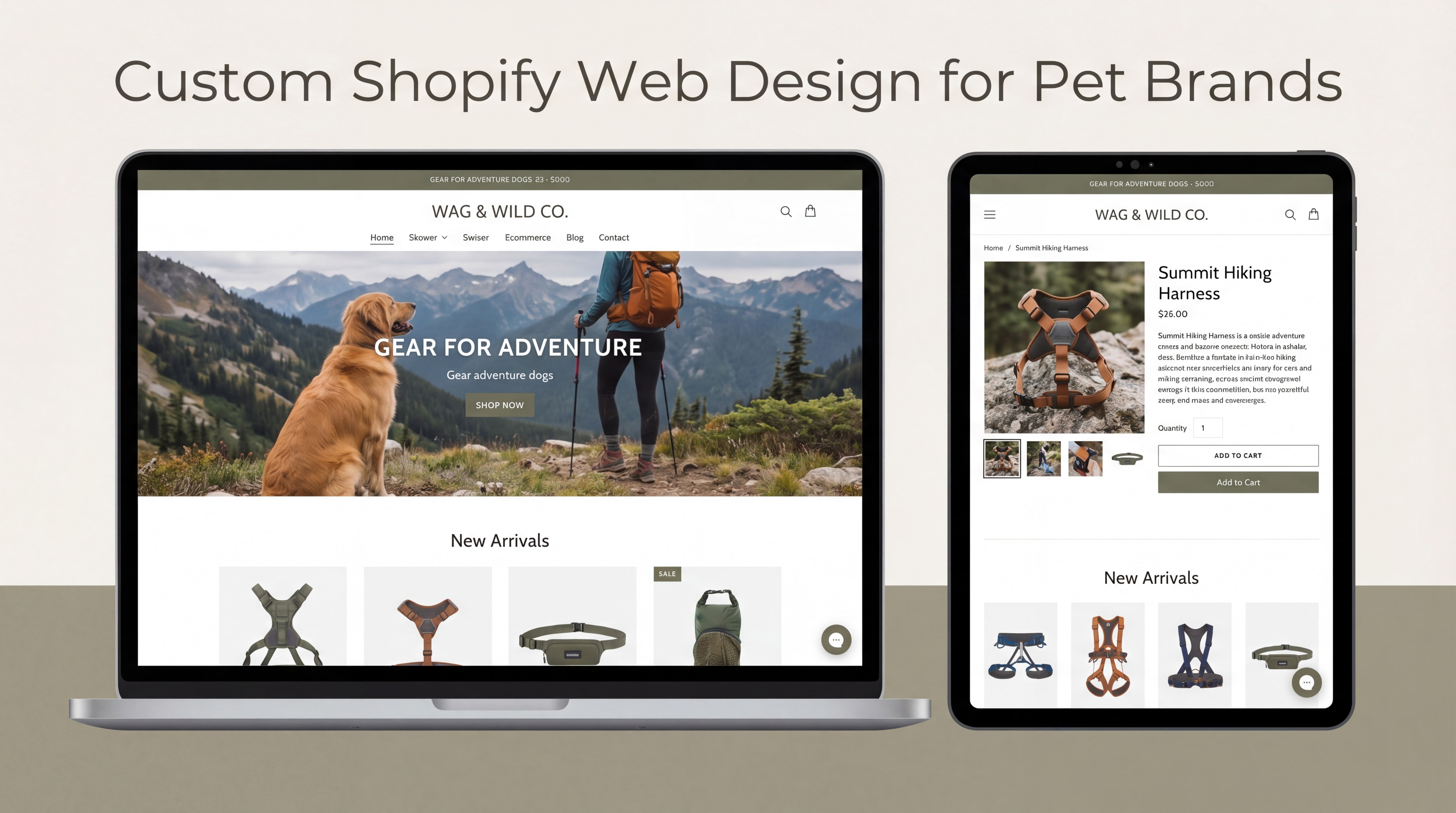
The Challenge: Rigby Pets, an Atlanta-area pet products brand specializing in adventure dog pouches for active lifestyles, needed more than a generic Shopify template. Their products were premium, their audience was passionate, and their old digital storefront simply wasn’t reflecting the brand’s personality or converting the traffic they were earning.
The Strategy: Atlanta-based agency Soda Web Media took on the project with a clear mandate: build a
unique, branded online shopping experience that would resonate with active pet owners. The approach included:
- Custom Shopify theme development based on the Shapes theme, heavily modified to reflect the brand’s adventure-forward aesthetic
- Educational content integration — blog posts, usage guides, and product storytelling that built trust and reduced purchase hesitation
- Marketing and support tool integration — connecting email automation, live chat, and loyalty programs directly into the Shopify ecosystem
The Results: Rigby Pets went from a forgettable storefront to a
fully branded digital experience that communicates quality at every touchpoint. Customer engagement improved significantly, and the brand now has a digital home worthy of its premium product line.
The Key Insight: In the pet products market — where consumers are deeply emotionally invested in their purchases —
ecommerce web design that tells a story outperforms ecommerce web design that just displays products. A skilled
Shopify developer in Atlanta understands this distinction.
Case Study 4: The Lion Group — 142% More Leads After a Full Redesign
The Challenge: The Lion Group is an Atlanta-based ecommerce accelerator that works with Fortune 500 firms and fast-growing startups. Ironically, the company that helped others scale their ecommerce operations had outgrown its own website. The site wasn’t generating qualified leads at the volume the business needed to sustain its growth trajectory.
The Strategy: Atlanta web design agency ThrillX conducted a full website overhaul with a conversion-focused methodology:
- Messaging audit: Rewriting the homepage and service pages to clearly communicate the value proposition to enterprise buyers
- UX restructuring: Redesigning the user journey so that high-intent visitors could find relevant case studies and book consultations without friction
- Strategic CTA placement: Adding contextual calls-to-action throughout the site rather than relying on a single contact page
The Results:
| Metric |
Improvement |
| Qualified Leads |
+142% (reported as +187% qualified leads) |
| Average Time on Page |
+24% |
| Bounce Rate |
-32% |
“Before working with [the agency], we had really only focused on outbound which made us not quite as scalable. Having a high-converting website was something that ultimately helped us become a lot more profitable.” — CEO, Atlanta eCommerce Company
The Broader Pattern: This case study is particularly instructive because The Lion Group
already understood ecommerce. Even businesses with deep digital expertise can dramatically underperform when their own
website development in Atlanta doesn’t match the quality of their service offering.
📊 **ThrillX Case Studies 2026]
Case Study 5: Atlanta’s The Scale Tech — The Digital Blueprint Shift
The Insight: In early 2026, Atlanta-based digital firm The Scale Tech published findings that crystallized what the city’s most successful ecommerce businesses already knew:
a company’s website is no longer a marketing asset — it’s a core business asset, what they term a “Digital Blueprint.”
[CITATION: Atlanta’s The Scale Tech identifies that the ‘Digital Blueprint’ approach reframes minimalism, micro-interactions, and responsive UI as strategic business assets rather than stylistic choices** – Atlanta web design agencies report an average bounce rate reduction of 32% and lead increases of 142%+ following conversion-focused redesigns
What This Means in Practice: The Scale Tech’s framework argues that popular design trends — minimalism, micro-interactions, responsive UI — should not be treated as aesthetic choices but as
conversion infrastructure. Every visual decision should map to a business outcome.
For Atlanta businesses working with a
Shopify developer in Atlanta, this means:
- Minimalist design → fewer distractions → higher checkout completion rates
- Micro-interactions (hover effects, add-to-cart animations) → increased perceived product quality → higher average order value
- Responsive UI → seamless mobile experience → capturing the 60%+ of ecommerce traffic that now comes from mobile devices
The Scale Tech’s findings align with a broader trend identified in a separate 2026 report: 78% of enterprise websites now load under 1.8 seconds — a threshold that directly correlates with conversion performance. Atlanta businesses that treat their website as a strategic asset, rather than a digital brochure, are consistently outperforming competitors.
What These Success Stories Have in Common
Across every case study above — from the apparel brand’s 198% conversion jump to Range Beauty’s path to Sephora — five patterns emerge consistently:
1. Strategy before design. Every successful project began with a deep audit of user behavior, business goals, and competitive positioning. No agency jumped straight to colors and fonts.
2. Platform matters. Shopify’s infrastructure — its speed, its app ecosystem, its checkout optimization — was a common denominator. Brands that migrated
to Shopify consistently reported better performance than those on legacy platforms. In fact, brands migrating to Shopify see an average of
15% more revenue and 15% higher checkout conversion post-migration.
3. Mobile-first execution. With mobile commerce accounting for over
60% of all online visits, every redesign in these case studies prioritized thumb-friendly navigation, fast load times, and one-tap checkout options.
4. Local expertise with national ambition. Each brand worked with agencies that understood the Atlanta market — its culture, its customer demographics, its entrepreneurial energy — while building stores capable of competing nationally.
5. Ongoing optimization, not one-and-done. None of these results came from a single launch. They came from continuous testing, data analysis, and iterative improvement.
Chiffres Clés
📊
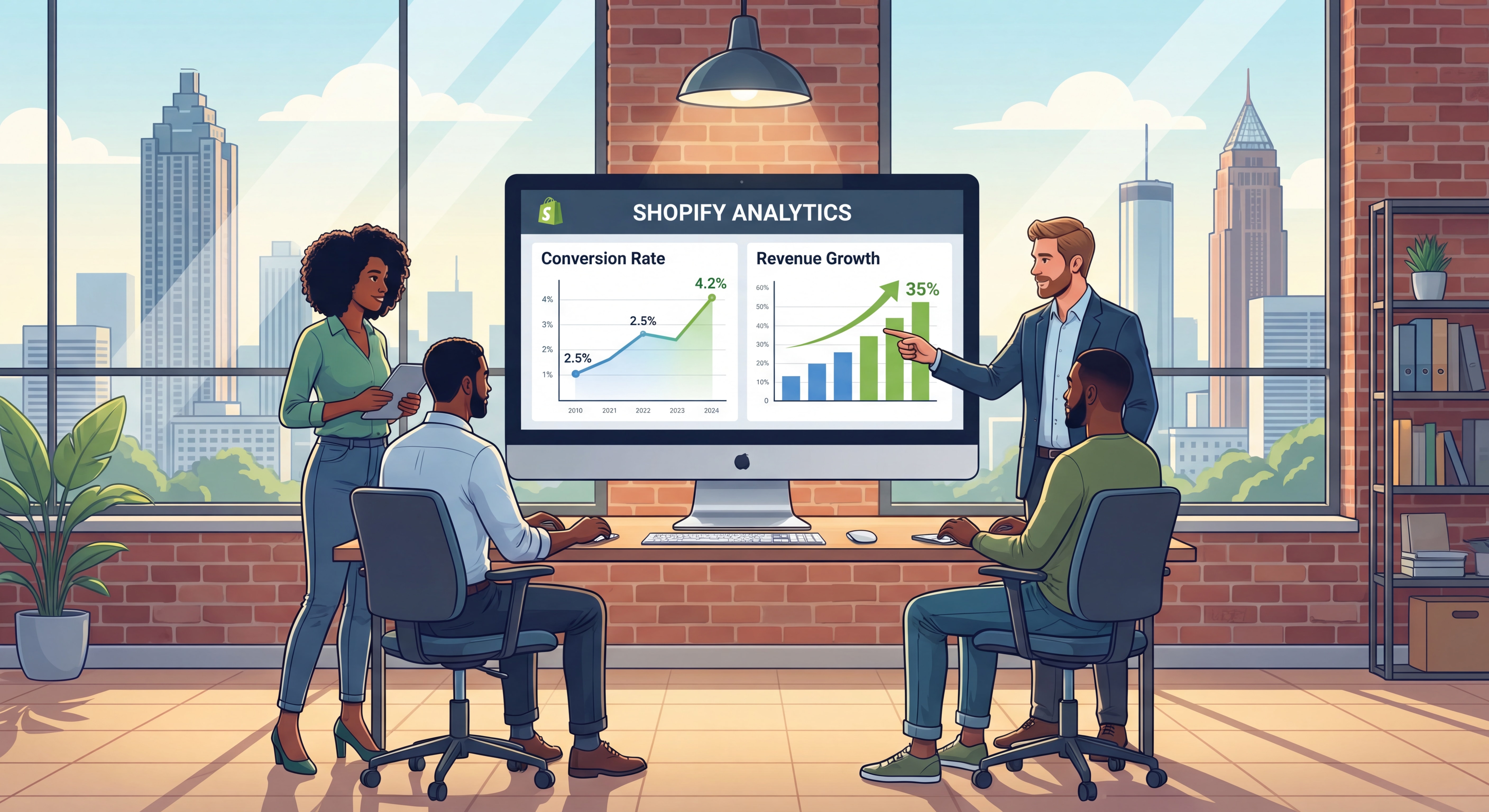
198% — Conversion rate increase achieved by an Atlanta apparel brand after a CRO-focused Shopify redesign (Source: Forix eCommerce, 2026)
💡
15% — Average revenue increase brands experience after migrating from legacy platforms to Shopify (Source: Shopify Enterprise Digital Transformation Report, 2026)
🛒
$300B+ — Gross merchandise volume processed by Shopify merchants in 2025, with US stores accounting for over 12% of all US ecommerce sales (Source: Brenton Way Shopify Statistics 2026)
📱
60%+ — Share of ecommerce traffic now coming from mobile devices, making mobile-first ecommerce web design non-negotiable (Source: Red Stag Fulfillment Ecommerce Data 2026)
Questions Fréquentes (FAQ)
How much does it cost to hire a Shopify developer in Atlanta?
Costs vary significantly based on project scope. For a custom Shopify store build in Atlanta, project-based pricing typically ranges from a few thousand dollars for a template-based build to $15,000–$50,000+ for fully custom ecommerce web design with integrations, migration, and CRO strategy. Many Atlanta agencies also offer monthly retainer plans for ongoing optimization, typically starting around $1,000–$3,000/month. Always request a detailed project scope before committing.
How long does it take to see results after a Shopify redesign?
Based on the case studies above, significant results typically appear within
30–90 days of launch. The Atlanta apparel brand saw double-digit conversion improvements “within months.” However, the full compounding effect of SEO improvements from better website development in Atlanta can take 3–6 months to fully materialize in organic traffic and revenue.
Should I migrate from WooCommerce or Magento to Shopify?
For most Atlanta small-to-mid-sized businesses, yes. Shopify’s managed infrastructure eliminates hosting headaches, security patches, and plugin conflicts that plague WooCommerce and Magento. Brands migrating to Shopify report an average of 15% more revenue and 15% higher checkout conversion. A skilled Shopify developer in Atlanta can manage the migration while preserving your SEO rankings through proper 301 redirect mapping.
What makes ecommerce web design in Atlanta different from generic templates?
The best
ecommerce web design in Atlanta goes far beyond aesthetics. It incorporates conversion rate optimization (CRO), mobile-first UX, local market knowledge, and brand storytelling that resonates with your specific customer base. Generic templates treat all businesses the same — Atlanta-based developers treat your brand as unique, because it is.
Can a Shopify developer in Atlanta help with SEO too?
Absolutely. The best
website development in Atlanta agencies integrate SEO from the ground up — optimizing site architecture, page speed (Core Web Vitals), product descriptions, meta tags, and URL structures. As highlighted by the Atlanta startup featured in Hypepotamus (March 2026), search is fragmenting rapidly, and businesses that don’t invest in technical SEO risk disappearing from search results entirely.
Ready to Write Your Own Success Story?
The five case studies above share one common thread:
decisive action. The brands that are winning in Atlanta’s ecommerce landscape didn’t wait for the perfect moment. They partnered with the right
Shopify developer in Atlanta, committed to a data-driven ecommerce web design strategy, and executed with discipline.
Whether you’re a local startup ready to launch your first Shopify store, an established retailer looking to escape a clunky WooCommerce setup, or a growing DTC brand that knows its current site is leaving money on the table — the path forward starts with a conversation.
Atlanta’s ecommerce opportunity is real. The question is whether your website is ready to capture it.
If you’re ready to invest in professional
website development in Atlanta that delivers measurable, documented results like the businesses above, reach out to a vetted Shopify expert today. Your success story is waiting to be written.
Related Services