
Here’s what most Atlanta business owners don’t want to hear: your website is probably losing you money right now. Not because it’s ugly. Not because you didn’t spend enough building it. But because it’s missing the specific, executable elements that turn visitors into customers in 2026’s search environment. And the gap between a website that generates leads and one that just sits there is not as complicated as most agencies make it sound.
This guide is not a list of buzzwords. It’s a step-by-step breakdown of what actually works for
web design in Atlanta, how to run a real
SEO audit, how to build a
content marketing engine that compounds over time, and how to deploy an
AI chatbot that earns its keep. Every tactic here is something you can implement, measure, and build on — whether you’re a Buckhead law firm, a Marietta HVAC company, or a Decatur restaurant that’s tired of watching competitors show up before you on Google Maps.
Let’s get into it.
Table of Contents
Step 1: Fix Your Website Before You Spend Another Dollar on Traffic
Most Atlanta business owners treat their website like a business card. It exists. It has their phone number on it. They move on. That’s a mistake that compounds every single month.
Web design in Atlanta is not about aesthetics — it’s about conversion architecture. The question is not “does the site look good?” The question is “does a visitor who lands on this page know exactly what to do next within five seconds?” If the answer is no, you have a problem that no amount of Google Ads spend will fix.
The Five-Second Test
Pull up your homepage on your phone. Don’t touch it for five seconds. Ask yourself three questions:
- Can you immediately tell what the business does?
- Is there one clear action you’re being asked to take?
- Does it load fast enough that you didn’t get frustrated waiting?
If you hesitated on any of those, your site is leaking revenue. Here’s how to plug the holes.
Web Design Fixes That Move the Needle
Mobile-first is not optional. Over 63% of local searches in Atlanta happen on mobile devices. If your site isn’t designed for a thumb, not a cursor, you’re losing leads before they’ve read a single word. Start with mobile layout. Desktop is secondary.
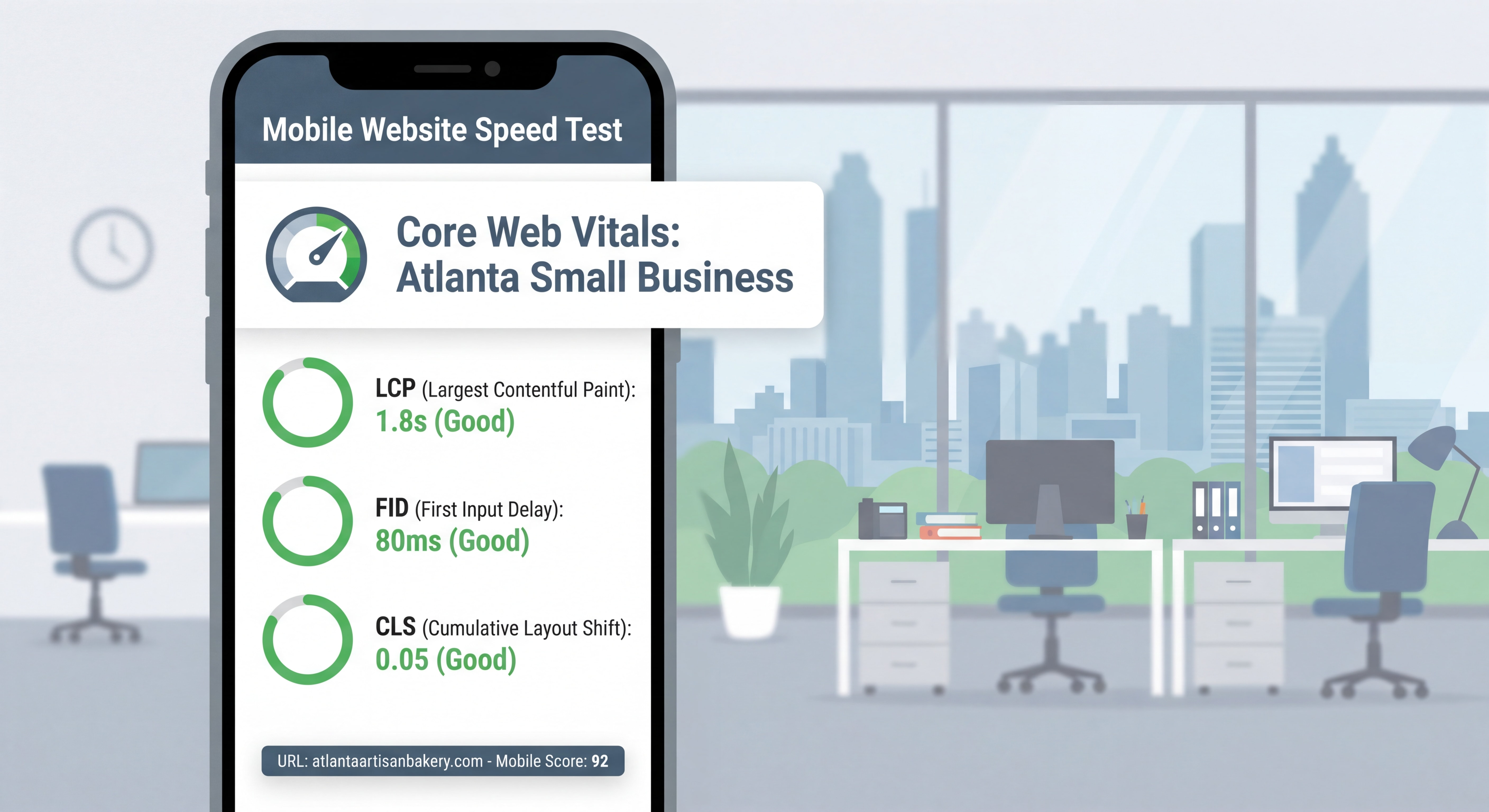
Page speed kills conversions. Google’s Core Web Vitals are a ranking factor — and a trust signal. A page that loads in under 2 seconds converts at a measurably higher rate than one that takes 4. Compress your images (WebP format, under 200KB), eliminate render-blocking scripts, and use a CDN if you’re not already. Tools like Google PageSpeed Insights will show you exactly what’s broken and in what order to fix it.
One CTA per page. This is the mistake that costs Atlanta service businesses the most leads. You have a “Call Us,” a “Get a Quote,” a “Learn More,” a “Book Online,” and a newsletter signup all on the same page. Pick one. Make it prominent. Repeat it at the top, middle, and bottom of the page.
Trust signals above the fold. Before someone scrolls, they need a reason to stay. That means your Google rating, number of reviews, years in business, or a recognizable client logo needs to be visible without scrolling. A Midtown dental practice that shows “4.9 stars — 312 Google reviews” above the fold is going to hold visitors longer than one that buries that information in the footer.
Question-based headings for AI visibility. Atlanta’s The Scale Tech recently identified a critical shift in how companies should think about their web strategy — your site now needs to communicate clearly not just to human visitors, but to AI systems that summarize and surface content in search results. Use headings like “What does an Atlanta HVAC company charge for AC installation?” followed by a direct, concise answer. This structure gets you cited by AI Overviews and featured snippets simultaneously.
📊
63%+ of local searches in Atlanta happen on mobile devices – Mobile Local Search Share
Step 2: Run a Real SEO Audit — Not a Vanity Check
An
SEO audit in Atlanta is not running your site through a free tool and looking at the score. That number tells you almost nothing. A real audit is a structured diagnostic that answers one question: why isn’t this site ranking for the searches that bring in paying customers?
Here’s how to do it yourself, section by section.
Technical SEO: The Foundation
Before content does anything, the technical foundation has to be solid. Check these items in order:
| Technical Issue |
What to Check |
Free Tool |
| Crawl errors |
Pages Google can’t access |
Google Search Console |
| Broken links |
404 errors across the site |
Screaming Frog (free up to 500 URLs) |
| Duplicate content |
Same content on multiple URLs |
Siteliner |
| Page speed |
Core Web Vitals scores |
Google PageSpeed Insights |
| Mobile usability |
Mobile rendering issues |
Google Search Console |
| Schema markup |
Structured data implementation |
Google Rich Results Test |
| XML sitemap |
Submitted and error-free |
Google Search Console |
Fix crawl errors first. Always. If Google can’t access a page, nothing else matters.
On-Page SEO: What Most Atlanta Sites Get Wrong
Every service page on your site needs to target one primary keyword. One. Not three, not five — one. A Roswell plumbing company trying to rank for “plumber Roswell,” “emergency plumber,” “drain cleaning Roswell,” and “water heater repair” all on the same page will rank for none of them. Create separate pages for each service. Give each page one keyword to own.
Your primary keyword needs to appear:
- In the H1 heading
- In the first 100 words of body copy
- In the meta title and meta description
- In at least one H2 subheading
- Naturally, 3–5 times throughout the page
Local signal injection is what separates Atlanta-specific SEO from generic optimization. Don’t just say “we serve the Atlanta area.” Name the neighborhoods. A Buckhead chiropractor should reference Buckhead, Midtown, Sandy Springs, and Vinings — because those are the ZIP codes their patients are actually searching from.
Google Business Profile: Your Fastest Path to Local Visibility
According to Whitespark’s 2026 Local Search Ranking Factors report, Google Business Profile signals account for
32% of what determines which businesses appear in the local pack. That’s the single biggest lever you have, and most Atlanta businesses aren’t pulling it correctly.
Here’s the GBP audit checklist:
- Primary category: Is it the most specific category available for your business? “HVAC Contractor” outperforms “Contractor.”
- Services section: Have you listed every individual service with a description? This is keyword real estate most businesses leave blank.
- Photos: Are you uploading new photos at least twice a month? Businesses with 100+ photos get 520% more calls than those with fewer than 10.
- Review velocity: Are you getting new reviews consistently? Not a burst of 20 and then nothing for six months — steady, weekly reviews.
- Posts: Are you publishing GBP posts at least once a week? Treat it like a social media channel, because Google does.
“Google Business Profile signals account for 32% of local pack ranking factors”
— Whitespark Local Search Ranking Factors Report(https://infinitemarketing.co/free-seo-audit-atlanta/)
Related Services