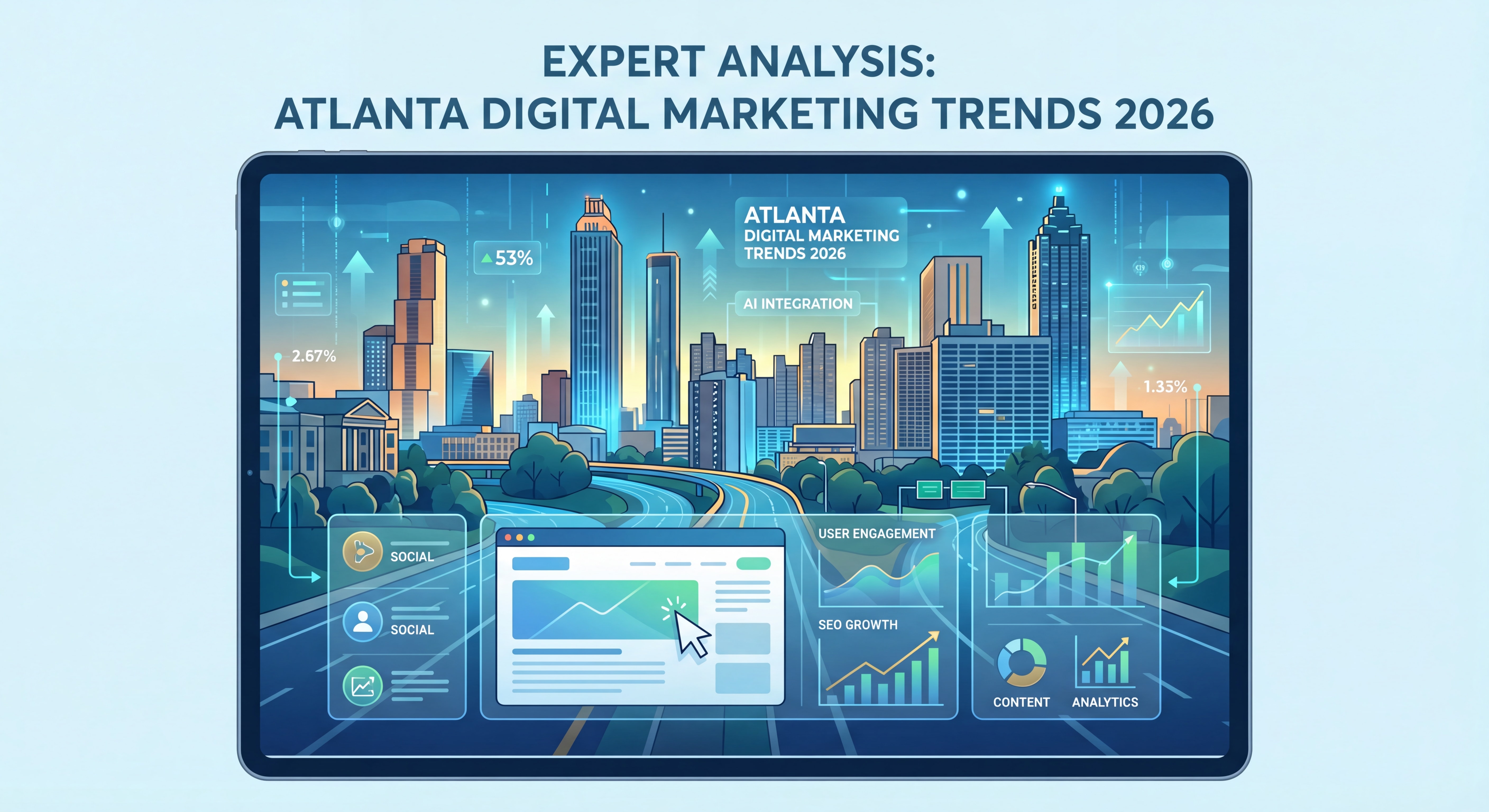
Buckhead law firms. Midtown restaurants. HVAC companies in Alpharetta. Every one of them is operating in a digital landscape that looks fundamentally different than it did eighteen months ago — and most of them don’t know it yet.
The question isn’t whether web design, SEO services, content marketing, and AI chatbots are changing in Atlanta. They are. The real question is whether your business is positioned to benefit from those changes, or quietly losing ground to competitors who already adapted. This article breaks down what the experts are actually saying, what the data confirms, and what Atlanta businesses should do about it right now — not in six months.
Table of Contents
The Digital Blueprint Shift: Web Design Is Now a Business Asset
Here’s something most Atlanta agencies won’t tell you. Your website isn’t a branding exercise. It’s infrastructure — and the experts are finally saying it out loud.
Atlanta-based firm The Scale Tech made headlines earlier this year when it identified what it called a “critical shift in corporate web strategy,” arguing that the website has become a
core business asset — a “digital blueprint” that, when built correctly, drives every downstream marketing outcome. Revenue. Leads. Reputation. All of it flows from the foundation your site either provides or doesn’t.
This isn’t a new idea. But it’s an idea that’s finally getting the urgency it deserves.
Web design experts in 2026 are converging on a clear set of predictions that should inform every Atlanta business owner making a site decision this year:
Performance is no longer optional. Wix Studio’s content and trends team has identified speed, clean navigation, and mobile-first architecture as non-negotiables — not features, but baseline expectations. If your site feels sluggish on a phone in the Hartsfield-Jackson parking deck, you’ve already lost the lead.
AI-powered personalization is moving from novelty to necessity. The strongest websites in 2026 are replacing static landing pages with adaptive experiences. AI analyzes real-time browsing behavior and serves different layouts, CTAs, and content to different users. An Alpharetta HVAC company showing storm-season emergency content to a user who just searched “emergency AC repair” isn’t magic — it’s conversion math.
The “Human Scribble” countertrend is real. Wix Studio experts are also flagging a design reaction to AI-generated aesthetics: handwritten overlays, doodles, sketch-like elements that signal authenticity. For Atlanta businesses in food, hospitality, and personal services, this trend is worth understanding. Polished can read as manufactured. Humanity converts.
The bottom line from the design community: in 2026, your website is judged less on how it looks and more on how it performs. A Decatur contractor with a fast, clear, conversion-focused site will outperform a Buckhead firm with a beautiful but slow one — every single time.
SEO in Atlanta Has a New Rulebook
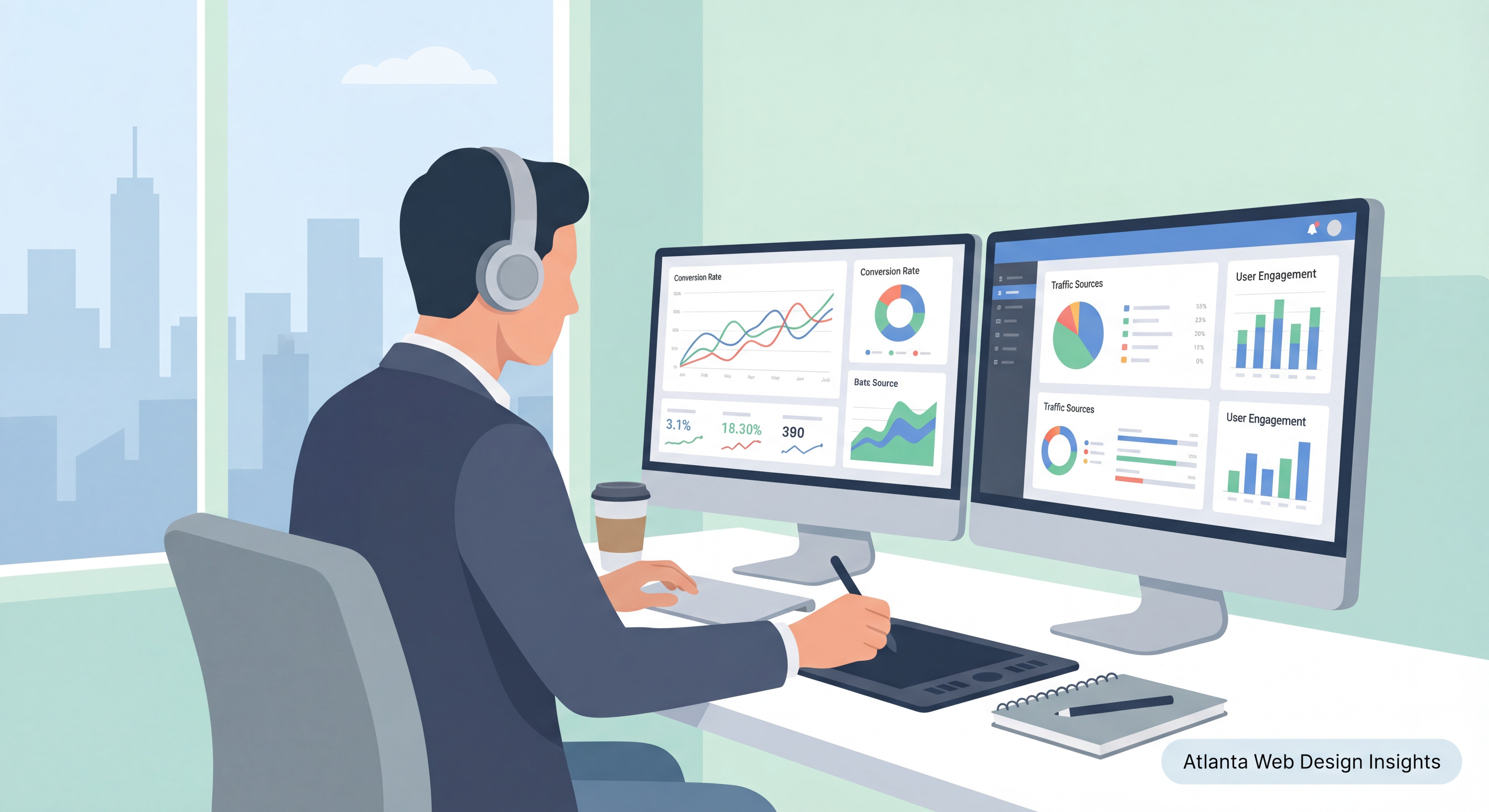
The SEO landscape in Atlanta has fractured. And that’s not a bad thing — if you understand which game you’re playing.
Traditional SEO — keyword targeting, on-page optimization, link building, local citations — still matters enormously. A Sandy Springs medical practice that doesn’t rank on Google Maps for “family doctor near me” is invisible to the most valuable patients. That hasn’t changed.
What has changed is the layer on top of traditional search. In 2026,
Generative Engine Optimization (GEO) and
Answer Engine Optimization (AEO) have emerged as distinct disciplines that leading Atlanta agencies are now treating as required services, not upsells.
Vincent DeCastro, President of The ABM Agency and a recognized leader in the Atlanta tech community, was named to Conductor’s “15 AI Search and AEO Experts to Follow in 2026” list — a recognition that underscores how seriously the local market is taking this shift. The Technology Association of Georgia highlighted his work specifically because it bridges traditional SEO fundamentals with the realities of generative search. That bridge is where the money is.
Here’s what the expert consensus says about SEO in Atlanta right now:
AI Overviews are eating clicks. When Google’s AI summarizes an answer at the top of the results page, users don’t always scroll down. Businesses that aren’t optimized to appear
within those summaries — not just below them — are losing visibility they can’t measure because they never knew they had it.
Local SEO is more competitive, not less. Multiple national agencies have expanded into Atlanta in 2026, including a Manila-based firm that explicitly targeted Georgia businesses. More competition means the baseline for ranking has risen. A Google Business Profile that would have ranked you in the top 3 two years ago might not crack the map pack today without a full
SEO services Atlanta strategy behind it.
AI-ready content structure is the new technical SEO. Structured data, clear entity relationships, FAQ schema, and authoritative sourcing — these aren’t just ranking signals anymore. They’re the criteria that AI systems use to decide which businesses get cited in generated answers. If your site can’t be parsed by an LLM, you don’t exist in that search environment.
📊
312% increase achieved by businesses completing full GEO + technical SEO overhauls – Atlanta SEO organic traffic growth
The SEO Audit Has Evolved — Most Agencies Haven’t
Ask ten Atlanta agencies what an SEO audit includes. Nine of them will describe a process that was current in 2022.
A proper
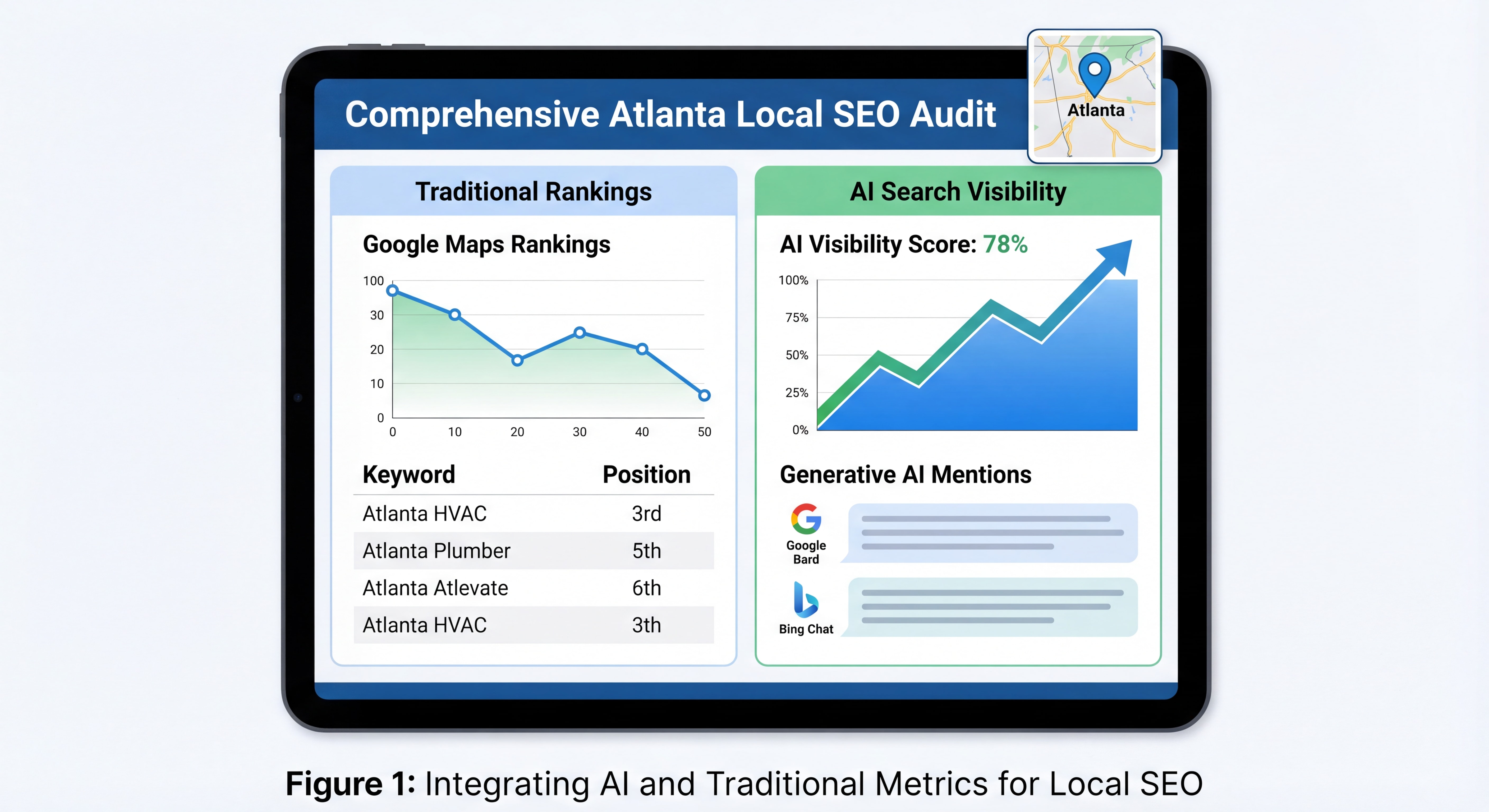
SEO audit in Atlanta in 2026 has to cover significantly more ground than it did even eighteen months ago. The checklist has expanded because the search environment has expanded. Here’s what experts are now saying a complete audit must include:
| Audit Category |
2022 Standard |
2026 Standard |
| Technical SEO |
Crawl errors, broken links, sitemap |
Core Web Vitals, mobile performance, structured data, schema markup |
| On-Page SEO |
Keyword density, title tags, meta descriptions |
Entity optimization, semantic clustering, AI-readability |
| Local SEO |
GBP completeness, NAP consistency |
GBP optimization, review velocity, local schema, AI citation signals |
| Content Audit |
Thin content, duplicate pages |
Topical authority gaps, LLM training alignment, content freshness |
| Off-Page SEO |
Backlink profile |
Backlink profile + brand mentions, unlinked citations, AI source authority |
| AI Search Visibility |
Not assessed |
ChatGPT, Gemini, Perplexity visibility — separate audit track |
The gap between column two and column three is where Atlanta businesses are getting hurt. They think they had an audit. What they actually had was a 2022 checklist applied to a 2026 problem.
The good news: a proper
SEO audit Atlanta process — one that covers traditional signals
and AI search visibility — gives you a clear picture of exactly where you’re losing ground and what it will take to recover it. That clarity is worth more than another month of vague “optimization.”
Content Marketing in Atlanta: What’s Working and What’s Dead
DigiMarCon Southeast 2026 returned to Atlanta this spring, and the theme running through nearly every session was the same:
content that doesn’t serve a specific audience in a specific moment is content that doesn’t convert.
Atlanta’s content marketing landscape is being shaped by several forces simultaneously. The FIFA World Cup brought hundreds of thousands of visitors to the city this summer, creating a once-in-a-generation opportunity for local businesses to produce content that captured both global attention and local intent. Smart businesses — the ones who started building content strategies in Q1, not June — saw measurable traffic and lead spikes. The ones who waited scrambled.
Here’s what the expert analysis of Atlanta’s content marketing environment tells us for the rest of 2026 and beyond:
Video is non-negotiable, but format matters. Short-form content on TikTok and Instagram Reels continues to drive local discovery, particularly for restaurants, contractors, and personal services in neighborhoods like Virginia-Highland and Old Fourth Ward. But long-form video — webinars, detailed how-to content, case study walkthroughs — is winning for B2B and professional services. A Midtown law firm doesn’t need a TikTok dance. It needs a 12-minute YouTube breakdown of what to do after a car accident in Georgia.
Geo-targeted content is the Atlanta edge. National agencies can’t replicate it. A content strategy that references the Beltline, Ponce City Market, or the specific permit process for Fulton County contractors signals local expertise that no generic blog post can fake. Google knows the difference. More importantly, Atlanta readers know the difference.
AI-assisted content is everywhere. Human-verified content wins. The HubSpot 2026 State of Marketing report found that 48.57% of marketers are using AI to produce personalized content — but the brands pulling ahead are the ones using AI as a drafting tool, not a publishing tool. The editorial voice, the local insight, the specific example that only someone who’s worked in Atlanta’s market would know: that’s what separates content that builds authority from content that fills a page.
“Content remains the cornerstone for driving visibility, engagement and conversions for Atlanta businesses in 2026”
— Marketing Eye Atlanta
A Hypepotamus report highlighted an Atlanta startup that built its entire business model around repurposing underused video content into marketing assets — turning raw footage into social clips, blog posts, email sequences, and ad creative. That’s the kind of
content marketing Atlanta businesses need to be thinking about: not just producing content, but building systems that make content work harder.
The AI Chatbot Debate: Real ROI vs. Real Risk
The AI chatbot conversation in 2026 is more complicated than most marketing agencies want to admit. And that complexity is exactly why Atlanta business owners need a clear-eyed analysis rather than a sales pitch.
Here’s the honest picture.
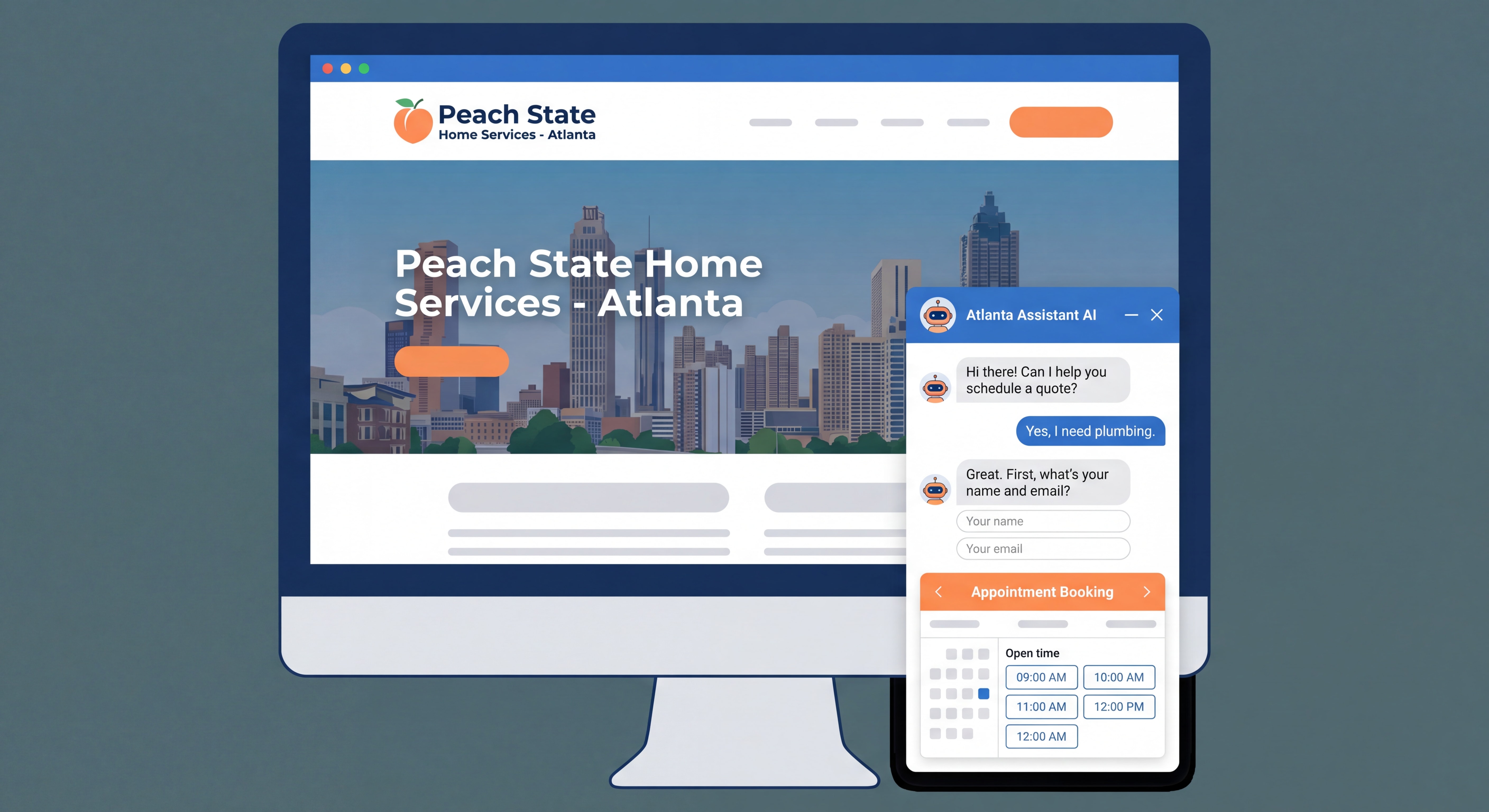
The ROI case is real. Documented ROI on AI chatbot implementations ranges from 148% to 200% (Jotform, January 2026). Companies using chatbots for sales report an average 67% increase in sales conversions. Small businesses implementing basic chatbot tools at $29–$200 per month are recovering those costs within weeks through reduced customer service hours and faster lead qualification. An Atlanta plumbing company that captures an emergency inquiry at 11pm — when no human is available — and books the appointment automatically has just turned a technology expense into a revenue engine.
The risk case is equally real. A Financial Times study published in April 2026 found that AI chatbots misdiagnose in over 80% of early medical cases. Bloomberg reported separately that AI chatbots give misleading advice 50% of the time in medical contexts. For Atlanta healthcare providers, dental practices, and any business where accuracy has legal or safety implications, deploying a generic AI chatbot without guardrails isn’t a marketing decision — it’s a liability decision.
The expert consensus for Atlanta small businesses in 2026 is nuanced:
📊
148%–200% documented ROI within first year – AI chatbot ROI for small businesses
| Business Type |
Chatbot Recommendation |
Risk Level |
Expected ROI Timeline |
| HVAC / Plumbing / Roofing |
✅ Strong fit — 24/7 emergency capture |
Low |
30–60 days |
| Restaurants / Retail |
✅ Strong fit — reservations, FAQs, hours |
Low |
30–90 days |
| Law Firms |
⚠️ Proceed carefully — intake only, no legal advice |
Medium |
60–120 days |
| Medical / Dental |
⚠️ Appointment booking only — zero clinical advice |
High |
90–180 days |
| Real Estate |
✅ Good fit — property inquiries, showing scheduling |
Low-Medium |
45–90 days |
| Financial / Insurance |
⚠️ Compliance review required before deployment |
High |
90–180 days |
By 2026, 80% of small businesses are projected to integrate some form of AI chat functionality. If you haven’t started evaluating your options, you’re not ahead of the curve — you’re behind it. But the businesses winning with AI chatbots are the ones that deployed with a specific use case, clear guardrails, and a human escalation path. Not the ones who installed a generic bot and hoped for the best.
What the Industry Consensus Actually Looks Like
Step back from the individual trends and a clear picture emerges. The experts — whether they’re analyzing web design, SEO, content, or AI — are all pointing toward the same underlying principle:
the businesses that win in Atlanta’s digital market in 2026 are the ones that treat every digital touchpoint as a system, not a tactic.
A beautiful website that doesn’t load fast doesn’t convert. Fast SEO rankings that don’t match what AI systems are citing don’t capture the full opportunity. Content marketing that produces volume without local specificity doesn’t build authority. AI chatbots deployed without strategy create risk, not revenue.
The Scale Tech’s “digital blueprint” framing isn’t just a press release talking point. It’s an accurate description of how the market is moving. Your website, your SEO strategy, your content calendar, and your AI tools are either working together as a coherent system — or they’re working against each other and burning your budget in the process.
Atlanta’s market is competitive. Strive Enterprise opened an Atlanta office this year specifically because they saw growth opportunity in this metro. National agencies are targeting Georgia businesses because the market is valuable. A local HVAC company in Marietta is now competing for digital attention against firms with national budgets and dedicated AI teams.
The answer isn’t to panic. It’s to get specific, get local, and get a real plan built on data — starting with an honest audit of where you actually stand.
Key Figures
📊
312% — Organic traffic increase achieved by Atlanta businesses that completed a full GEO + technical SEO overhaul in 2026
(Semrush Agency Data)
💡
80% — Percentage of small businesses projected to integrate AI chatbot functionality by end of 2026
(Adratech Systems / Tidio Research)
📈
40.6% — Marketers currently updating their SEO strategy specifically for AI-powered search engines in 2026
(HubSpot State of Marketing Report 2026)
🤖
$3.70 average ROI per $1 invested in AI tools for small businesses, with top performers reaching $10.30 per dollar
(McKinsey 2025)
Questions Fréquentes (FAQ)
How is web design in Atlanta different from what national agencies offer?
Atlanta businesses operate in a market with specific competitive dynamics — dense local competition in Buckhead and Midtown, suburban growth corridors in Alpharetta and Roswell, and industry clusters that national agencies simply don’t understand at the ground level. A web design strategy built for Atlanta accounts for local search behavior, neighborhood-specific landing pages, Georgia-specific compliance requirements for regulated industries, and the cultural context that makes a site feel genuinely local rather than adapted from a template. National agencies can build you a good-looking site. A local partner builds you one that converts Atlanta customers.
What should an SEO audit in Atlanta include in 2026?
A complete SEO audit in Atlanta now needs to cover six areas: traditional technical SEO (Core Web Vitals, crawlability, schema markup), on-page optimization, local SEO (Google Business Profile, local citations, review velocity), content gap analysis, off-page authority, and — critically — AI search visibility across platforms like ChatGPT, Gemini, and Perplexity. If your audit doesn’t assess how your business appears in AI-generated answers, you’re missing a growing portion of the search landscape. Ask any agency you’re evaluating whether they include GEO and AEO analysis. If they look confused, keep looking.
Is AI chatbot worth it for a small Atlanta business?
For most Atlanta small businesses in trades, home services, restaurants, and retail — yes, with the right setup. The documented ROI ranges from 148% to 200% within the first year, and the primary use case (capturing leads and answering basic questions outside business hours) is low-risk and immediately measurable. The businesses that struggle with chatbot ROI are the ones that deploy without a clear purpose. Start with one specific job: booking appointments, capturing emergency service inquiries, or answering your ten most common customer questions. Measure it for 60 days. Then expand.
How does content marketing in Atlanta actually drive SEO results?
Content marketing and SEO are the same strategy executed at different layers. Content creates the topical authority that tells Google — and AI search systems — that your business is the definitive resource on a subject. An Atlanta roofing company that publishes detailed, locally grounded content about storm damage claims, Fulton County permitting, and insurance adjuster negotiations isn’t just producing blog posts. It’s building the citation infrastructure that makes it more likely to appear in AI-generated answers, rank for competitive local keywords, and earn the trust of a prospect who’s done their research before calling. Content without SEO strategy is noise. SEO without content is a shell. Together, they compound.
How long does it take to see results from SEO services in Atlanta?
Honest answer: it depends on where you’re starting. A business with no existing SEO foundation in a competitive Atlanta market — say, a new Midtown law firm competing against established practices — should expect 3–6 months before meaningful ranking movement, and 6–12 months before significant lead volume from organic search. A business that already has some SEO history and needs optimization rather than a rebuild can see measurable improvements in 60–90 days. Any agency promising page-one rankings in 30 days is either targeting keywords nobody searches or telling you what you want to hear. Sustainable SEO takes time. The businesses that start now are the ones who won’t be scrambling in 12 months.
Ready to see exactly where your Atlanta business stands against these 2026 benchmarks? Get a free SEO audit from Infinite Marketing — no fluff, no sales theater, just a data-driven look at what’s working, what isn’t, and what it will take to compete.
Book your free Atlanta SEO audit today.
Related Services