It's Friday morning in Buckhead. Your phone rings with a potential customer asking about your services—but you're in a meeting. By the time you call back three hours later, they've already hired your competitor who answered instantly with a chatbot. This scenario plays out thousands of times daily across Atlanta's small business community, but it doesn't have to happen to you.
The chatbot market has exploded in 2026, with dozens of platforms claiming to solve your customer service and lead generation problems. Yet choosing between text-based chatbots, voice AI, WordPress integrations, and Shopify-specific solutions feels overwhelming. Should you pick ChatGPT? Invest in a specialized platform like Boei or Tidio? Go with a voice-first approach? The decision matters because your choice directly impacts conversion rates, customer satisfaction, and your bottom line.
This guide cuts through the noise. We'll compare the major AI chatbot categories, show you exactly how to evaluate options for your Atlanta-based small business, and reveal which solutions actually deliver measurable ROI within 90 days.
Table of contents
- The AI Chatbot Landscape in 2026
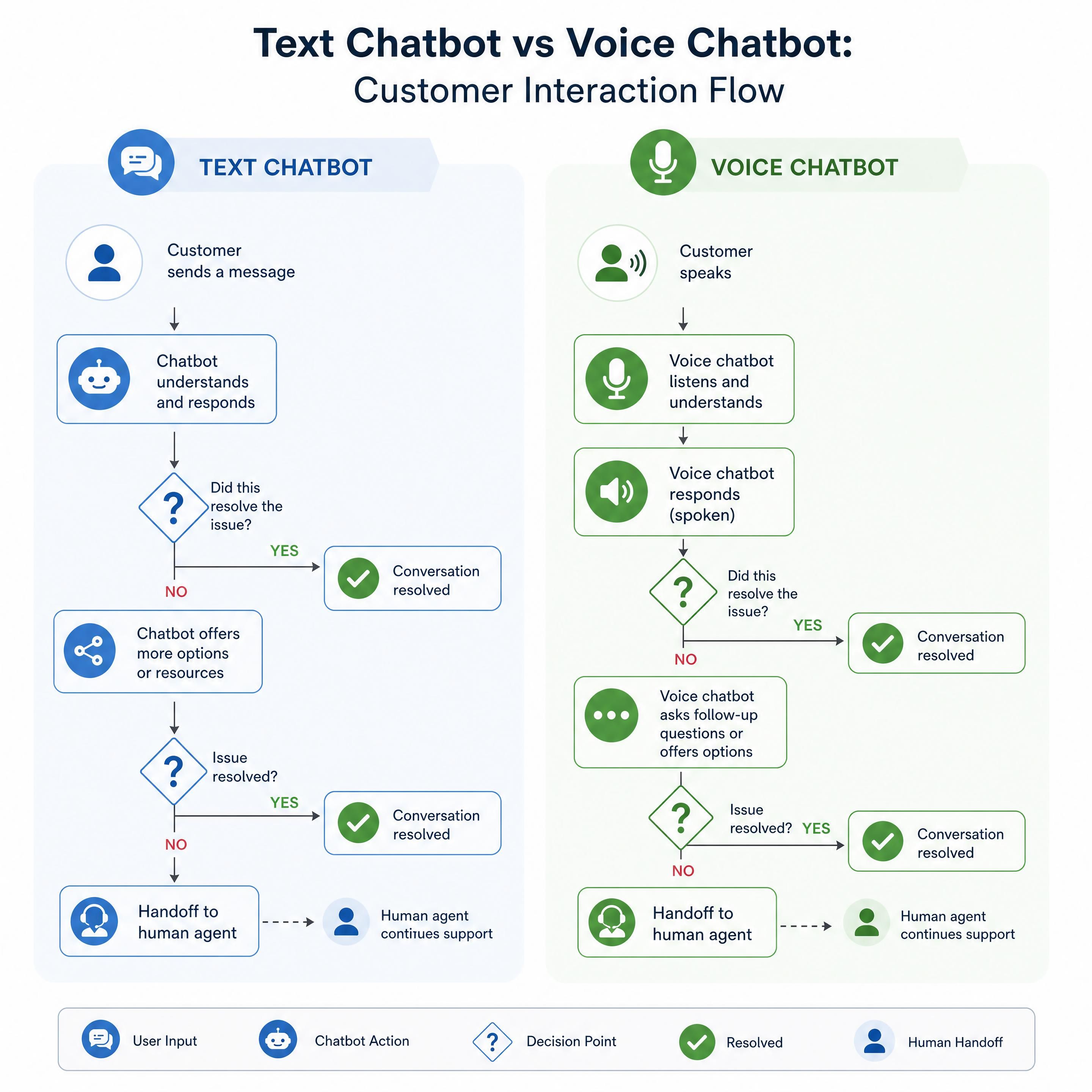
- Text-Based vs. Voice Chatbots: The Core Decision
- Platform Comparison: WordPress, Shopify, and Website Builders
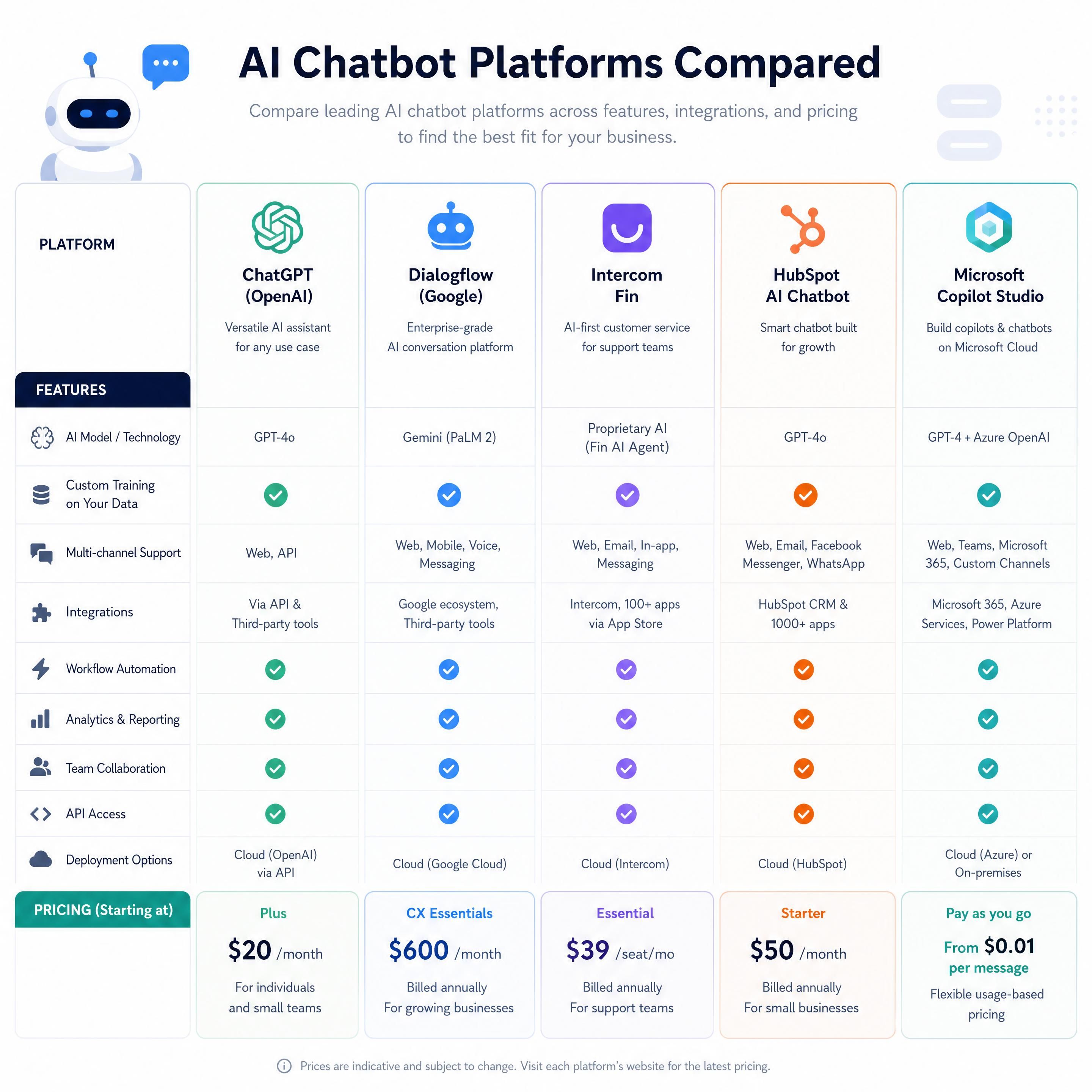
- Leading AI Chatbot Solutions Compared
- ROI and Cost Analysis: What to Actually Expect
- Decision Framework for Atlanta Small Businesses
- Questions Fréquentes (FAQ)
- Chiffres Clés
The AI chatbot landscape in 2026
The AI chatbot market looks radically different than it did just 18 months ago. In early 2024, businesses faced a binary choice: hire a development team to build a custom bot or settle for a clunky rule-based system that frustrated customers. Today, setup takes minutes, not months.
What changed? Three things converged simultaneously:
First, large language models (LLMs) became genuinely useful. ChatGPT, Claude, and others moved beyond impressive demos into reliable business tools. They understand context, handle nuance, and rarely produce nonsensical responses anymore.
Second, pricing collapsed. Flat-rate plans replaced per-conversation models, making budgeting predictable. Small businesses can now access enterprise-grade AI for $19–$100 per month instead of thousands.
Third, integration became frictionless. Whether you run WordPress, Shopify, Wix, or a custom site, adding a chatbot requires a single snippet of code—no developers needed.
📊 **McKinsey/Gartner 2026 Analysis]
But this abundance creates a new problem: which platform actually fits your business model? A Shopify store needs different features than a B2B services firm in Midtown. A high-call-volume law practice requires voice AI, while an ecommerce retailer thrives with text. The decision framework matters more than the hype.
Text-based vs. voice chatbots: the core decision
Before evaluating specific platforms, you need to understand the fundamental split in conversational AI: text versus voice. This choice determines everything downstream.
Text-based chatbots
Text chatbots live in web widgets, WhatsApp, Facebook Messenger, or SMS. Customers type questions; the bot responds with text. They're the default choice for most small businesses.
When text chatbots win:
- Website visitors ask repetitive questions (FAQs, product details, pricing)
- You need a written record of conversations (compliance, dispute resolution)
- Your customers prefer asynchronous communication
- You're running an ecommerce store with straightforward product questions
- Your budget is tight (text solutions start at $19/month)
Real-world example: A boutique fitness studio in Inman Park uses a text chatbot to handle class scheduling, pricing questions, and cancellations. The bot captures 70% of inquiries without human involvement, freeing staff to focus on member experience.
Voice chatbots (AI voice agents)
Voice chatbots handle phone calls using speech recognition and text-to-speech. Callers hear a natural-sounding AI that can qualify leads, verify information, and route complex issues to humans.
When voice chatbots win:
- Your customers prefer calling (insurance, healthcare, professional services)
- Urgency matters (emergency repairs, urgent questions)
- You have high call volume and want to reduce wait times
- Complex conversations require vocal tone and relationship-building
- Your industry expects phone accessibility (law firms, HVAC contractors, dentists)
Real-world example: An Atlanta HVAC contractor implemented voice AI to handle after-hours emergency calls. The system qualifies problems, books appointments, and handles 60% of calls without human intervention. Cost per interaction dropped from $12 (live agent) to $0.50 (AI agent).
 ** – 85% of small and mid-sized businesses using AI expect clear ROI within their first year
Leading AI chatbot solutions compared
Now let's zoom into the major platforms and how they actually perform for small businesses.
General-purpose platforms (ChatGPT, Claude)
ChatGPT and Claude are powerful but not optimized for business use. They're conversation engines, not customer service platforms.
Pros:
- Exceptional reasoning and writing quality
- Cheap API costs
- Flexible for custom development
Cons:
- No built-in lead capture or CRM integration
- No conversation history or analytics
- Requires technical setup (API keys, webhooks)
- Not designed for 24/7 business operations
Verdict: Use as a foundation for custom development, not as a standalone business solution. An Atlanta marketing agency might use Claude's API to build a custom chatbot, but they wouldn't use Claude directly as their customer service tool.
Specialized ecommerce platforms
Tidio, Gorgias, and Jotform are purpose-built for online stores.
| Feature | Tidio | Gorgias | Jotform |
|---|---|---|---|
| Setup Time | 10 minutes | 30 minutes | 15 minutes |
| Shopify Integration | Native app, product-aware | Deep, order-level access | Native app with voice support |
| Pricing | Free-$100/mo | $50-$300+/mo | $29-$99/mo |
| Best For | Getting started, small stores | Growing stores, omnichannel | Voice + text hybrid |
| Learning Curve | Low | Medium | Low |
Real example: An Atlanta boutique selling handmade jewelry on Shopify started with Tidio's free plan. The chatbot answered product questions and recovered abandoned carts. After 60 days, they upgraded to the $50/month plan after seeing a 28% reduction in cart abandonment.
Full-featured support platforms
Intercom, Boei, and Crisp are designed for businesses that need live chat + chatbot + CRM in one platform.
Intercom ($85+/seat/month):
- Strength: Production-ready, enterprise-grade features
- Weakness: Expensive for small teams; requires commitment
- Best for: Funded startups, growing SaaS companies
Boei ($19-$100/month):
- Strength: Unbeatable value; works on WordPress, Shopify, Wix; flat-rate pricing
- Weakness: Fewer integrations than enterprise platforms
- Best for: Budget-conscious small businesses, agencies managing multiple clients
Crisp (€25-€100/month):
- Strength: EU-focused, GDPR compliant, modern interface
- Weakness: Smaller integration ecosystem
- Best for: European businesses, privacy-conscious companies
Verdict for Atlanta small businesses: Start with Boei if you want maximum value. Graduate to Intercom when you have 3+ team members and need advanced automation.
AI-first platforms (conversica, exceed.AI)
These platforms specialize in lead engagement and sales automation.
Conversica ($1,500-$5,000/month):
- Autonomous AI agents that follow up with leads via email and chat
- Trains on your sales process
- Designed for B2B sales teams
Exceed.ai ($2,000-$8,000/month):
- Focus on conversation intelligence and coaching
- Analyzes sales calls for coaching opportunities
- More aligned with sales enablement than customer service
Verdict: These are expensive and designed for teams with 5+ sales reps. Most Atlanta small businesses should skip these until they're generating 50+ qualified leads per month.
ROI and cost analysis: what to actually expect
Let's talk numbers. What should a small business actually expect from a chatbot investment?
The real ROI formula
AI chatbot ROI comes from three sources:
1. Increased Conversions (20-35% improvement)
Studies show chatbots improve conversion rates by 20-35% on average. Some businesses report 50%+ improvements on high-traffic pages.
Example: An Atlanta digital marketing agency with 5,000 monthly website visitors implements a chatbot. Baseline conversion rate: 2% (100 leads/month). Chatbot improves conversion to 2.5% (125 leads/month). That's 25 additional qualified leads per month.
If your average deal value is $5,000, that's $125,000 in additional annual revenue from a $50/month chatbot.
2. Reduced Support Costs (30-40% savings)
AI chatbots handle routine inquiries at $0.50–$0.70 per interaction versus $4–$15 for human support.
Example: A Shopify store with 200 customer inquiries per month currently costs $1,600/month in support labor (200 × $8 average). A chatbot handles 60% of inquiries (120 conversations), costing $60/month in AI. Savings: $1,540/month or $18,480/year.
3. 24/7 Lead Capture (Previously Lost Sales)
Your website loses leads outside business hours. A chatbot captures them.
Example: An Atlanta HVAC contractor's website gets 30 inquiries per day, but only answers 9-5 M-F. That's roughly 60 lost leads per week (9 hours × 5 days = 45 hours; remaining 123 hours unattended). At a 10% close rate, that's 6 lost customers per week or $12,000 in lost revenue weekly if average job value is $2,000.
A $100/month chatbot captures 70% of after-hours inquiries, recovering $8,400/week in potential revenue.
The 90-day ROI timeline
📊 **FwdSlash AI 2026]
Here's what a typical small business experiences:
Month 1: Setup and training. Chatbot handles 30-40% of inquiries. Cost: $50-$100. Benefit: Minimal (testing phase).
Month 2: Optimization based on real conversations. Chatbot handles 50-60% of inquiries. Cost: $100. Benefit: 5-10 additional leads or $2,000-$5,000 in recovered after-hours sales.
Month 3: Chatbot refined and integrated with CRM. Handles 60-70% of inquiries. Cost: $150 (potentially added voice AI). Benefit: 15-20 additional leads or $8,000-$15,000 in recovered revenue.
3-Month Total Cost: $250-$350
3-Month Total Benefit: $15,000-$25,000 (conservative estimate)
ROI: 4,200-7,000% (yes, really)
Payback period: 2-4 weeks for most small businesses.
Cost comparison: small business scenarios
Let's model three common Atlanta business types:
Scenario A: Ecommerce Store (Shopify)
- Monthly visitors: 5,000
- Conversion rate: 2%
- Average order value: $150
- Current customer service cost: $800/month
Investment: Tidio chatbot ($50/month)
Expected benefit:
- 25 additional conversions/month = $3,750 revenue
- 30% support cost reduction = $240/month savings
- Total monthly benefit: $3,990
- 3-month ROI: 2,590%
Scenario B: B2B Services (WordPress)
- Monthly website visitors: 2,000
- Lead conversion rate: 5%
- Average deal value: $8,000
- Current sales development cost: $4,000/month
Investment: Boei chatbot ($50/month)
Expected benefit:
- 25% improvement in lead capture = 2.5 additional leads/month = $20,000 revenue
- 20% reduction in sales qualification time = $800/month savings
- Total monthly benefit: $20,800
- 3-month ROI: 20,700%
Scenario C: Service Business (HVAC, Plumbing, etc.)
- Monthly website inquiries: 60
- Current response time: Business hours only (40 hours/week)
- Average job value: $2,500
- Close rate: 15%
Investment: Voice AI chatbot ($80/month) + text chatbot ($50/month)
Expected benefit:
- 50% of after-hours inquiries captured = 30 inquiries/week = 4.5 jobs/week = $11,250/month
- 25% reduction in phone support time = $600/month savings
- Total monthly benefit: $11,850
- 3-month ROI: 4,850%
Key insight: The ROI isn't theoretical. It's based on recovering leads you're currently losing and reducing labor costs on routine tasks.
Decision framework for atlanta small businesses
Choosing the right chatbot isn't about picking the "best" platform—it's about matching your specific needs to the right solution.
Step 1: define your primary use case
Ask yourself: "What problem am I trying to solve?"
Lead Generation → Text chatbot on website + optional voice for phone calls
Customer Service → Text chatbot for FAQ/support + voice for high-call-volume businesses
Ecommerce Sales → Platform-specific solution (Shopify app, WordPress plugin)
Appointment Booking → Hybrid approach (text for website, voice for phone)
Step 2: assess your traffic and volume
Under 500 monthly website visitors: Chatbot ROI is statistically insignificant. Focus on driving traffic first.
500-2,000 monthly visitors: Text chatbot makes sense. Start with Boei ($19-$50/month).
2,000-10,000 monthly visitors: Text chatbot + optional voice. Budget $50-$150/month.
10,000+ monthly visitors: Full platform (Intercom, Gorgias) or hybrid text + voice. Budget $100-$300/month.
Step 3: choose your platform** – businesses report an average 340% first-year ROI from AI chatbot implementation, with payback periods typically ranging from 1 to 3 months(https://Limova-public-v2.s3.eu-central-1.amazonaws.com/blog-images/blog-image-1784207023413-euvp1jz5.jpeg)
Questions fréquentes (FAQ)
Should i use ChatGPT directly or a dedicated chatbot platform?
ChatGPT is powerful but not designed for business operations. You'd need to build custom infrastructure for lead capture, CRM integration, conversation history, and analytics. For most small businesses, a dedicated platform like Boei or Tidio is better because these features are built-in.
Exception: If you have a developer on staff and need highly customized behavior, ChatGPT's API can be a cost-effective foundation for a custom chatbot.
What's the difference between a chatbot and a conversational AI agent?
Technically, chatbots use rule-based responses ("if customer says X, reply Y") while conversational AI agents use machine learning to understand context and generate appropriate responses. In practice, most modern "chatbots" are actually conversational AI agents trained on your business data.
For your purposes, the distinction doesn't matter. What matters is whether the platform learns from your conversations and improves over time.
How long does it take to see ROI from a chatbot?
Most small businesses see positive ROI within 2-4 weeks. This comes from recovered after-hours leads and reduced support time. Full optimization (where the chatbot handles 70%+ of inquiries) takes 60-90 days.
Can i use the same chatbot across multiple channels (website, WhatsApp, Facebook, SMS)?
Yes, platforms like Boei, Intercom, and Crisp support 50+ channels from a single chatbot. You train it once, and it works across all platforms. This is one of the biggest advantages of modern platforms versus custom solutions.
What happens if my chatbot gives customers wrong information?
This is a real risk. That's why the best approach is to start in "suggestion mode" where the chatbot recommends responses to your team, who then review before sending. After 2-3 weeks of this, you can enable full automation with confidence.
Most platforms also let you set up escalation rules: if the chatbot isn't confident in its response, it automatically escalates to a human.
Is a chatbot worth it if i only have 500 monthly website visitors?
Statistically, no. You need at least 500 monthly visitors to generate enough conversations for meaningful data. Below that threshold, the sample size is too small to measure impact reliably.
Focus on driving traffic first. Once you hit 1,000+ monthly visitors, a chatbot becomes a high-ROI investment.
Should i implement text chatbot or voice AI first?
Text first. It's cheaper ($19-$50/month), faster to implement (5 minutes), and works for 80% of use cases. Once you validate ROI with text, add voice AI ($50-$150/month) if your business model supports phone interactions.
The exception: If your business is phone-first (HVAC, plumbing, law firms), start with voice AI instead.
What's the learning curve for implementing a chatbot?
For modern platforms, essentially zero. Boei, Tidio, and similar tools have drag-and-drop interfaces. You can have a functioning chatbot running within 15 minutes of signing up.
The learning curve comes in optimization—refining responses, adjusting triggers, integrating with your CRM. This takes 2-4 weeks of active management.
Chiffres clés
📊 20-35% average improvement in website conversion rates after implementing AI chatbots (some businesses report 50%+ improvements)
💰 $0.50-$0.70 cost per AI chatbot interaction versus $4-$15 for human support agents
⏱️ 340% average first-year ROI from AI chatbot implementation, with payback periods of 1-3 months
🌐 85% of small and mid-sized businesses using AI expect clear ROI within their first year
📱 60% of customer inquiries can be handled by well-trained AI chatbots without human escalation
💡 24/7 availability means recovering leads that were previously lost outside business hours
🔄 2-4 weeks typical timeline to see measurable positive ROI from chatbot implementation
Conclusion: your next step
The chatbot decision isn't complicated once you understand your options. Text or voice? WordPress or Shopify? General-purpose or specialized platform? Each choice has clear trade-offs, and the right answer depends on your specific business model.
Here's what to do this week:
1. Identify your primary use case (lead generation, customer service, ecommerce sales, or appointment booking).
2. Choose a platform based on the decision framework above. If you're unsure, start with Boei ($19-$50/month) for any website type or Tidio for Shopify stores.
3. Run the free trial for 7 days. Train the chatbot on your FAQ. Monitor conversations.
4. Make a decision by day 7: Is this creating value? If yes, upgrade. If no, try a different platform.
The businesses in Atlanta winning right now aren't waiting for the "perfect" chatbot. They're implementing something good enough, measuring results, and optimizing based on real data. Your competitors are already doing this.
The question is: Will you catch up, or will you keep losing leads to chatbots that answer faster than you do?
Start your free trial today. Your future customers are already expecting instant responses.