If you've been shopping for local SEO cost in Atlanta lately, you've probably noticed the quotes look different than they did 18 months ago. That's not a coincidence. Google has detonated three major algorithm updates in 2026 — including the sweeping March 2026 Core Update — and the ripple effects are landing directly on Atlanta business owners' marketing budgets, strategies, and expectations.
The rules changed. The price of playing by the new rules changed with them. Here's exactly what's happening, what it means for your bottom line, and how Atlanta businesses are adapting right now.
Table of Contents
- Google's 2026 Crackdown: What Actually Changed
- What Local SEO Now Costs in Atlanta — The Real 2026 Numbers
- Google Maps SEO: The New Ranking Signals Every Atlanta Business Must Know
- AI Chatbots and Shopify: The Digital Stack Atlanta Businesses Are Building Alongside SEO
- FAQ
- Related Insights
- Get Your Free SEO Audit
Google's 2026 Crackdown: What Actually Changed
Google didn't just tweak a few signals this year — it fundamentally rewired how local search works. Between February and April 2026, three separate algorithm updates rolled out in rapid succession, with the March 2026 Core Update completing on April 8th and landing as the most consequential of the three.
The core message from Google is blunt: stop relying on tactics, start building real local authority.
Here's what got hit hardest:
- Keyword stuffing in Google Business Profiles — businesses that loaded their GBP descriptions with repetitive keyword phrases saw immediate ranking drops
- Templated location pages — sites that swapped city names into identical page templates without genuine local content lost significant organic visibility
- Stale Google Business Profiles — businesses that set up their GBP years ago and never touched it again are now falling out of the local pack
"The March 2026 Core Update is hitting hardest in YMYL categories — home services, legal, and healthcare — especially sites built on templated location pages"
— Scorpion
What gained ground? Businesses with active, well-maintained Google Business Profiles, consistent NAP (Name, Address, Phone) data across directories, genuine local content, and steady review velocity. The update reinforced Google's shift toward entity-based local authority — meaning Google wants to understand your business as a real, trusted local entity, not just match your keywords.
For Atlanta businesses, this is especially significant. Atlanta's search market spans 242 recognized neighborhoods and dozens of independent suburbs, each behaving as its own distinct market. The businesses that win in Buckhead search differently than those winning in Decatur or Sandy Springs. Generic, city-swapped content was never going to hold up — and now Google is enforcing that reality algorithmically.
📊 **Advice Local / ClickRank 2026 Local SEO Ranking Factors Study]
What Local SEO Now Costs in Atlanta — The Real 2026 Numbers
Here's the question every Atlanta business owner is asking: what does this actually cost?
The honest answer is that the 2026 algorithm changes have pushed serious local SEO investment upward — because doing it right now requires more ongoing work than it did before. The days of a one-time GBP setup holding your rankings for two years are over.
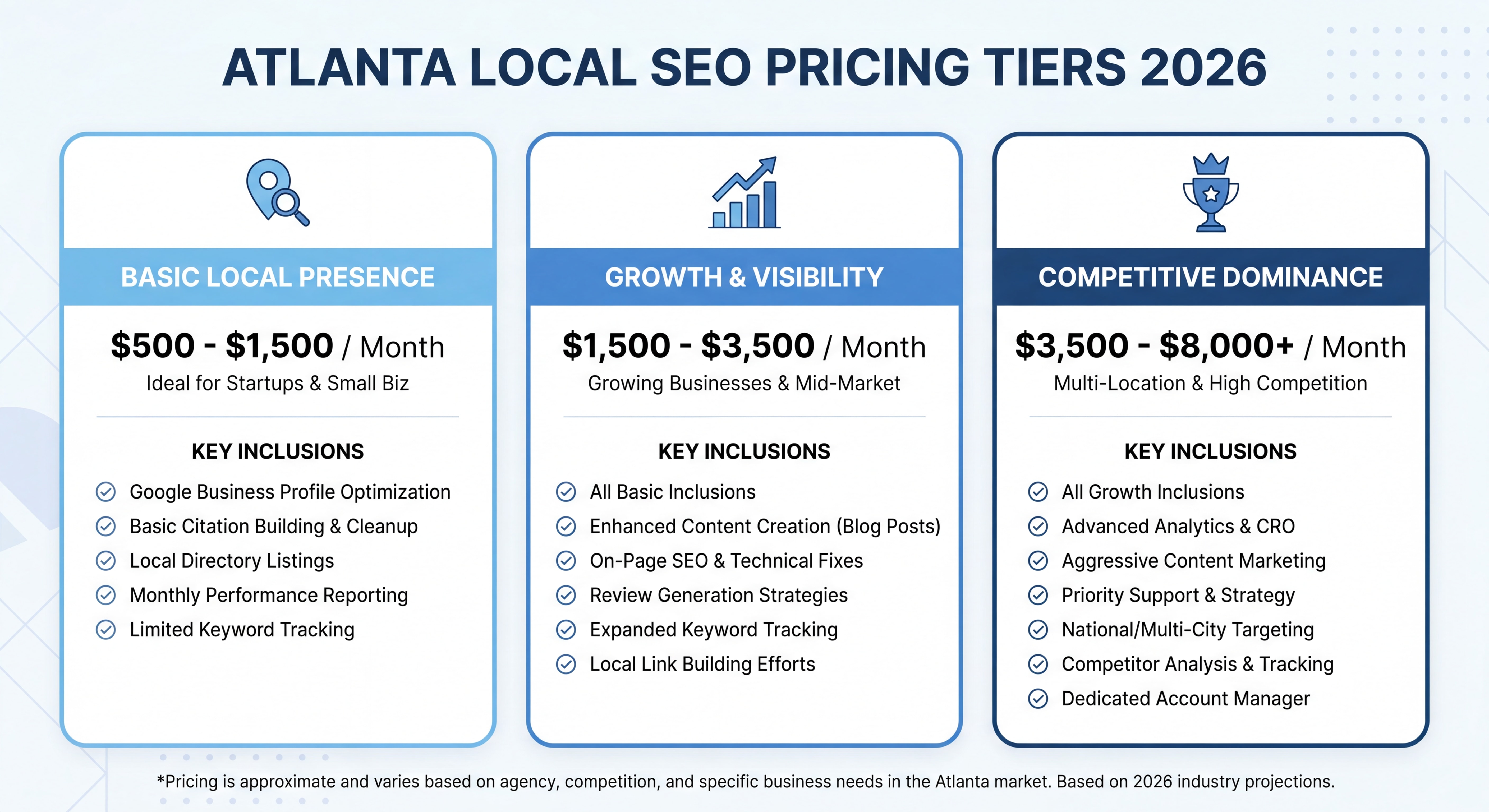
Current Atlanta Local SEO Pricing Tiers** – Google Business Profile signals now account for 32% of local pack ranking weight in 2026(/seo-services-atlanta/) that understand both the new algorithmic landscape and the specific competitive dynamics of the Atlanta metro.
📊 **Local SEO Pricing Research 2026]
Google Maps SEO: The New Ranking Signals Every Atlanta Business Must Know
The Google Maps SEO landscape shifted dramatically with the 2026 updates. Understanding what Google is actually measuring — and weighting — is the difference between a $1,500/month campaign that moves rankings and one that burns budget.
Here's the current breakdown of local pack ranking signals, post-March 2026 update:** – Atlanta businesses investing $1,500–$2,500/month in local SEO report an average ROI of 200–300% when attribution tracking is implemented correctly(https://limova-public-v2.s3.eu-central-1.amazonaws.com/blog-images/blog-image-1778504558383-8ewdmav7.jpeg)
AI Chatbots and Shopify: The Digital Stack Atlanta Businesses Are Building Alongside SEO
Here's something Atlanta's sharpest small business owners have figured out: ranking on Google Maps is only half the equation. What happens when a customer lands on your website matters just as much as getting them there.
That's where AI chatbots for small business and Shopify integrations are becoming part of the conversation — even for businesses that primarily rely on local SEO for discovery.
The AI Chatbot Shift of 2026
The chatbot market hit $11.8 billion globally in 2026, with ecommerce representing nearly 30% of that spend. But the more relevant development for Atlanta small businesses is what Forbes reported in April 2026: customers still prefer humans over AI chatbots for complex issues, but they actively want AI for fast, transactional interactions — order status, product questions, appointment scheduling.
This creates a clear strategy: deploy AI chatbots to handle the high-volume, low-complexity interactions (which frees your team for higher-value conversations), while maintaining a human escalation path for anything nuanced.
For Atlanta businesses running Shopify and chatbots website setups, the data is compelling. Proactive AI chatbots on Shopify stores are increasing conversion rates by 20–67% by eliminating purchase uncertainty and recommending relevant products. Stores deploying AI-powered recommendation chatbots report 15–35% conversion rate improvements across product discovery and guided selling.
The Shopify-ChatGPT integration announced in late 2025 — allowing Shopify merchants to sell products directly through ChatGPT conversations — is now live and represents a genuine new channel for Atlanta ecommerce businesses.
Building the Full Digital Stack
The Atlanta businesses pulling ahead in 2026 aren't choosing between SEO and AI tools — they're layering them:
- Local SEO drives discovery in Google Maps and organic search
- AI chatbots convert that traffic once it lands on the site
- Shopify integrations streamline the purchase path for ecommerce
For more on deploying AI tools alongside your SEO strategy, the recent deep-dives on AI chatbots just changed again — what Atlanta small businesses must know right now and AI chatbots for small business: 7 actionable strategies Atlanta owners can deploy today are worth reading alongside this piece.
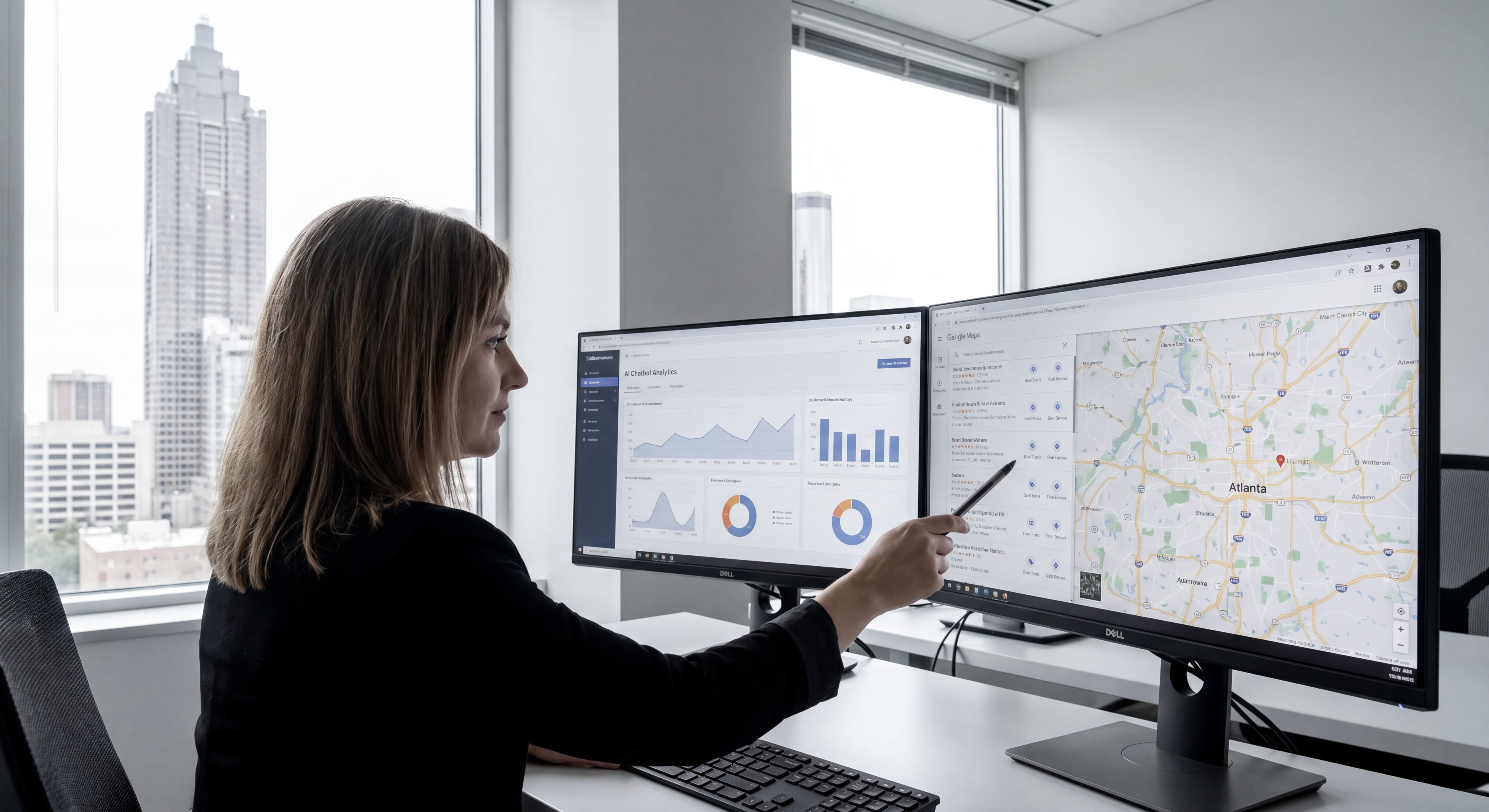
[STAT: The global chatbot market reached $11.8 billion in 2026, with ecommerce representing the largest segment at nearly 30% of total spend | Grand View Research 2026]
Chiffres Clés
📊 32% of local pack ranking weight now comes from Google Business Profile signals alone — up significantly from previous years (Source: Advice Local / ClickRank 2026 Local Ranking Factors Study)
💡 3 algorithm updates in four weeks — Google's February, March, and April 2026 updates represent the most concentrated period of local search volatility in recent memory (Source: Scorpion, March 2026)
📈 46% of all Google searches now carry local intent, making local SEO one of the highest-ROI channels for Atlanta businesses (Source: ClickRank Local SEO Ranking Factors 2026)
🤖 20–67% conversion rate increase reported by Shopify stores deploying proactive AI chatbot recommendations (Source: Qualimero / eCommerce AI Research 2026)
Questions Fréquentes (FAQ)
How much does local SEO cost for a small business in Atlanta in 2026?
Most Atlanta small businesses should budget between $1,000 and $2,500 per month for a legitimate, results-oriented local SEO campaign. Entry-level packages start around $500–$900/month but typically cover only GBP optimization and basic citations — which isn't enough to compete in most Atlanta markets post-2026 algorithm changes. One-time SEO audits run $300–$2,000+ depending on depth. The key question isn't what you pay — it's what you get, and whether the agency is doing the active, ongoing work that Google now requires.
What did Google's 2026 algorithm updates actually change for Atlanta businesses?
The March 2026 Core Update — the largest of three updates rolled out between February and April — fundamentally shifted local search toward active, ongoing profile management rather than historical accumulation. Businesses that keyword-stuffed their GBP descriptions, used templated location pages, or let their profiles go stale saw measurable ranking drops. Businesses with well-maintained profiles, genuine local content, and consistent review velocity largely held or gained ground. The update also strengthened AI-powered review detection, making fake review schemes more dangerous than ever.
What should I look for in a Google Maps SEO agency in Atlanta?
A credible agency should be actively managing your Google Business Profile — not just setting it up. Look for weekly GBP posts, photo uploads, review response management, and regular reporting on behavioral signals (clicks, calls, direction requests). They should also be doing citation audits, category optimization, and on-page local SEO for your website. If an agency can't clearly explain what they're doing each month and show you measurable movement in GBP insights, you're paying for a retainer without results. A good starting point is to get a free SEO audit to understand your current baseline before committing to any agency.
Are AI chatbots worth it for Atlanta small businesses?
Yes — with the right implementation. The key is matching the chatbot's role to what customers actually want from it: fast answers to transactional questions (hours, pricing, order status, booking), not complex consultations. Forbes research from April 2026 confirmed customers still prefer humans for nuanced issues, but actively want AI for speed and convenience on routine interactions. For Atlanta businesses with Shopify stores, AI chatbots are delivering measurable conversion lifts. The mistake is deploying a chatbot and treating it as a "set it and forget it" tool — it requires ongoing tuning to stay effective.
How long does it take to see results from local SEO in Atlanta?
For Google Maps / local pack rankings, most Atlanta businesses see initial movement within 60–90 days of consistent GBP optimization, citation cleanup, and review velocity improvements. More competitive markets (legal, healthcare, home services in Buckhead or Midtown) may take 4–6 months to see significant movement. Organic website rankings typically take longer — 3–6 months minimum. The businesses that see results fastest are those that start with a proper audit to identify quick wins versus longer-term plays.
Related Insights
- Why Your Website Isn't Ranking in Atlanta — And What to Do About It
- Advanced Web Design Atlanta: The Optimization Playbook That Actually Moves Rankings
- Web Design, Atlanta SEO Services & AI Chatbots: How to Pick the Right Digital Marketing Stack
Get Your Free SEO Audit {#cta}
Google's 2026 algorithm changes have reset the playing field for Atlanta local search — and the businesses that act now, with a clear picture of where they stand, are the ones that will own their local market over the next 12–18 months.
We work with Atlanta businesses across every neighborhood and industry — from Buckhead law firms to Decatur boutiques to Alpharetta tech companies. If you're serious about ranking in 2026's new local search environment, let's start with the data.