Most Atlanta businesses have a website. Far fewer have one that actually works. There’s a difference — a significant one — between a site that exists and a site that earns. Between a page that loads and a page that converts. Between an SEO strategy that looks busy and one that actually moves your rankings.
This isn’t a beginner’s guide to web design in Atlanta. You can find those anywhere. This is the advanced playbook: the technical decisions, the optimization layers, and the AI-powered tools that separate businesses growing their revenue online from businesses wondering why their phone isn’t ringing. If you’re already past the basics and want to know what the sharpest operators in Buckhead, Midtown, and Alpharetta are doing differently in 2026, keep reading.
Table of Contents
The Digital Blueprint Shift: Why Your Website Is a Business Asset, Not a Brochure {#the-digital-blueprint-shift}
Atlanta’s The Scale Tech put it plainly in January 2026: the corporate website has shifted from a marketing afterthought to what they called a “Digital Blueprint” — a core business asset that drives revenue, trust, and competitive positioning simultaneously. That framing matters.
For years, Atlanta business owners treated their website like a business card. Print it once, hand it out, forget about it. A Marietta contractor would build a five-page site in 2019, never touch it again, and then wonder in 2026 why a newer competitor with half the experience was getting all the calls. The answer was never the competitor’s experience. It was their digital infrastructure.
The businesses winning in Atlanta’s competitive market right now — whether they’re law firms in Sandy Springs, dental practices in Alpharetta, or HVAC companies serving the entire metro — treat their website as a living system. It gets audited. It gets optimized. It gets tested. And it integrates with every other piece of their marketing stack, including AI-powered tools that work around the clock so they don’t have to.
Here’s what that actually looks like in practice.
Advanced Web Design Principles That Drive Conversions in Atlanta {#advanced-web-design-principles}

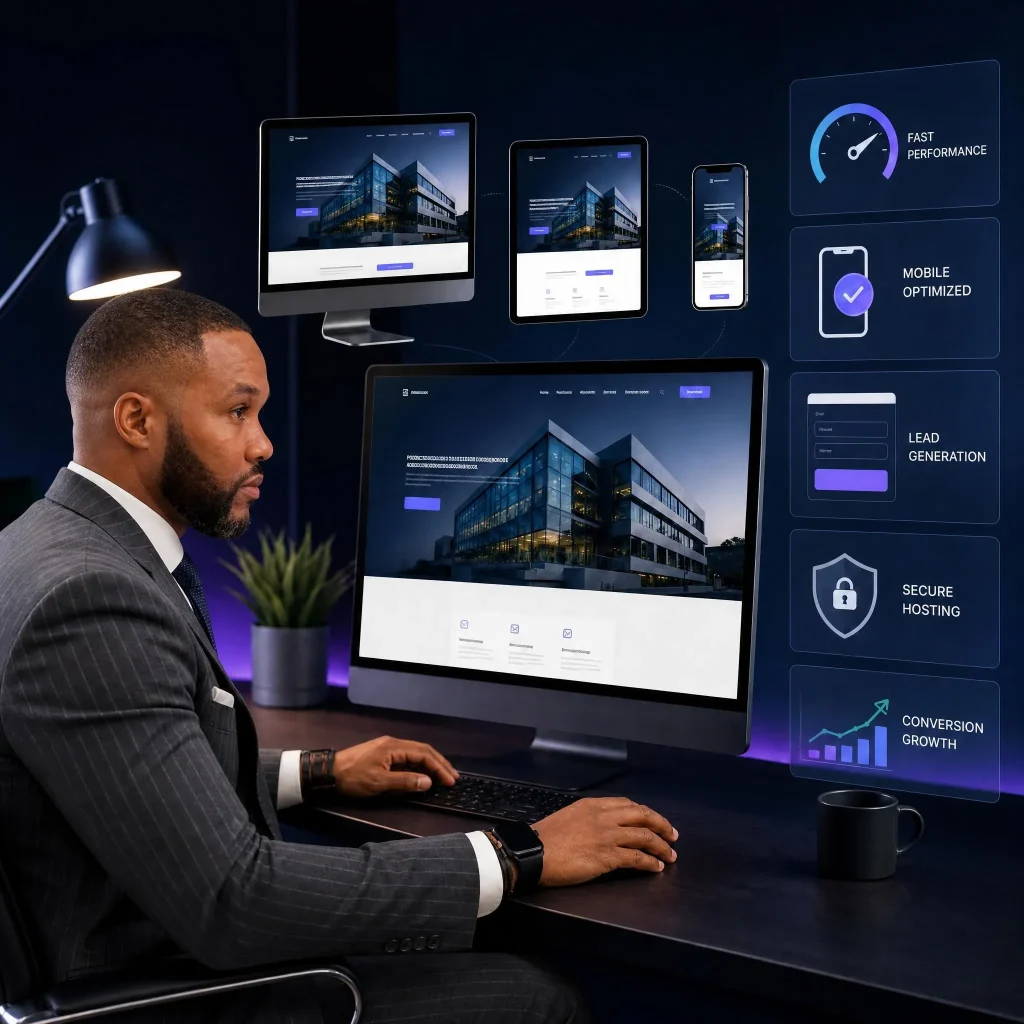
Good design is not the same as good web design. A beautiful site that loads slowly, confuses visitors, or buries the call-to-action is just expensive decoration. Advanced web design in Atlanta means building with conversion architecture from the ground up — not bolting it on afterward.
Core Web Vitals Are Not Optional in 2026
Google’s Core Web Vitals — Largest Contentful Paint (LCP), Interaction to Next Paint (INP), and Cumulative Layout Shift (CLS) — are ranking signals. Period. An Atlanta HVAC company with a 4.8-second LCP is competing against a competitor with a 1.9-second LCP. On mobile. In a market where 63% of local searches happen on smartphones.
Here’s what the numbers actually mean for your site:
| Core Web Vital |
Poor Score |
Needs Improvement |
Good Score |
Business Impact |
| LCP (Load Speed) |
>4.0s |
2.5–4.0s |
<2.5s |
7% conversion drop per second of delay |
| INP (Interactivity) |
>500ms |
200–500ms |
<200ms |
High bounce rates on mobile |
| CLS (Visual Stability) |
>0.25 |
0.1–0.25 |
<0.1 |
Users abandon unstable pages |
If your Atlanta site isn’t hitting “Good” across all three, you are paying a ranking penalty and a conversion penalty simultaneously. Fix it before you spend another dollar on ads.
Conversion Architecture: Building the Path, Not Just the Page
Most Atlanta web designers build pages. Advanced web design builds paths. The difference is intentionality. Every element on every page should answer one question: does this move the visitor closer to calling, booking, or buying?
The highest-converting Atlanta business sites in 2026 share a specific structural pattern:
Above the Fold: A clear, specific headline that names the outcome (not the service), a subheadline that names the audience and location, a primary CTA button, and a trust signal — a review count, a certification badge, or a specific result.
Social Proof Block: Not a generic “We love our customers!” statement. Specific, named outcomes. “A Decatur dental practice added 47 new patients in 90 days after a full site rebuild” converts. “Trusted by hundreds of Atlanta businesses” does not.
Process Section: Atlanta business owners are skeptical. They’ve been burned by agencies and vendors who overpromised. A transparent, numbered process section — showing exactly what happens after they contact you — removes the biggest objection before it’s ever raised.
Secondary CTA Placement: Place a second CTA after every major section. Not the same button. A softer offer — a free audit, a downloadable guide, a 15-minute call. Not everyone is ready to buy on the first scroll.
Mobile-First Is Not Mobile-Friendly
There’s a critical distinction most Atlanta agencies gloss over. Mobile-friendly means your desktop site doesn’t break on a phone. Mobile-first means you designed for the phone first, then scaled up to desktop. The experience is fundamentally different. On a mobile-first site, tap targets are large, forms are short, CTAs are sticky, and content is ruthlessly prioritized. On a mobile-friendly site, you’re just looking at a compressed version of something built for a 27-inch monitor.
In Old Fourth Ward, in Roswell, in Alpharetta — wherever your customers are — they’re searching on their phones. Build for that reality.
The Technical SEO Audit: What Atlanta Businesses Miss Every Time {#the-technical-seo-audit}

A proper SEO audit in Atlanta isn’t a 15-minute scan with a free tool. It’s a systematic investigation of every technical, on-page, and off-page factor that determines whether Google trusts your site enough to show it to people searching for your services. Most businesses — even those who’ve worked with agencies — have never had a real one done.
Here’s what a real SEO audit Atlanta covers, and what gets missed most often.
Technical Layer: The Foundation Most Agencies Skip
Crawl Budget Optimization: Google allocates a finite number of crawls to your site. If your Atlanta business website has hundreds of low-value pages — thin category pages, duplicate content from URL parameters, pagination issues — Google is wasting its crawl budget on pages that don’t matter. The fix: implement canonical tags, consolidate thin content, and submit a clean XML sitemap that directs crawlers to your highest-value pages.
Schema Markup: Local businesses in Atlanta that implement structured data — specifically LocalBusiness schema, Review schema, and FAQ schema — give Google explicit signals about who they are and what they do. A Buckhead law firm with proper schema markup is communicating directly with Google’s knowledge graph. A competitor without it is hoping Google figures it out on its own. Schema is not optional for local SEO in 2026.
Internal Link Architecture: The way your pages link to each other tells Google which pages are most important. Most Atlanta business sites have a flat architecture where every page gets roughly equal link equity. Advanced SEO means deliberately funneling authority to your highest-priority service pages through strategic internal linking — using keyword-rich anchor text, not “click here.”
On-Page Layer: Beyond Keywords
Keyword placement is table stakes. The advanced on-page factors that move rankings in Atlanta’s competitive market in 2026 are:
E-E-A-T Signals: Experience, Expertise, Authoritativeness, and Trustworthiness. Google’s quality raters evaluate these signals on every page. For Atlanta businesses, this means: author bios with credentials on blog posts, real business address and phone number in the footer, verified Google Business Profile linked from the site, and industry credentials displayed prominently. A Virginia-Highland restaurant with a verified GBP, a linked Yelp profile, and a chef bio page ranks higher than one without — all else being equal.
Content Depth vs. Content Length: The mistake most Atlanta businesses make is confusing long content with good content. A 2,000-word page that repeats the same three points in different ways is not better than a 900-word page that answers every question a potential customer has. Depth means covering the topic completely, addressing objections, and providing specific local context. Length is just a number.
Page Experience Signals: HTTPS, no intrusive interstitials, logical page structure, and mobile usability all factor into rankings. These aren’t advanced — they’re baseline. But a surprising number of Atlanta business sites still fail one or more of these checks.
Off-Page Layer: Link Building in Atlanta’s Market
Local link building is different from national link building. For Atlanta businesses, the highest-value links come from:
- Atlanta Business Chronicle features and mentions
- Georgia Chamber of Commerce listings
- Industry associations (Georgia Bar Association for law firms, Georgia Dental Association for practices)
- Local sponsorships with digital footprints (Atlanta United, Braves sponsorship pages, local event sites)
- Neighborhood business associations (Buckhead Coalition, Midtown Alliance, etc.)
A single link from the Atlanta Business Chronicle is worth more than 50 links from generic directory sites. Quality over quantity. Always.
Content Marketing Atlanta: The Depth-Over-Volume Strategy {#content-marketing-atlanta}
DigiMarCon Southeast 2026 is returning to Atlanta this year — a signal of how seriously the city’s business community is taking digital marketing as a competitive differentiator. The conversations happening at those tables aren’t about posting more on social media. They’re about content that compounds.
The shift in content marketing Atlanta businesses need to understand in 2026 is this: Google’s AI-powered search results favor content that demonstrates genuine expertise and answers real questions completely. A blog post that skims the surface of a topic ranks below a page that goes deep, cites sources, and provides actionable guidance.
The Topic Cluster Model for Atlanta Businesses
Instead of writing random blog posts about anything loosely related to your industry, the advanced approach is topic clusters: one authoritative “pillar” page on a broad topic, supported by multiple “cluster” pages that go deep on specific subtopics, all internally linked.
Example for an Atlanta HVAC Company:
| Pillar Page |
Cluster Pages |
| HVAC Services Atlanta |
AC Repair Costs in Atlanta |
|
Best HVAC Brands for Georgia Climate |
|
How Often to Service HVAC in Atlanta |
|
Emergency HVAC Repair Alpharetta |
|
HVAC Maintenance Checklist for Atlanta Homeowners |
Each cluster page links back to the pillar. The pillar links out to each cluster. Google sees a network of deeply related, authoritative content and ranks the entire cluster higher — not just individual pages.
Atlanta-Specific Content That Competitors Can’t Copy
The content that performs best for Atlanta businesses is content that is genuinely, specifically local. Not “how to choose an HVAC company” — any company in any city can write that. But “why Atlanta’s humidity makes HVAC maintenance more critical than in other Southern cities” — that’s content only someone who knows this market can write credibly.
Reference the Georgia climate. Reference Atlanta’s specific neighborhoods and their housing stock. Reference local regulations, local competition, local events. A Decatur restaurant writing about “the best date night spots near Oakhurst Village” is creating content that earns local links, drives local search traffic, and builds genuine community trust. That’s content marketing Atlanta businesses can actually use.
AI Chatbot Integration: What Actually Works for Atlanta SMBs {#ai-chatbot-integration}
The AI chatbot conversation in 2026 is noisy. Every vendor is promising the world. The reality for Atlanta small and mid-size businesses is more nuanced — and more practical — than the hype suggests.
Here’s the honest breakdown: an AI chatbot on your Atlanta business website can meaningfully improve lead capture, reduce response time, and qualify visitors before they ever speak to a human. But only if it’s implemented correctly. A poorly configured chatbot drives visitors away faster than a slow website.
What AI Chatbots Actually Do Well for Atlanta Businesses
Lead Capture After Hours: Atlanta businesses lose leads every night. A visitor lands on your site at 10 PM, has a question, finds no one available, and leaves. An AI chatbot captures that visitor — gets their name, their question, their phone number — and queues a follow-up for the next morning. For a Roswell law firm or an Alpharetta medical practice, that’s a real, measurable business impact.
FAQ Deflection: If your Atlanta business gets the same 10 questions over and over — “What are your hours?”, “Do you serve my area?”, “What does a service call cost?” — a properly trained AI chatbot handles all of them instantly. That frees your team for conversations that actually require a human.
Appointment Pre-Qualification: For service businesses in Atlanta — dentists, contractors, HVAC companies — an AI chatbot can walk a visitor through a pre-qualification sequence before they book. What type of service do you need? What’s your zip code? Is this an emergency? By the time the lead hits your calendar, you already know if it’s worth your time.
Implementation Best Practices That Most Atlanta Businesses Get Wrong
| Common Mistake |
Advanced Approach |
Business Impact |
| Generic greeting (“Hi, how can I help?”) |
Specific, page-aware opener (“Looking for AC repair in Atlanta? I can help.”) |
3x higher engagement rate |
| No fallback to human |
Clear escalation path to live chat or call |
Prevents frustrated abandonment |
| Chatbot on every page |
Strategic placement on high-intent pages only |
Cleaner UX, higher conversion |
| No CRM integration |
Full sync with CRM and email automation |
Zero leads fall through the cracks |
| Static responses only |
Dynamic responses based on visitor behavior |
Feels like a real conversation |
The Atlanta businesses getting real ROI from AI chatbots in 2026 are treating them as part of their full marketing stack — not as a standalone widget. The chatbot feeds the CRM. The CRM triggers the email sequence. The email sequence books the call. That’s a system. That’s what converts.
Choosing the Right AI Chatbot for Your Atlanta Business
Not all chatbots are built the same. For Atlanta SMBs, the evaluation criteria should be:
Training Flexibility: Can you train the chatbot on your specific services, your specific service area (Buckhead, Midtown, Sandy Springs, etc.), and your specific pricing? A chatbot that gives generic answers about your industry is worse than no chatbot at all.
Integration Depth: Does it connect to your CRM, your booking system, your email platform? Standalone chatbots create data silos. Integrated chatbots create revenue.
Escalation Logic: When a visitor is ready to buy or has a complex question, the chatbot should recognize that and route them to a human — not keep trying to answer. The best AI chatbots know their limits.
The Full-Stack Optimization Stack: Putting It All Together {#the-full-stack-optimization-stack}
The businesses that are genuinely dominating in Atlanta’s digital market in 2026 aren’t just doing one of these things well. They’ve built a system where web design, SEO services, content marketing, and AI tools work together as a unified growth engine.
Here’s what that stack looks like in practice:
Layer 1 — Foundation (Web Design Atlanta): A fast, mobile-first site built with conversion architecture. Core Web Vitals in the green. Schema markup implemented. Clear hierarchy. Sticky CTAs on mobile. Trust signals above the fold.
Layer 2 — Visibility (SEO Services Atlanta): A full technical SEO audit identifying and fixing every crawl issue, duplicate content problem, and missing schema element. A local SEO strategy that optimizes the Google Business Profile, builds local citations, and earns links from Atlanta-specific sources.
Layer 3 — Authority (Content Marketing Atlanta): A topic cluster strategy that builds topical authority in your industry and your geography. Content written with genuine local expertise — not generic posts with the city name swapped in.
Layer 4 — Conversion (AI Chatbot + CRO): An AI chatbot trained on your specific business, integrated with your CRM, deployed on high-intent pages. Conversion rate optimization testing on your key landing pages. Heat mapping to understand where visitors are dropping off.
Layer 5 — Measurement: Google Analytics 4 configured correctly, with conversion tracking, goal funnels, and attribution modeling. You can’t optimize what you can’t measure. Most Atlanta businesses are flying blind.
Each layer supports the others. Fast web design makes SEO easier. Strong SEO drives more traffic to well-designed pages. Good content gives the AI chatbot real answers to give visitors. It’s not four separate projects — it’s one system.
📊
Atlanta ranks among the top U.S. cities for “SEO near me” search demand – Local SEO Demand
📊
63% of local searches in competitive metro markets occur on mobile devices – Mobile Search Dominance
📊
Businesses using AI chatbots for after-hours lead capture report 25–40% increase in qualified leads – AI Chatbot Lead Capture
“”The corporate website has shifted from a marketing afterthought to a core business asset — the Digital Blueprint — that drives revenue, trust, and competitive positioning simultaneously.””
— The Scale Tech, Atlanta(https://infinitemarketing.co), we run full-stack audits that cover web design performance, technical SEO, content strategy, and AI tool integration — all built specifically for the Atlanta market. Get a free SEO audit Atlanta — no fluff, just data, and a clear plan for what to fix first.