If you're a small business owner in Atlanta trying to figure out what local SEO cost in Atlanta actually looks like — and whether you're getting real results for your money — this guide is for you. Not theory. Not vague "best practices." Concrete, step-by-step strategies you can act on this week to improve your Google Maps visibility, deploy AI chatbots that convert, and integrate smart tools on your Shopify website — without burning your entire marketing budget.
Atlanta's digital marketing landscape is more competitive than ever. Google's 2026 local SEO crackdown has forced U.S. small businesses to rethink their primary keyword strategies, and the businesses winning right now aren't the ones spending the most — they're the ones spending the smartest. Let's break down exactly how to do that.
Table of contents
- What Local SEO Actually Costs in Atlanta (And What to Demand for It)
- Step-by-Step: How to Dominate Google Maps as an Atlanta Business
- How AI Chatbots Give Atlanta Small Businesses a Competitive Edge
- Shopify + Chatbots: The Atlanta Ecommerce Stack That Drives Revenue
- FAQ
- Key Statistics
- Related Insights
What local SEO actually costs in atlanta (and what to demand for it)
Before you sign any contract with an local SEO services in Atlanta agency, you need to understand what pricing actually means — and what red flags to avoid.
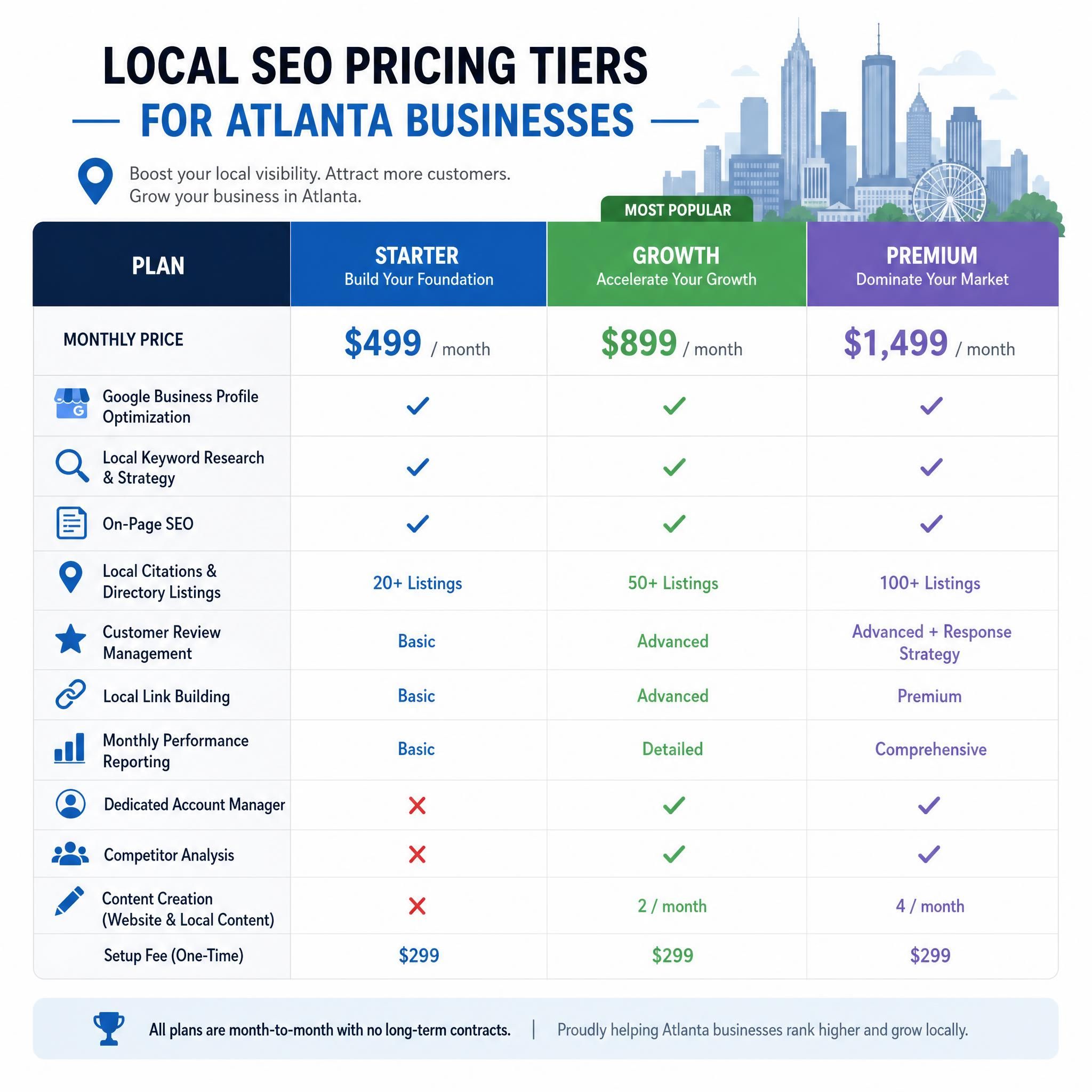
Local SEO costs an average of $500 to $3,000 per month, with some small businesses paying around $1,000 per month while enterprises pay more than $5,000 per month. Your costs can vary depending on the number of locations you have and the scope of services and projects you need.
Here's how that breaks down for Atlanta-specific businesses:
| Business Type | Monthly SEO Investment | What You Should Expect |
|---|---|---|
| Single-location service biz | $300–$600/mo | GBP optimization, citation building, review management |
| Competitive Atlanta market (law, HVAC, dental) | $800–$1,500/mo | Full local SEO + content + Maps strategy |
| Multi-location Atlanta brand | $1,500–$3,000+/mo | Location pages, advanced GBP, link building |
| Enterprise / ecommerce | $3,000–$5,000+/mo | Full-funnel SEO + AI optimization |
Among agencies that raised prices in 2025–2026, 37% cited GEO and AEO services — optimizing for visibility inside ChatGPT, Perplexity, and Google AI Overviews — as the primary reason, often charged separately at $900 or more per month.
What this means for Atlanta businesses: If an agency quotes you $200/month for "full SEO," walk away. If they're quoting $1,500+ and can't explain exactly what deliverables you'll receive each month — also walk away. Demand a clear scope: GBP management, citation audits, monthly reporting, and content creation should all be itemized.
One smart move before committing to any retainer? Get a free SEO audit to understand exactly where your business stands and what's actually worth fixing first.
Step-by-step: how to dominate Google maps as an atlanta business
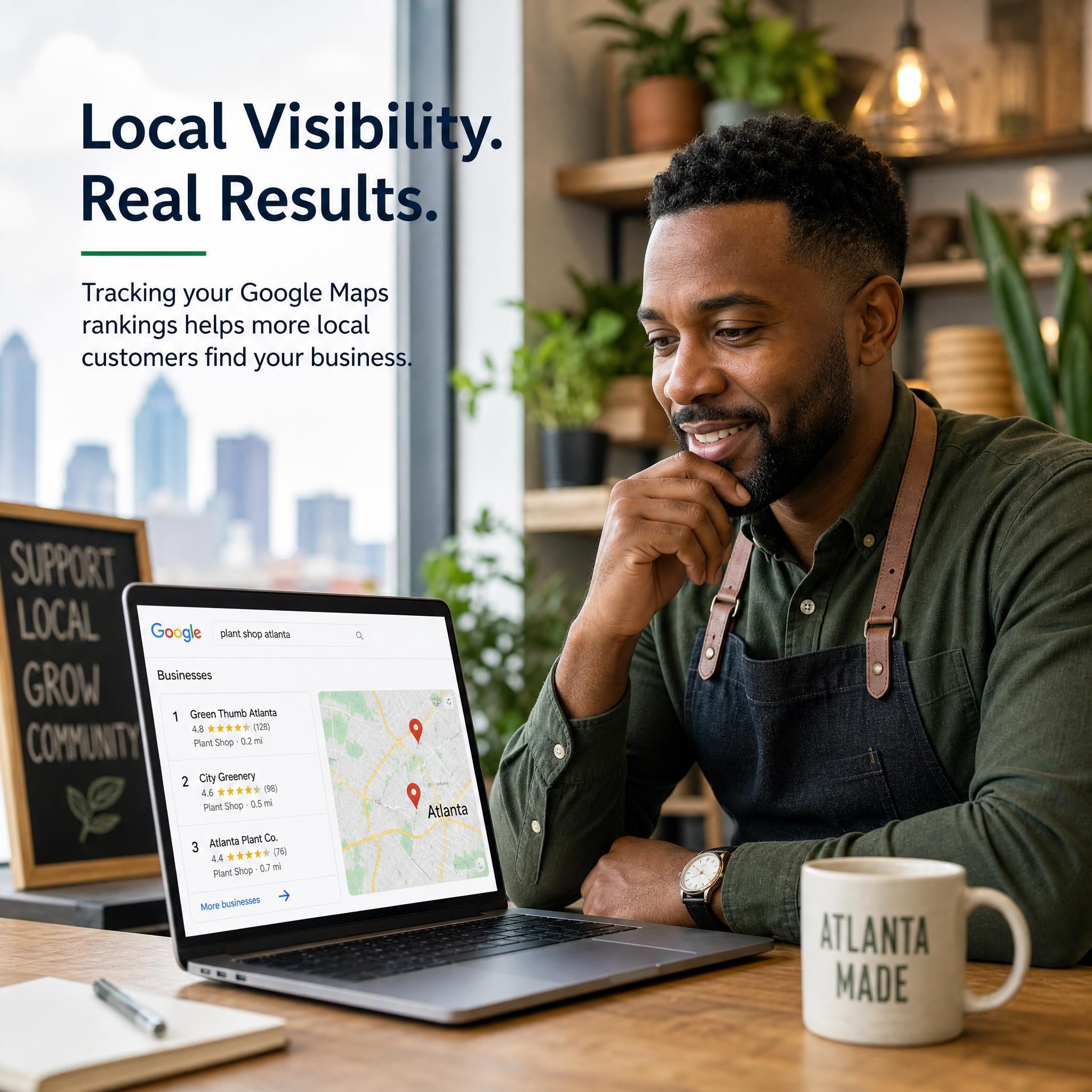
Google Maps visibility is the single highest-ROI lever most Atlanta small businesses aren't pulling hard enough. 87% of consumers use Google to find local businesses, and 76% of people who search for something "near me" visit a business within 24 hours. That's not a nice-to-have — that's your entire walk-in traffic strategy.
Here's the actionable playbook:
Step 1: lock down your Google business profile category
According to Whitespark's 2026 Local Search Ranking Factors report, the #1 ranking factor for Google Maps is your primary GBP category. Most Atlanta businesses pick a category once and never revisit it. That's a mistake.
Action: Log into your GBP dashboard. Confirm your primary category is the most specific option available. If you're a "Plumber," don't just select "Plumber" — check if "Emergency Plumber" or "Drain Cleaning Service" better matches your top revenue service.
Step 2: nail your NAP consistency across every directory
NAP = Name, Address, Phone. If your business is listed as "Johnson HVAC" on Google but "Johnson HVAC Services LLC" on Yelp and "Johnson Heating & Cooling" on Angi — Google sees three different businesses. This kills your Maps ranking.
Action: Run a citation audit. Check your listings on Google, Yelp, Bing Places, Apple Maps, Angi, HomeAdvisor, and any Atlanta-specific directories. Every listing should match your GBP exactly — same business name, same address format, same phone number.
Step 3: build a review velocity system (not just a review count)
Businesses with updated photos, reviews, and business details receive up to 42% more direction requests and 35% more website clicks. But it's not just about total reviews — recency matters enormously in 2026.
Action: Create a simple post-service text or email sequence. After every job, send: "Thanks for choosing [Business Name]! If we earned it, a quick Google review helps other Atlantans find us: [link]". Aim for at least 2–4 new reviews per month minimum. Respond to every single review — positive and negative.
Step 4: post to your GBP weekly
Most Atlanta businesses set up their GBP profile and ghost it. Google's algorithm treats your GBP like a social media profile — activity signals freshness and relevance.
Action: Post once per week. Rotate between: a recent project photo, a seasonal promotion, a tip relevant to your service, and a customer spotlight. Each post should include your city name ("serving Buckhead," "available across Midtown Atlanta") and your primary service keyword.
Step 5: align your website pages with your GBP services
The alignment strategy most businesses miss is matching GBP services to your website pages — this approach jumped 75 positions in importance according to the 2026 Local Search Ranking Factors report.
Action: Every service listed in your GBP should have a corresponding page on your website. If you list "Roof Inspection" as a GBP service, you need a dedicated /roof-inspection-atlanta/ page with at least 500 words of content. This alignment sends powerful relevance signals to Google.
For a deeper dive into what's holding your site back from ranking, check out why your website isn't ranking in Atlanta — it covers the technical and on-page issues that silently kill Maps performance.
How AI chatbots give atlanta small businesses a competitive edge
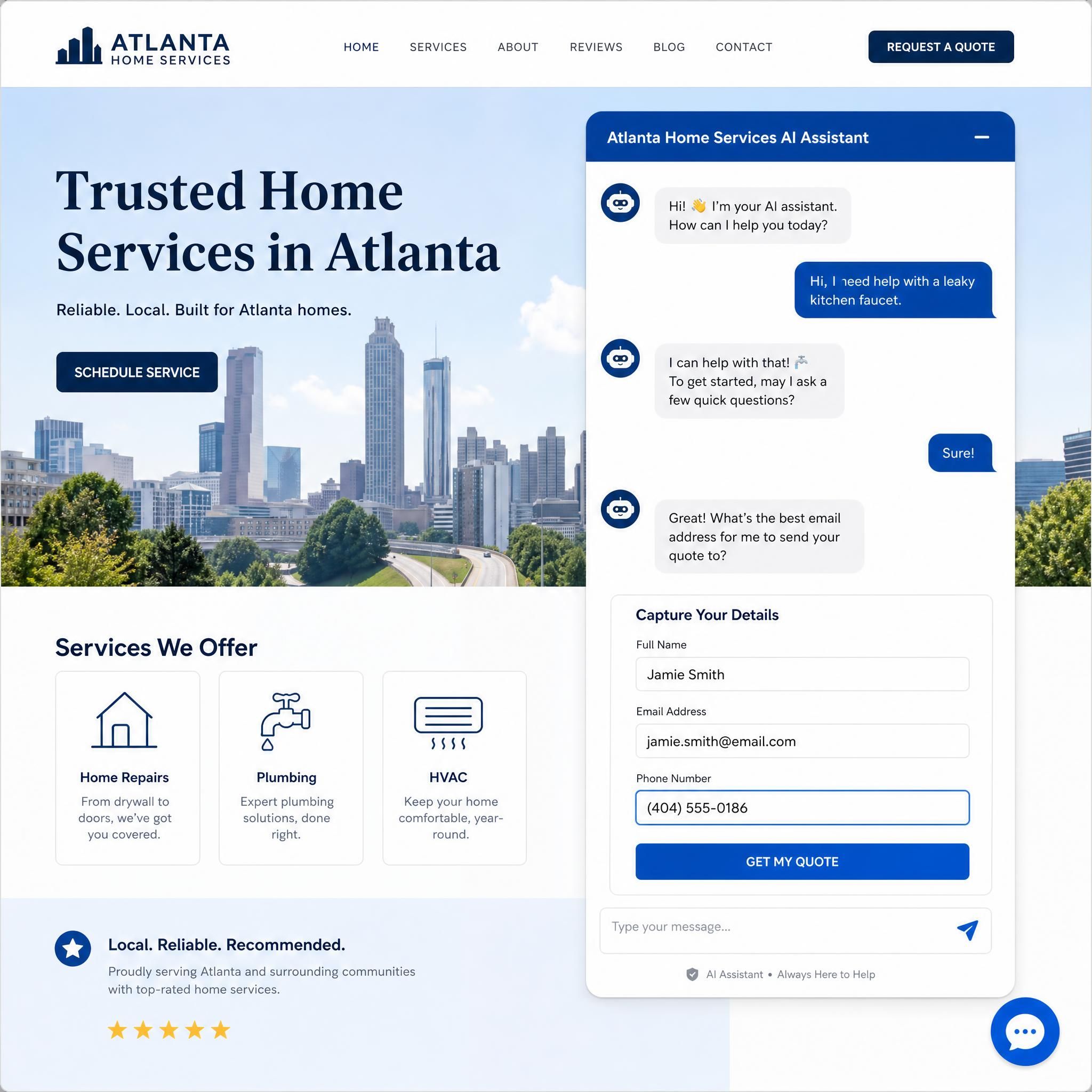
Atlanta small businesses are sitting on an untapped conversion tool: AI chatbots. And the data in 2026 is impossible to ignore.
Businesses deploying AI-powered chatbots are seeing 20–40% increases in lead conversion rates, 30–60% reductions in support costs, and positive ROI within 12 months of proper implementation.
Here's how Atlanta service businesses should deploy them strategically:
Chatbot use case #1: after-hours lead capture
Most Atlanta service businesses lose leads between 6 PM and 8 AM — when customers are searching but no one's answering the phone. An AI chatbot can qualify leads, collect contact information, and schedule callbacks 24/7.
Implementation: Configure your chatbot to ask three qualifying questions: What service do you need? What's your zip code? What's the best time to reach you? This single setup can recover 15–25% of after-hours traffic that would otherwise bounce.
Chatbot use case #2: FAQ deflection to free up your team
62% of respondents prefer engaging with customer service digital assistants rather than waiting for human agents, and chatbots have the potential to automate 30% of tasks performed by contact center staff.
For Atlanta businesses fielding repetitive questions ("Do you serve Decatur?" "What are your hours?" "Do you offer free estimates?"), a well-trained chatbot handles these instantly — freeing your team for actual revenue-generating conversations.
Chatbot use case #3: proactive engagement on high-intent pages
Don't just place a chatbot in the corner of your homepage. Deploy it proactively on your highest-intent pages: service pages, pricing pages, and your contact page. Set a trigger: if a visitor spends 30+ seconds on your "HVAC Repair Atlanta" page without clicking, the chatbot fires: "Need a same-day quote? I can get that started for you in 60 seconds."
Industry data shows that AI chatbots increase conversion rates by 23% when they guide customers through purchasing decisions.
For more tactical chatbot deployment strategies, read AI chatbots for small business: 7 actionable strategies Atlanta owners can deploy today.
Shopify + chatbots: the atlanta ecommerce stack that drives revenue
If you're running a Shopify store as part of your Atlanta business, you're leaving serious money on the table without a chatbot integration. Here's the specific playbook.
Tackle cart abandonment head-on
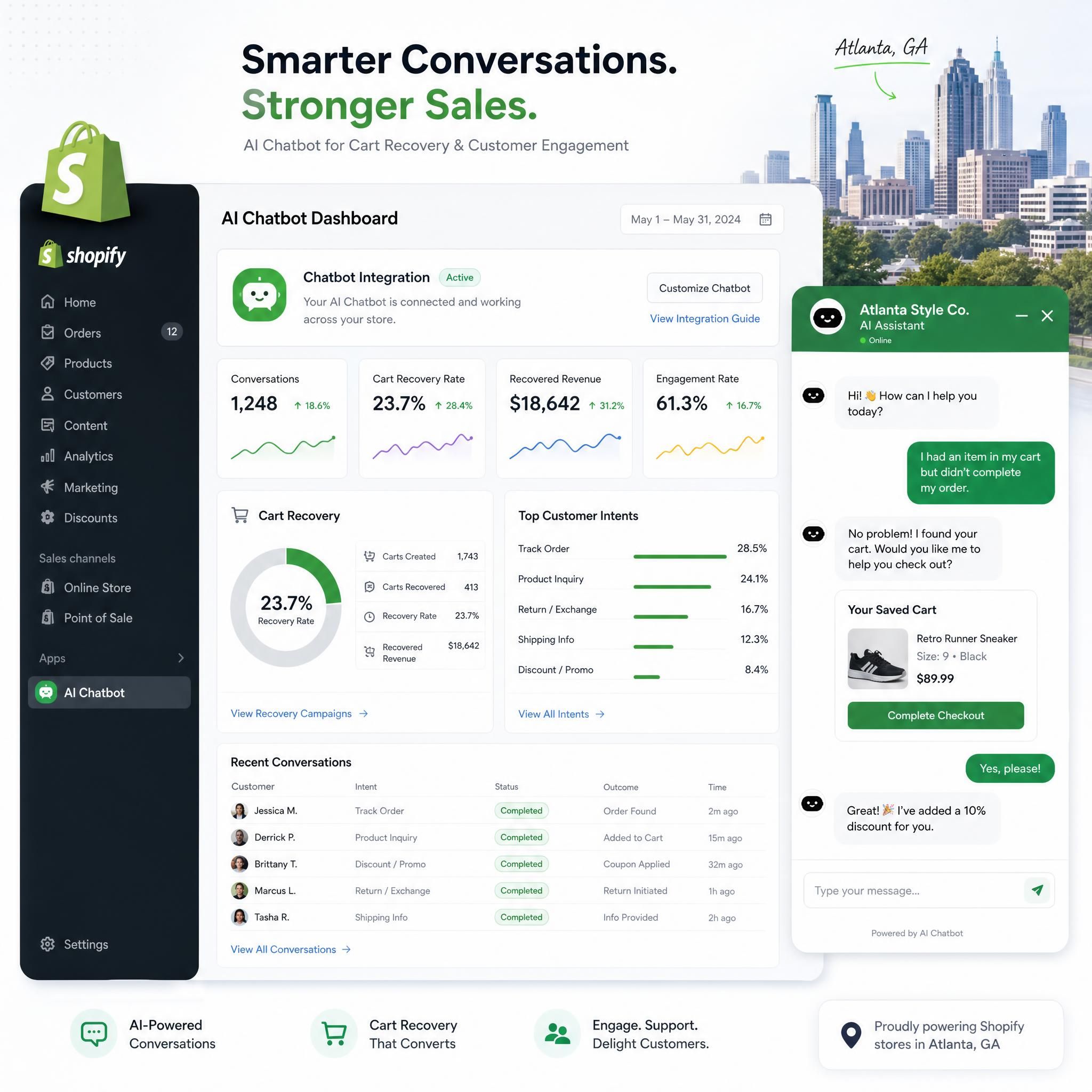
Cart abandonment rates hover around 70%, largely driven by unanswered questions. AI chatbots combat this by providing instant, accurate answers that build trust and increase conversion rates.
Action: Set up a Shopify chatbot trigger that fires when a user has items in their cart and has been inactive for 2+ minutes: "Still deciding? I can answer any questions about sizing, shipping, or returns — what's holding you back?"
Use chatbots for post-purchase upsells
Most Shopify merchants focus chatbots entirely on pre-purchase support. The smarter play is post-purchase engagement. After an order is confirmed, your chatbot can recommend complementary products, offer a loyalty discount on the next order, or invite customers to leave a Google review — which feeds directly back into your local SEO performance.
Integrate your chatbot with your shopify product catalog
The best Shopify chatbots in 2026 connect directly to your product catalog, allowing them to answer specific questions like "Do you have this in a size 10?" or "Is the blue version in stock?" in real time. Customer expectations have shifted dramatically, with 74% now demanding 24/7 service, making AI-powered support essential for modern Shopify stores.
Recommended Stack for Atlanta Shopify Merchants:
- Chatbot: Tidio, Gorgias, or Wonderchat (all have native Shopify integrations)
- Review Collection: Klaviyo post-purchase flow → Google review request
- Local SEO Bridge: Link your Shopify store's /contact page to your GBP for citation consistency
For real Atlanta ecommerce transformation stories, see 5 jaw-dropping Atlanta business transformations powered by a Shopify developer.
Frequently asked questions
How much should an Atlanta small business budget for local SEO in 2026?
For a single-location service business in Atlanta competing in a moderately competitive category (landscaping, cleaning, HVAC), budget $500–$900/month for meaningful results. In highly competitive niches like personal injury law, dental, or roofing, expect $1,200–$2,500/month for a reputable agency. Avoid any agency offering "full SEO" for under $300/month — that's either automated software with no human strategy or offshore content that will hurt more than help. Before committing to any budget, get a free SEO audit to identify your highest-priority gaps.
What's the fastest way to improve my Google Maps ranking in Atlanta?
The fastest wins come from your Google Business Profile: update your primary category, add 10+ recent photos, respond to all existing reviews, and post a GBP update this week. These actions cost nothing and can produce measurable ranking movement within 30–60 days. For bigger jumps, focus on building review velocity (2–4 new reviews per month) and ensuring your website has dedicated pages for each GBP service you list.
Do AI chatbots actually work for small businesses, or are they just for big companies?
They work exceptionally well for small businesses — often better, because the ROI is more visible. A small HVAC company in Atlanta that captures 3 extra after-hours leads per week via chatbot, at an average job value of $400, generates $62,400 in additional annual revenue. Chatbot tools like Tidio start at $19/month. The math is straightforward.
Can a Shopify chatbot help with local SEO?
Indirectly, yes. A chatbot that collects post-purchase reviews and routes customers to your Google Business Profile review link builds your review count — which is a direct local ranking factor. Additionally, a well-configured chatbot reduces bounce rate and increases on-site engagement time, both of which send positive signals to Google about your site's quality.
What's the difference between a Google Maps SEO agency and a general SEO agency?
A Google Maps SEO agency specializes in local pack optimization — GBP management, citation building, review strategy, and proximity signals. A general SEO agency focuses on organic rankings. For most Atlanta small businesses with a physical location or service area, Google Maps visibility drives more immediate foot traffic and phone calls than organic rankings. Ideally, your agency handles both — but if budget is tight, prioritize Maps first.
Chiffres clés / key statistics
📊 76% of people who search "near me" on Google visit a business within 24 hours — making Google Maps the highest-converting local marketing channel available. (Source: Google/Ipsos, 2026)
📊 23% increase in conversions when guiding purchase decisions – AI Chatbot Conversion Lift
💡 $1,500–$5,000/month is the most common local SEO investment tier, with 48% of agencies operating in this range for competitive markets. (Source: Goodfirms Agency Survey, April–May 2026)
📊 ~70% of carts abandoned due to unanswered questions – Shopify Cart Abandonment
📈 32% of Google Maps local pack rankings are determined by Google Business Profile signals alone — making GBP the single highest-leverage optimization asset for Atlanta businesses. (Source: Whitespark Local Search Ranking Factors, 2026)
📊 Businesses with updated photos and reviews get 42% more direction requests – Review Impact on GBP
Related insights
- Advanced Web Design Atlanta: The Optimization Playbook That Actually Moves Rankings
- AI Chatbots Just Changed Again: What Atlanta Small Businesses Must Know Right Now
- How Atlanta Businesses Are Winning with Web Design, SEO, and AI: Real Results, Real Numbers
Ready to stop guessing and start ranking?
You now have the exact playbook — from understanding what local SEO cost in Atlanta actually buys you, to dominating Google Maps, deploying AI chatbots that capture leads around the clock, and building a Shopify stack that converts browsers into buyers. The businesses winning in Atlanta right now aren't waiting for perfect conditions. They're executing.
Our Atlanta-based team will audit your Google Maps presence, identify the exact gaps costing you leads, and hand you a prioritized action plan — no obligation, no sales pressure. Just clarity on what's actually holding your business back in one of the most competitive local markets in the Southeast.