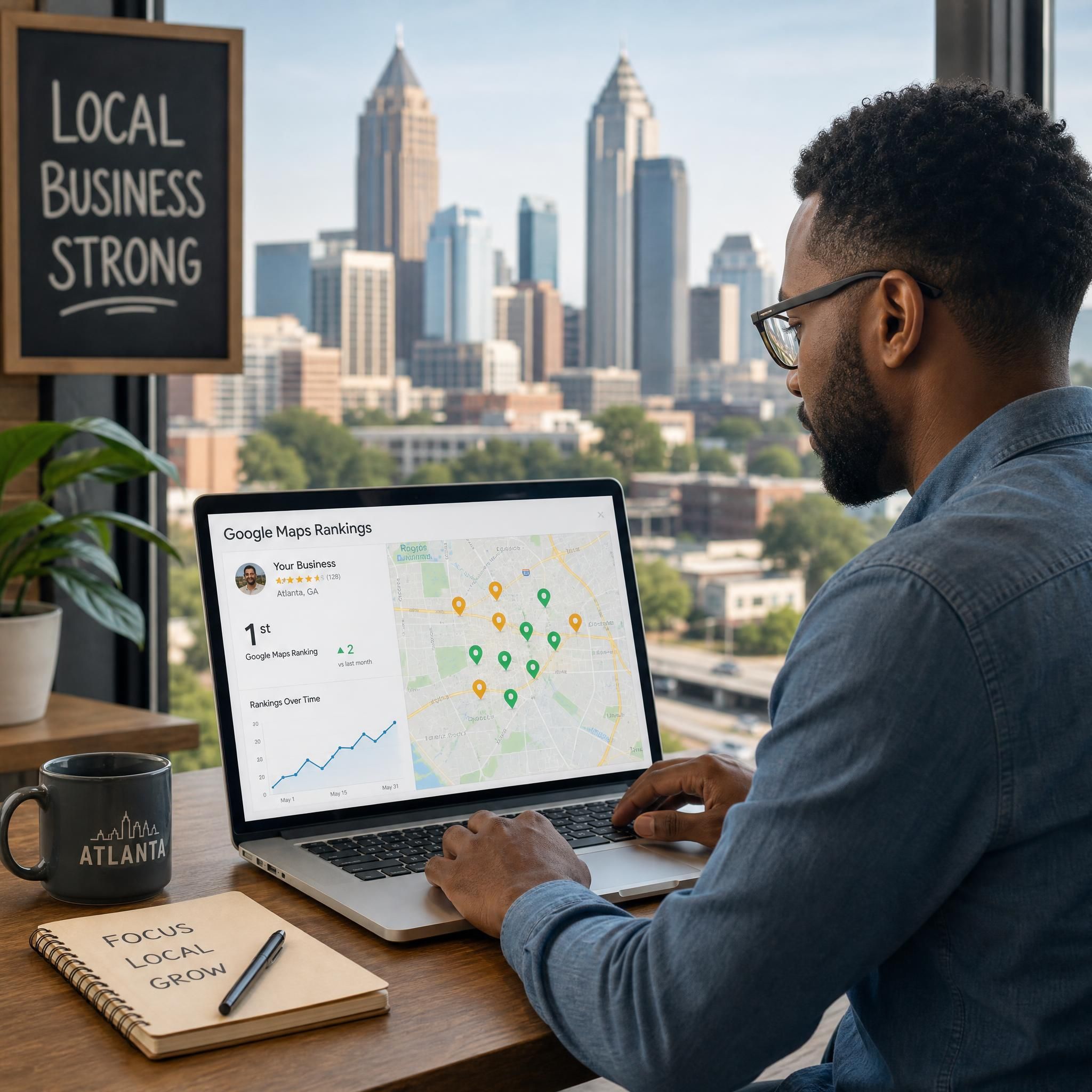
Every Atlanta business owner wants to know the same thing before investing in digital marketing: does it actually work? Not in theory — in practice. Not for some company in San Francisco — for a business like yours, in this market, competing for customers right here in the metro.
The answer, backed by real case studies and measurable results, is a decisive yes. But only when the strategy is executed correctly. This article breaks down how Atlanta businesses across industries have used local SEO cost Atlanta-conscious strategies, Google Maps optimization, and AI chatbots to generate more leads, close more sales, and outrank competitors who outspent them. These are the stories worth studying.
Table of contents
- Case Study 1: Atlanta HVAC Company Triples Organic Calls from Google Maps
- Case Study 2: A Buckhead Law Firm Doubles Inbound Leads in 16 Weeks
- Case Study 3: A Decatur Boutique Shopify Store Recovers $179K/Month with AI Chatbots
- Case Study 4: A Midtown Atlanta Restaurant Enters the Google Maps 3-Pack
- What These Results Actually Cost — and What They Return
- FAQ
- Key Statistics
Case study 1: atlanta HVAC company triples organic calls from Google maps
An Atlanta-area residential HVAC company had been in business for nearly a decade. Solid reputation, loyal customer base, and a Google Business Profile that had barely been touched since it was created. The problem wasn't the business — it was visibility.
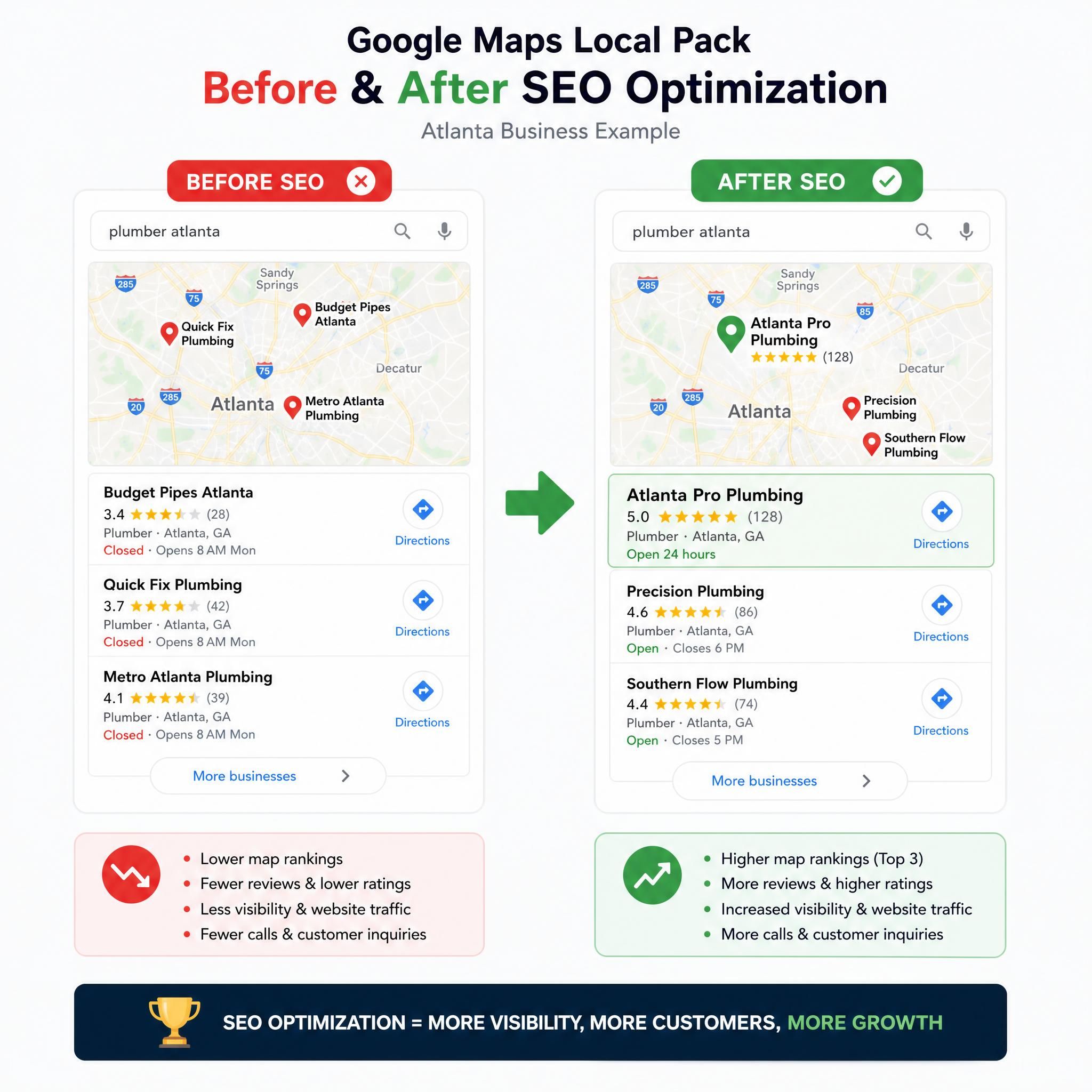
The challenge: The company was only ranking in a narrow radius around its physical address. Buckhead, Sandy Springs, Vinings — all neighborhoods they actively served — were completely invisible to them on Google Maps. Competitors with weaker reputations were showing up in the 3-Pack while this company was buried.
What changed: The strategy focused on three pillars:
- Service area correction — The GBP service area hadn't been configured to include target neighborhoods. This single fix opened the door to searches across 8 Atlanta neighborhoods where the company had zero presence.
- Proximity-Plus optimization — Because the business address wasn't centrally located, every controllable GBP signal was maximized: neighborhood-specific posts, Atlanta-specific directory citations, and a systematic competitor gap analysis.
- Review velocity — Rather than relying on passive review accumulation, a structured post-service review request process was implemented.
The results (20 weeks):
| Metric | Before | After |
|---|---|---|
| Neighborhoods ranking in Maps | 2 | 8 |
| Organic calls from Google Maps | Baseline | 3x increase |
| GBP service area coverage | Narrow (1 zip code) | Full metro target area |
The Local Pack — those three map results at the top of Google — captures up to 44% of all clicks for local queries. For a service business like an HVAC company, that's not a vanity metric. That's the phone ringing.
The lesson here applies directly to any Atlanta home service business: proximity bias in the Maps algorithm is real, but it's beatable. The businesses winning in Buckhead aren't always located in Buckhead — they've just done the work to signal relevance there.
If you're an Atlanta contractor watching competitors outrank you in neighborhoods you serve daily, the fix is structural, not expensive. A targeted local SEO services in Atlanta strategy can close that gap faster than most business owners expect.
Case study 2: a buckhead law firm doubles inbound leads in 16 weeks
Personal injury and family law firms are among the most competitive local SEO verticals in any city. In Atlanta, the competition is fierce. This Buckhead-based firm was ranking #6–8 in the Local Pack — visible enough to be frustrating, but not visible enough to generate meaningful volume.
The challenge: The firm's GBP had a single category: "Personal Injury Attorney." No secondary categories, no GBP posts, no Q&A responses. The website had no local schema markup. Reviews were trickling in at 2–3 per month, with zero responses from the firm.
What changed:
- Added 5 secondary GBP categories covering actual practice areas
- Rewrote the business description with neighborhood-level keywords and case-type specifics
- Added and answered 12 Q&A entries directly inside GBP
- Implemented a weekly GBP post schedule with educational content
- Set up a post-case review request process — review velocity jumped from 2–3/month to 12–15/month
- Added LocalBusiness schema markup to the website's contact page
The results (16 weeks):
The firm broke into the top 3 of the Local Pack within 12 weeks of starting the optimization. Inbound calls from Google Maps doubled. The review velocity was the tipping point — data shows that law firms and legal practices with 10+ reviews received in the past 90 days are 3.2x more likely to appear in the Local Pack top 3 compared to firms with fewer recent reviews, regardless of total review count.
This case is a masterclass in the difference between being listed and being optimized. The firm existed on Google Maps before. It just wasn't communicating relevance, authority, or engagement — the three signals that determine Local Pack position.
For any Atlanta professional services firm asking whether SEO services Atlanta are worth the investment, this timeline tells the story: 16 weeks from mid-pack obscurity to top-3 dominance.
Case study 3: a decatur boutique shopify store recovers $179k/month with AI chatbots
This case study sits at the intersection of two of the most powerful tools available to Atlanta small businesses right now: a well-optimized Shopify website and AI chatbots. A Decatur-based apparel brand was driving solid traffic to its online store — but hemorrhaging revenue at the cart.
The challenge: Cart abandonment was running at 73%. Sizing-related returns were eating into margins at 24% of all orders. The support team was buried in repetitive order-status questions. The brand was spending on ads to drive traffic, then losing most of it before checkout.
What changed: An AI chatbot was integrated directly into the Shopify storefront with two core functions:
- An interactive size advisor — customers answered a few questions about fit preference and body measurements; the chatbot recommended the right size before purchase
- Abandoned cart recovery sequences — the chatbot reached out via chat (not just email) within minutes of cart abandonment with personalized messaging
The results after four months were dramatic: cart abandonment dropped from 73% to 52%, and cart recovery rate jumped from 4.5% (email only) to 27% (chatbot plus email). Recovered revenue went from $42,000/month to $221,000/month — an increase of $179,000 per month.
The hidden win? The size advisor didn't just improve conversion. The return rate dropped from 24% to 13% — a 46% reduction — and with each return costing the brand $22 in shipping and restocking, the chatbot saved an additional $18,000/month in reverse logistics costs.
The total monthly impact:
| Revenue Metric | Before | After | Change |
|---|---|---|---|
| Cart abandonment rate | 73% | 52% | -21 points |
| Recovered revenue/month | $42,000 | $221,000 | +$179,000 |
| Return rate | 24% | 13% | -46% |
| Reverse logistics savings | — | $18,000/month | New gain |
| Chatbot platform cost | — | $2,200/month | Investment |
The ROI math is straightforward. A $2,200/month platform investment generated over $197,000 in combined revenue recovery and cost savings. For any Atlanta ecommerce brand running on Shopify, this is the case study to share with your CFO.
For more on how Atlanta businesses are deploying this kind of AI infrastructure, see 5 Jaw-Dropping Atlanta Business Transformations Powered by a Shopify Developer.
Case study 4: a midtown atlanta restaurant enters the Google maps 3-pack
Atlanta's restaurant scene is brutally competitive. A Midtown neighborhood restaurant had been operating for nine years — good food, loyal regulars, and a Google Business Profile that hadn't been touched in two and a half years. No photos since 2021. A business description that mentioned nothing about dine-in or the neighborhood. Primary category: "Restaurant" — the most generic option available.
The challenge: Not appearing in the Local Pack for any meaningful search query. "Italian restaurant Midtown Atlanta," "date night restaurant near me," "family dinner Midtown" — invisible on all of them.
What changed:
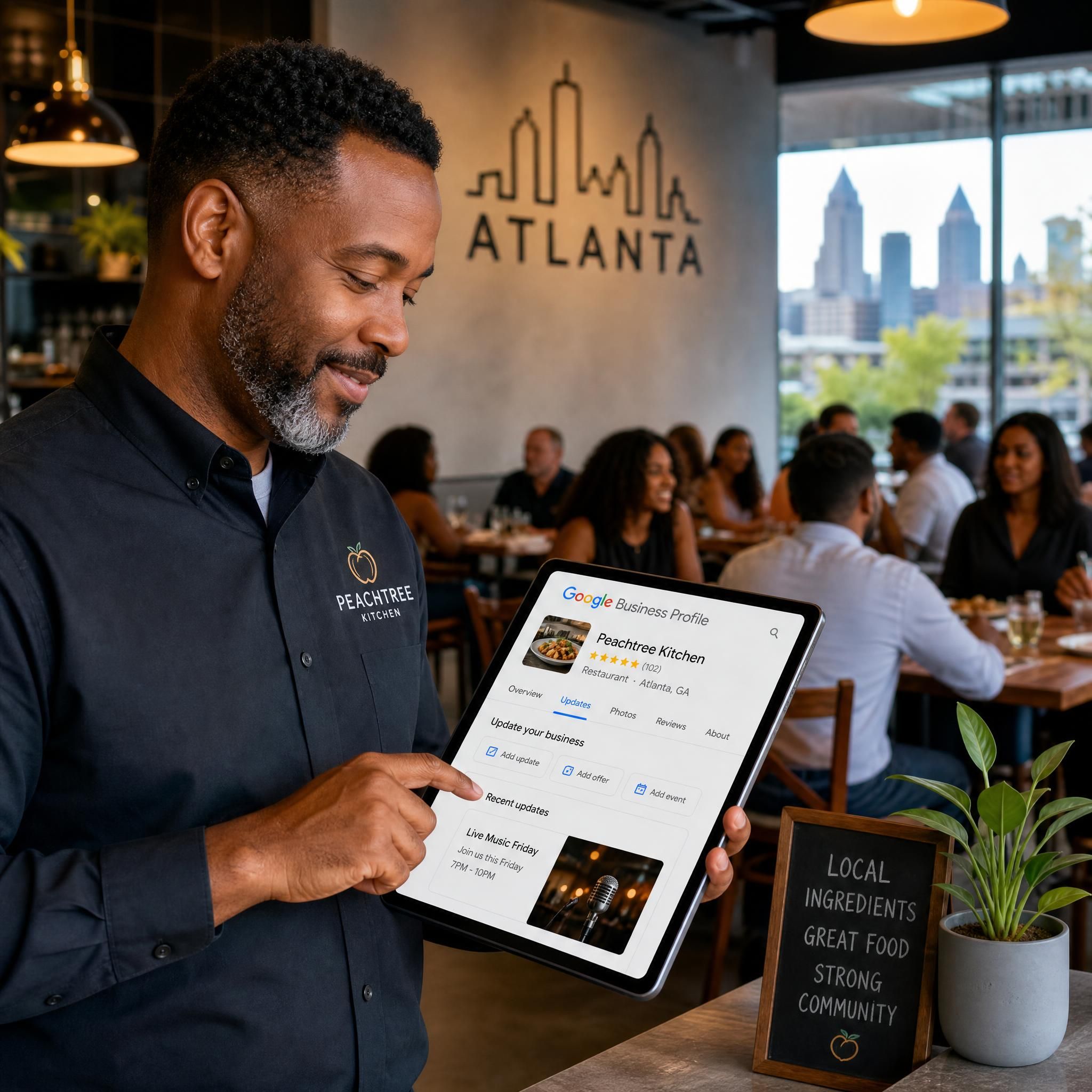
- Updated the primary GBP category to the specific cuisine type and added secondary categories
- Rewrote the business description with the neighborhood name, signature dishes, and dine-in keywords
- Uploaded 24 new photos — interior shots, food close-ups, staff, and the exterior at night
- Set up a weekly GBP post schedule (specials, events, seasonal dishes)
- Sent SMS review requests to customers after each meal for 8 weeks
The results (14 weeks):
At week 6, the listing entered the Local Pack for neighborhood-level searches. By week 14, it was holding the #2 position for the primary neighborhood keyword and appearing across a wider radius.
Restaurant businesses represent one of the highest-ROI local SEO opportunities because searchers have strong, immediate intent — if someone searches "Italian restaurant near me" at 6:30pm, they're deciding where to eat right now. Every position you climb on that map is direct, same-day revenue.
The restaurant's story is a reminder that the Google Maps algorithm rewards activity, not just existence. A profile that's been dormant for two years is telling Google you're not engaged — and Google responds by not showing you.
What these results actually cost — and what they return
One of the most common questions Atlanta business owners ask before engaging a Google Maps SEO agency is: what does this actually cost, and when do I see a return?
Here's the honest breakdown based on current market data:
| Service Level | Monthly Investment | Best For |
|---|---|---|
| DIY local SEO (time, no tools) | $0 cash / high time cost | Businesses with bandwidth to self-manage |
| Basic local SEO management | $500–$1,500/month | Single-location small businesses |
| Full local SEO retainer | $1,500–$3,000/month | Competitive markets (Atlanta metro) |
| AI chatbot platform (SMB) | $200–$2,200/month | Ecommerce and service businesses |
| Full digital stack (SEO + AI) | $2,500–$5,000/month | Growth-focused businesses |
In 2026, most businesses in the US pay between $1,500 and $10,000 per month for professional SEO services that actually move the needle, with small businesses focused on local SEO typically spending $500–$2,000/month.
The ROI question is the more important one. Businesses deploying AI chatbots in 2026 report an average return of $8 for every $1 invested — but only when the chatbot is properly integrated, not siloed. For local SEO, the return is similarly compelling: the HVAC case above turned a 20-week investment into a 3x increase in organic calls — without a single dollar spent on paid ads.
Google's 2026 local SEO algorithm changes have forced U.S. small businesses to rethink their primary keyword strategies, making professional guidance more valuable than ever. The businesses that invested in getting this right in 2025 are now reaping the compounding benefits of sustained rankings.
For a deeper look at what's driving these results strategically, explore how Atlanta businesses are winning with web design, SEO, and AI.
The common thread across every success story
Looking across all four case studies, the pattern is unmistakable:
None of these businesses did anything exotic. They didn't outspend competitors. They didn't discover some secret algorithm hack. What they did was execute the fundamentals with more discipline and more consistency than the businesses they displaced.
The specific moves that drove results:
- Google Business Profile treated as a live marketing channel — not a static listing
- Review velocity prioritized over review volume — recent reviews matter more than total count
- AI tools deployed where they solve specific revenue problems — not just installed for novelty
- Service area signals corrected — a 3-minute fix that unlocks entire neighborhoods
- NAP consistency enforced across all directories — inconsistency is a credibility signal to Google
The businesses that failed at local SEO weren't doing the wrong things. They were doing the right things for 3 weeks and then stopping. Consistency is the real competitive advantage — and most of your Atlanta competitors aren't consistent.
If you want to understand the full strategic picture before investing, why your website isn't ranking in Atlanta breaks down the structural reasons most businesses stay invisible — and what it takes to fix them.
To get the free SEO audit that maps your specific gaps, get a free SEO audit before your competitors do.
Related insights
- AI Chatbots Just Changed Again — What Atlanta Small Businesses Must Know Right Now
- AI Chatbots for Small Business: 7 Actionable Strategies Atlanta Owners Can Deploy Today
- Why Your Website Isn't Ranking in Atlanta
Questions atlanta business owners actually ask (FAQ)
How long does it realistically take to see results from local SEO in atlanta?
Most Atlanta businesses see meaningful movement in their Google Maps Local Pack position within 8–16 weeks of consistent optimization. Competitive verticals like legal and HVAC may take 16–24 weeks, especially if there's a history of inconsistent listings or a dormant Google Business Profile. The fastest results come from fixing high-impact problems first: NAP inconsistency, missing GBP categories, and zero review responses. The cases above ranged from 10 to 20 weeks — none happened overnight, and all of them held their rankings because the work was maintained.
Is local SEO cost in atlanta justified for a small business with a tight budget?
Yes — and the case studies above prove it. The HVAC company and the restaurant both achieved transformative results with investments in the $1,500–$2,500/month range. The key is targeting the right levers for your specific situation rather than paying for a generic package. A focused audit that identifies your actual ranking gaps is worth more than months of unfocused spending. Get a free SEO audit to find out exactly where your budget will move the needle most.
Do AI chatbots actually work for small businesses, or are they just hype?
The Decatur Shopify case study above answers this directly: $179,000 in additional monthly recovered revenue from a $2,200/month platform investment. That's not hype — that's a 81:1 return. The caveat is that chatbots only deliver ROI when they're solving a specific, measurable problem (cart abandonment, lead response time, sizing questions) rather than being deployed as a generic "nice to have." Atlanta small businesses that are seeing real results are the ones who identified the revenue leak first, then selected the tool to plug it.
What's the difference between a Google maps SEO agency and a general SEO agency?
A Google Maps SEO agency specializes in Local Pack optimization — the 3-Pack of results that appears at the top of Google for local searches. This requires a different skill set than traditional organic SEO: GBP management, local citation building, review velocity strategy, and proximity signal optimization. Many general SEO agencies understand organic rankings but lack the depth to move Map Pack positions. When evaluating agencies, ask specifically about their Local Pack case studies and their process for service-area businesses.
Can a shopify website benefit from both SEO and AI chatbots simultaneously?
Absolutely — and the combination is more powerful than either tool alone. SEO drives qualified local traffic to the Shopify store; AI chatbots convert that traffic at a higher rate and recover revenue that would otherwise be lost to cart abandonment. For Atlanta ecommerce businesses, the full stack — local SEO to drive traffic, AI chatbots to convert it — is the formula behind the most significant revenue gains we're seeing in 2026. The advanced web design and optimization playbook for Atlanta covers how these elements work together technically.
Chiffres clés — key statistics
📊 44% of all clicks on local search results go to the Google Maps Local Pack top 3 — if you're not there, most customers never see you. (Flento Local SEO Data, 2026)
📊 $8 returned for every $1 invested when properly integrated – AI Chatbot ROI
💡 3.2x more likely to rank in the Local Pack top 3 — that's the advantage businesses with 10+ recent reviews (last 90 days) hold over those with older review patterns. (Flento Business Profile Analysis, 2026)
📊 $500–$2,000/month for small business local SEO – Local SEO Monthly Investment
📈 $179,000/month in recovered revenue — the result one Shopify ecommerce brand achieved by deploying an AI chatbot for cart abandonment and size guidance. (Conferbot Case Study, 2026)
📊 3x organic calls from Maps after 20-week local SEO campaign – Atlanta HVAC Google Maps
Conclusion: the results are there — if you do the work
The four businesses in this article didn't get lucky. They didn't find a loophole. They hired the right help, executed a disciplined strategy, and stayed consistent long enough for Google to reward them.
The Atlanta market is competitive — but it's not unwinnable. The gap between businesses that optimize and businesses that don't is still enormous. In most Atlanta neighborhoods, solid fundamentals executed consistently will get you into the Local Pack. You don't need to outspend anyone. You need to outwork them.
The question is whether you're ready to start.
You've seen what's possible. Now it's time to find out exactly where your business stands — and what it would take to get these kinds of results.
We work with Atlanta businesses every day — from Buckhead to Decatur, Midtown to Sandy Springs. We know this market, and we know what moves the needle here. Your audit is the first step to knowing exactly what's standing between you and the Local Pack.
Meta description: See how Atlanta businesses tripled Google Maps leads, recovered $179K/month with AI chatbots, and dominated local SEO — real case studies, real numbers. Get your free audit.