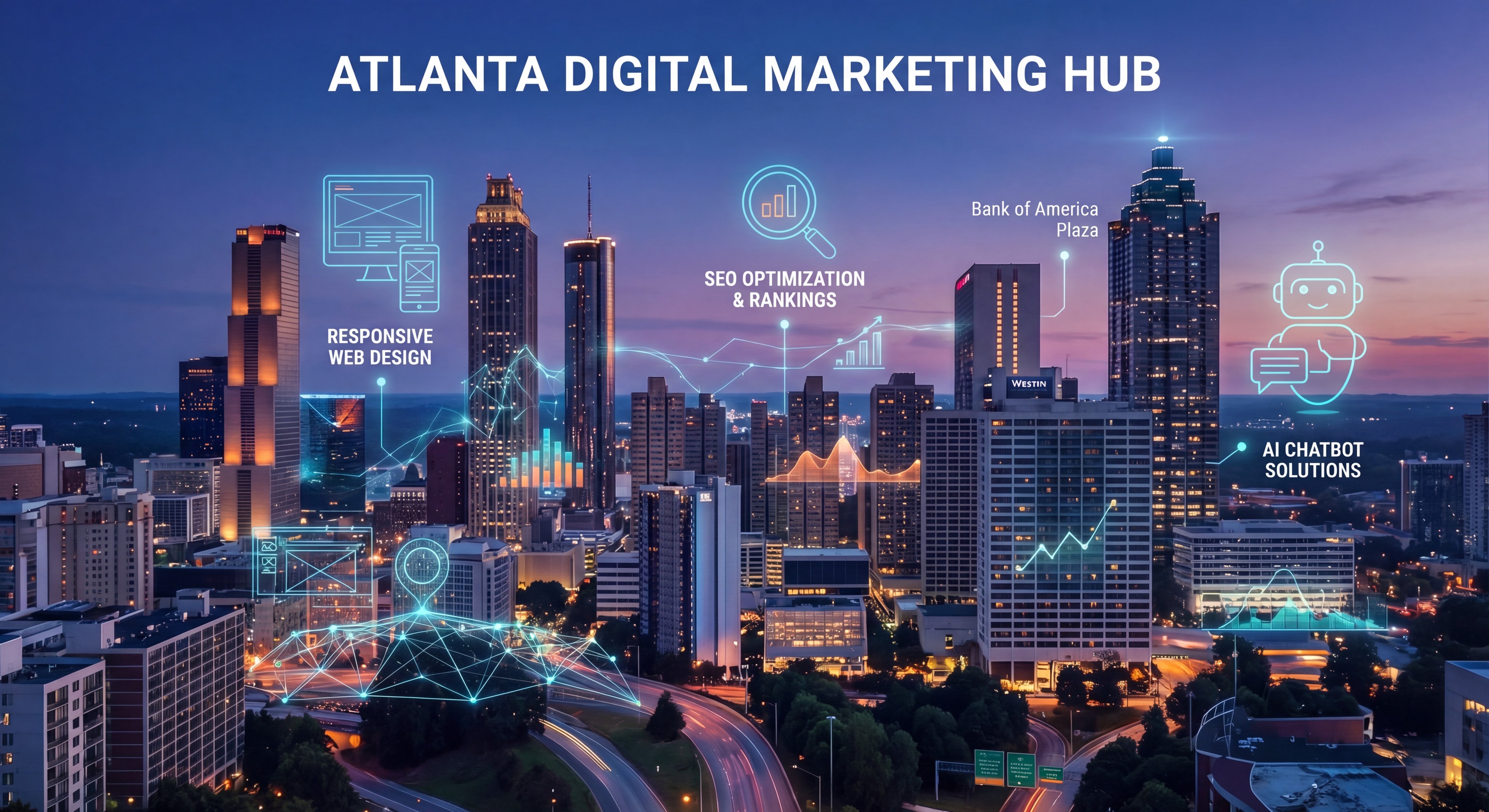
Something is shifting in Atlanta’s digital marketing landscape — fast. In the last 90 days alone, national agencies have planted flags in the metro, a major industry conference is returning to Peachtree Plaza, local companies are rethinking what a website even
is, and AI chatbots have moved from “nice to have” to a genuine business necessity. If you run a business in Buckhead, Midtown, Alpharetta, or anywhere in the Atlanta metro, what’s happening right now in
web design Atlanta, SEO, content marketing, and AI will directly affect whether your phone rings next quarter.
This isn’t a trend piece. This is a breakdown of what’s actually happening — the announcements, the moves, the market signals — and what each one means for your business today.
Table of Contents
The “Digital Blueprint” Shift: Websites Are Now Core Business Infrastructure {#the-digital-blueprint-shift}
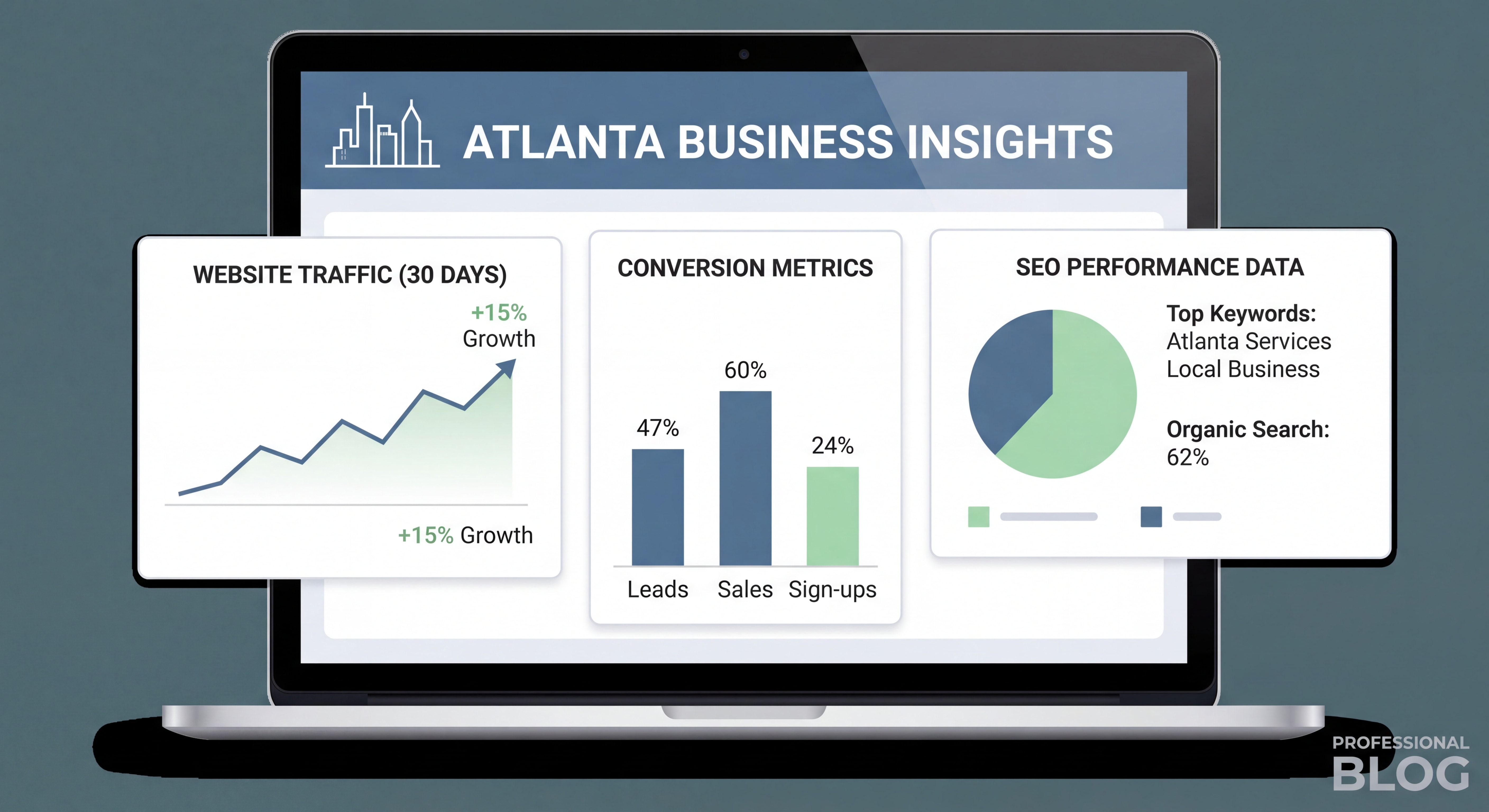
Here’s the announcement that should have every Atlanta business owner paying attention. The Scale Tech, an Atlanta-based digital strategy firm, recently identified what they’re calling a “Digital Blueprint” shift — the idea that a business website is no longer a design asset sitting in the corner of your marketing budget. It’s core infrastructure. The same category as your CRM, your point-of-sale system, your accounting software.
That framing matters more than it sounds.
For years, Atlanta small business owners have treated their websites the way they treat the break room — something you update when it gets embarrassing. The Scale Tech’s announcement reflects a broader market reality: businesses that treat
web design in Atlanta as a strategic foundation are outperforming those that treat it as a one-time expense. Period.
What does “core infrastructure” actually mean in practice? It means your site architecture has to support SEO from the ground up — not bolted on afterward. It means page speed isn’t a “nice to have” but a direct factor in whether Google shows you to anyone in Sandy Springs or Decatur. It means your site has to convert, not just exist. A Midtown law firm with a beautiful homepage that loads in 6 seconds and has no clear call to action isn’t a digital asset. It’s a liability.
📊
68% of B2B buyers judge a company’s credibility based on website design before any other contact – Websites as Core Business Infrastructure
The shift also signals something else:
web design Atlanta is no longer a conversation about aesthetics. It’s a conversation about performance. Load speed. Mobile-first architecture. Conversion rate. Local SEO structure. Schema markup. These are the things that make a website work as infrastructure — and the Atlanta market is catching up to that reality quickly.
National Agencies Are Moving Into Atlanta — What That Means for Local Businesses {#national-agencies-moving-into-atlanta}
Two separate announcements in March 2026 told the same story: national digital marketing players are actively targeting Atlanta.
Strive Enterprise opened an Atlanta office as part of its 2026 expansion strategy, citing the metro’s business density and growth trajectory as the primary driver. Around the same time, a Manila-based SEO agency announced it was expanding
SEO services in Atlanta, Georgia — a signal that the market is attractive enough to draw international attention.
And earlier this year, YEAH! Local was named a top Atlanta AI digital marketing agency, adding another credentialed player to an already competitive space.
Here’s the honest read on what this means for Atlanta business owners: competition is about to get louder, not quieter. When national and international agencies move into a market, they bring budget, brand recognition, and in some cases, genuinely good capabilities. They also bring something else — a complete lack of local context.
A firm based in Manila or New York doesn’t know that a roofing company in Marietta gets slammed with emergency calls every time a storm rolls through Cherokee County. They don’t know that the Buckhead legal market is brutally competitive for personal injury keywords, or that a dentist in Alpharetta’s tech corridor is competing against a completely different patient demographic than one in East Atlanta Village. They know how to run campaigns. They don’t know your market.
That gap is real. And it’s exploitable — by local businesses willing to work with a partner who actually knows the terrain.
“Strive Enterprise Opens Atlanta Office, Expanding Its National Footprint as 2026 Growth Accelerates”
— openPR.com(https://limova-public-v2.s3.eu-central-1.amazonaws.com/blog-images/blog-image-1776232986699-lvz3v2d1.jpeg)
The
AI chatbot conversation in 2026 has two very different tracks, and it’s worth separating them clearly.
Track one: the headline-grabbing stuff. This week, Anthropic’s Claude AI is facing user backlash over reported performance issues. Grok, Elon Musk’s chatbot, is in the news for generating harmful content despite promises to stop. Bloomberg and the Financial Times both published studies showing AI chatbots give misleading medical advice in 50–80% of early diagnostic cases. This is real, it’s relevant, and it should inform how you think about AI tools.
Track two: what actually works for Atlanta small businesses right now. And here’s where the noise and the reality diverge sharply.
An AI chatbot deployed on a Marietta HVAC company’s website to answer “how much does a new AC unit cost?” at 11pm on a Saturday is not the same thing as a general-purpose AI assistant trying to diagnose a medical condition. The use cases are completely different. The risks are completely different. And the results are measurable.
Businesses using AI chatbots for lead capture and customer service automation are seeing real numbers. AI-powered lead qualification is cutting response time by 30% and improving lead accuracy by up to 77%. Chatbots that handle after-hours inquiries — a critical window for home service companies in Atlanta, where emergency calls don’t follow business hours — are converting visitors who would otherwise bounce and call a competitor.
The practical question for an Atlanta business owner isn’t “is AI perfect?” It isn’t. The question is:
are you losing leads at 9pm because no one is answering your website’s contact form? If yes, an AI chatbot is a direct solution to a direct problem.
What to look for in an AI chatbot for your Atlanta business:
- Lead capture integration — it should sync directly with your CRM, not just collect names in a spreadsheet
- Handoff triggers — it should know when to escalate to a human and do it without friction
- Local context — it should be trained on your services, your service area (Buckhead, Sandy Springs, Alpharetta, etc.), and your pricing
- Analytics — you should be able to see exactly how many conversations turned into leads
Skip the hype. Focus on the use case. That’s the only frame that matters.
Content Marketing Atlanta: The Video-to-Content Opportunity {#content-marketing-atlanta}
One Atlanta startup is worth watching closely. Hypepotamus recently covered a local company that’s turning underused video footage into marketable content — taking raw, unedited video from business owners and converting it into social posts, blog content, and short-form clips. The play is elegant: most Atlanta businesses are sitting on hours of recorded content — Zoom calls, walkthroughs, customer testimonials, training sessions — that never gets repurposed.
This is
content marketing in Atlanta in its most practical form. Not the theoretical version where you publish three blog posts a week and hope Google notices. The version where you extract value from assets you already have, distribute them across channels where your customers actually spend time, and build the kind of consistent brand presence that makes you the obvious choice when someone in Virginia-Highland needs a contractor or a Decatur restaurant owner needs a marketing partner.
The broader trend this reflects:
content marketing in Atlanta is moving away from volume and toward utility. Google’s helpful content signals have made thin, generic content actively harmful to rankings. What wins now is content that answers a specific question for a specific person in a specific market — and answers it better than anyone else.
For an Old Fourth Ward restaurant, that might be a blog post about Atlanta’s best private dining options that actually gets cited in local publications. For a Roswell roofing company, it’s a detailed guide to storm damage claims in Cherokee and Fulton County that shows up every time a homeowner searches after a hail event. For a Buckhead financial advisor, it’s a quarterly market commentary that positions them as the local expert no national firm can replicate.
📊
Businesses that publish consistent, high-quality content generate 3x more leads than those that don’t, at 62% lower cost – Content Marketing ROI

Chiffres Clés
📊
45% of consumers now use AI tools to find local businesses — making AI search optimization as important as traditional SEO for Atlanta companies in 2026
💡
77% improvement in lead accuracy when AI-powered qualification tools are deployed on business websites (Source: Martal.ca Lead Generation Research 2026)
📈
68% of B2B buyers judge a company’s credibility based on website design before making any other contact — making web design a direct revenue driver, not a cosmetic expense (Source: Stanford Web Credibility Research)
🏙️
3x more leads generated by businesses that publish consistent, locally-targeted content at 62% lower cost than paid advertising alone (Source: Content Marketing Institute 2026)
FAQ {#faq}
How is the “Digital Blueprint” shift changing what Atlanta businesses need from their website?
The shift means your website can no longer be treated as a brochure or a one-time design project. Atlanta companies — from HVAC contractors in Marietta to law firms in Buckhead — now need sites built as performance infrastructure: fast-loading, mobile-first, structured for local SEO, and optimized to convert visitors into leads. A site that looks good but loads slowly or has no clear conversion path is actively costing you money in 2026.
What does the arrival of national agencies in Atlanta mean for local SEO services?
It means the market is getting more competitive, not less. National agencies like Strive Enterprise opening Atlanta offices brings more options for business owners — but also more noise. The critical differentiator remains local expertise. An agency that knows the difference between marketing to Alpharetta’s tech-corridor demographics versus East Atlanta Village’s small business community will outperform any national firm running generic campaigns, every single time. When evaluating
SEO services in Atlanta, ask specifically how the agency approaches your neighborhood, your industry, and your local competition.
How should Atlanta small businesses think about AI chatbots in 2026?
Ignore the headlines about general AI failures in medical diagnosis or content moderation — those are different use cases entirely. For Atlanta small businesses, the relevant question is simple: are you losing leads after business hours because your website can’t answer a basic question or capture contact information? If yes, an AI chatbot built for your specific service area and offerings solves a real problem. Focus on lead capture integration, CRM sync, and handoff triggers to a live person. Start narrow. Measure everything.
What is an SEO audit in Atlanta supposed to cover in 2026?
A proper
SEO audit in Atlanta today goes well beyond keyword rankings and backlinks. It must include: Google Business Profile completeness and review velocity, AI search visibility and structured data markup, mobile performance and Core Web Vitals, content depth and topic authority, local citation consistency across directories, and competitive gap analysis specific to your Atlanta market and industry. If your current agency’s audit doesn’t address AI search visibility, you’re working from an outdated playbook.
What does the DigiMarCon Southeast 2026 conference signal for Atlanta digital marketing?
It confirms Atlanta’s position as the Southeast’s leading hub for digital marketing innovation. The conference agenda — heavy on AI-driven content, generative search optimization, and conversion strategy — is a direct preview of what Atlanta businesses need to be building toward right now. The companies that start implementing these strategies in Q2 2026 will have a measurable head start on competitors who wait until the tactics become mainstream.
Conclusion
Atlanta’s digital marketing landscape is moving faster in 2026 than it has at any point in the last decade. New players are entering the market. The rules of SEO are being rewritten by AI. Websites are being reclassified from marketing expenses to core business infrastructure. And the businesses paying attention to these shifts — not just reading about them but actually acting on them — are the ones pulling ahead.
The opportunity is real. So is the gap between businesses that adapt and those that don’t.
Get more Atlanta leads with a free
SEO audit — no fluff, just data on where your site stands and exactly what it would take to compete.
Explore our Atlanta SEO services and
web design solutions built specifically for the metro market.
Related Services